

Band Geometry and Symmetry-Protected Matter
Band topology is a statement about a specified occupied subspace, not about an energy plot alone. One must declare the Brillouin-zone orientation, the phase or frame gauge, the protecting symmetry, the spectral or mobility gap, and the boundary conditions before a Berry integral or surface mode has a definite meaning. With those data fixed, Bloch projectors connect localization, geometric response, quantized pumping, Chern and Z2 indices, crystalline obstructions, and interacting symmetry-protected phases Hasan and Kane 2010, §§ II–V.
This chapter develops that connection for invertible matter. Intrinsic topological order, whose bulk contains nontrivial superselection sectors and topology-dependent ground-state structure, begins in Fractional Quantum Hall Matter and Anyons.
Helpful background. Bloch bands, Wannier functions, and effective band theories supplies the projector and localization language used throughout; background responses and invertible phases supplies the response-theory distinction between invertible and intrinsically ordered matter.
Enter this chapter
Section titled “Enter this chapter”The shortest mathematical route is Bloch/Wannier theory → Berry geometry → polarization and pumping → Chern response. The symmetry route continues from Chern insulators to time-reversal indices, the free-fermion periodic table, and crystalline topology. The physical-diagnostic route then asks what remains after interactions, disorder, a real interface, or a bulk node is admitted.
| Reader goal | Suggested route | Capability at the end |
|---|---|---|
| Geometric foundations | Bloch/Wannier → Berry geometry → polarization | Compute gauge-covariant projectors, curvature, metric, and polarization modulo charge |
| Free-fermion classification | Chern insulators → Z2 insulators → periodic table → crystalline phases | State the dimension, symmetry class, stable-equivalence convention, and invariant |
| Physical boundaries | Chern/Z2 phases → protected boundaries → nodal semimetals | Separate bulk topology from termination-dependent spectra and state protection hypotheses |
| Interacting diagnosis | Z2 phases → interacting SPT diagnostics → interfaces | Replace a free-band label by response, defect, entanglement, or anomaly data that survive interactions |
From projectors to physical claims
Section titled “From projectors to physical claims”For an isolated occupied subspace, the projector is invariant under any smooth change of occupied frame. The first figure shows why it is the reliable starting point: frame-dependent Berry connections feed gauge-invariant curvature and metric; Wilson loops and symmetry sewing data then yield polarization, pumps, Chern or Z2 indices, while Wannier localization tests the same bundle from real space.
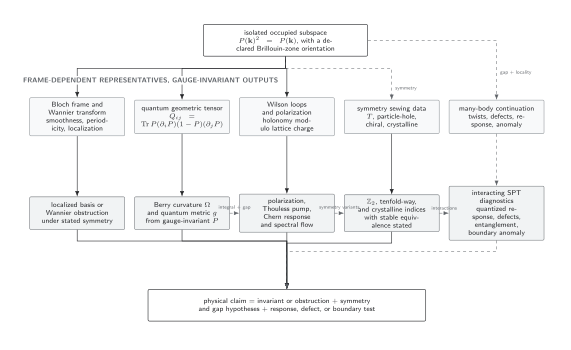
The band-geometry dictionary. Solid arrows are mathematical constructions for an isolated occupied subspace; dashed arrows require the stated symmetry, gap, or many-body continuation. The diagram is schematic and does not identify intrinsic topological order with a free-band obstruction.
Throughout the chapter, has positive orientation , and for a normalized cell-periodic state we use
Under , while is unchanged. With electron charge and , this convention gives for . Reversing the momentum orientation reverses both and the stated Hall sign. Declaring this bridge prevents a sign imported from another convention from becoming a false disagreement.
Validity boundaries
Section titled “Validity boundaries”A bulk invariant constrains a boundary only under hypotheses. The bulk must retain a spectral or mobility gap at the chemical potential; the relevant protecting symmetry must act at the boundary; locality and the thermodynamic half-space limit are required; and an interface is controlled by the difference of the two bulk invariants. Extra boundary topological order can absorb an anomaly, and surface reconstruction can change the dispersion without changing the protected net content Qi and Zhang 2011, §§ II–IV.
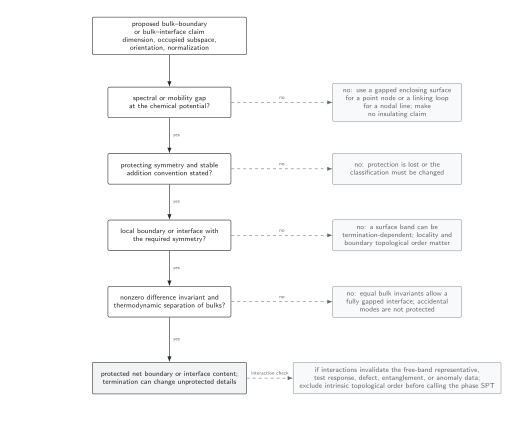
Validity and failure map for bulk–boundary and bulk–interface claims. The sequential path is specific to boundary or interface inference: the bulk gap, protecting symmetry, locality, and oriented invariant difference must all support the conclusion. Quantized bulk response has its own source, transport, and order-of-limits hypotheses. The figure is schematic, not a phase diagram.
Claim-validity table
Section titled “Claim-validity table”| Claim | Dimension and symmetry | Stable object | Bulk diagnostic | Boundary or response test | Interaction/disorder limit | Negative test |
|---|---|---|---|---|---|---|
| Localized occupied bands | Any ; declared space-group action | Isolated projector up to smooth occupied-frame gauge | Exponentially localized symmetry-compatible Wannier basis, when it exists | Boundary not required | Disorder needs a real-space projector; interactions need a many-body replacement | Gap closes, bands are entangled without a disentanglement window, or symmetry-compatible Wannier functions are obstructed |
| Chern insulator | , charge conservation; no time reversal | Class-A bundle after adding trivial bands | Integer | net chiral channels and quantized Hall response | Mobility gap can replace a spectral gap; intrinsic order is outside the band index | Hall sign conflicts after orientation/charge translation, or the Fermi level crosses extended bulk states |
| Time-reversal topological insulator | or , | Quaternionic occupied bundle in the stable limit | Z2 Wilson-loop flow or equivalent invariant | Odd protected Kramers-pair parity at a symmetry-preserving boundary | Strong interactions can reduce or replace the free classification | Boundary is gapped without breaking symmetry only because extra topological order or another anomalous sector was added |
| Crystalline/higher-order phase | Declared spatial symmetry and boundary geometry | Symmetry representation or real-space obstruction under specified band additions | Symmetry indicator, Wilson loop, nested invariant, or defect response | Symmetry-related surface, hinge, corner, or disclination signature | Disorder must preserve symmetry exactly or statistically as claimed | Bulk or defect invariant fails under its stated symmetry and stable-equivalence assumptions; a termination-localized feature alone is not decisive because boundary decorations can change it |
| Interacting SPT | On-site or crystalline symmetry stated | Short-range-entangled many-body ground state modulo symmetric product states | Quantized response, symmetry defect, entanglement invariant, or anomaly | Boundary cannot be trivially gapped while preserving symmetry and locality | Free indices are insufficient; intrinsic topological order is excluded by definition | Proposed signal is reproducible by a symmetric trivial state or depends only on single-particle bands |
| Weyl or nodal semimetal | Codimension and protecting symmetry stated | Topological charge on a gapped enclosing surface for an isolated point node or a gapped linking loop for a nodal line | Chern, winding, or Berry-phase charge on the relevant enclosing object | Arc or drumhead structure subject to projected-node geometry and termination | Strong disorder/interactions may broaden, annihilate, or reconstruct nodes | The relevant enclosing surface or linking loop is not gapped, opposite charges coincide, or the protection is broken |
The table complements the two figures by separating dimension, symmetry, stable equivalence, bulk data, boundary hypotheses, and failure tests; none of its rows treats a visually plausible surface band as sufficient evidence. Together, the adjacent prose, relationship-centered alt text, and table give the complete nonvisual account of the diagrams.
Guide to the pages
Section titled “Guide to the pages”- Bloch Bands, Wannier Functions, and Effective Band Theories constructs the occupied projector and states the localization obstruction precisely.
- Berry Geometry and the Quantum Metric derives connection, curvature, and metric from eigenstates and projectors.
- Polarization and Thouless Pumping explains polarization modulo and quantized transport over a gapped cycle.
- Integer Quantum Hall Matter and Chern Insulators connects the Chern number, Hall coefficient, mobility gap, and chiral edge count.
- Time-Reversal-Invariant Z2 Topological Insulators defines the invariant and its boundary meaning.
- Symmetry Classes and the Free-Fermion Periodic Table states the tenfold classification with its dimension and stable-limit conventions.
- Crystalline and Higher-Order Topological Matter distinguishes symmetry indicators from protected hinge, corner, and defect responses.
- Interacting SPT Matter and Physical Diagnostics replaces band indices by many-body response, defect, and anomaly tests.
- Protected Boundaries and Interfaces of Invertible Matter makes the bulk–boundary hypotheses and allowed gapping mechanisms explicit.
- Topological Semimetals and Nodal Surface States treats node charges, arcs, drumheads, and their disorder/interactions limits.
Review the chapter
Section titled “Review the chapter”Gauge check. A phase change of each occupied eigenvector alters but not , , a closed Wilson-loop spectrum, or an integer Chern number. A proposed observable that changes under this rephasing is not yet physical.
Boundary check. A surface Dirac cone disappears after a magnetic coating is applied. This does not refute the bulk Z2 index: the coating breaks its protecting time-reversal symmetry. A symmetric, trivially gapped surface of an isolated noninteracting strong topological insulator would require a different explanation.
Classification check. The tenfold table classifies stable, gapped free-fermion or BdG Hamiltonians with internal antiunitary/chiral symmetries. It does not by itself classify crystalline obstructions, interacting SPT reductions, intrinsic topological order, or gapless nodes.
References
Section titled “References”- M. Zahid Hasan and Charles L. Kane, “Colloquium: Topological Insulators,” Reviews of Modern Physics 82 (2010) 3045–3067, doi:10.1103/RevModPhys.82.3045.
- Xiao-Liang Qi and Shou-Cheng Zhang, “Topological Insulators and Superconductors,” Reviews of Modern Physics 83 (2011) 1057–1110, doi:10.1103/RevModPhys.83.1057.
Original QFT.org content:CC BY 4.0, unless an item supplies different terms. Third-party material retains its own terms.