

Vortices and Topological Defects in Paired Matter
A vortex is a defect around which the order parameter cannot be made uniform without leaving its low-energy manifold. For a one-component paired state, this obstruction is an integer phase winding. In a neutral condensate the winding fixes circulation; in a charged condensate the finite-energy condition ties it to magnetic flux. The energy still depends on geometry. A neutral two-dimensional vortex has a logarithmic energy cut off by the sample size, a straight bulk superconducting vortex has a London line energy cut off by the penetration depth, and a thin-film vortex crosses over at the Pearl length. None of these long-distance statements determines the microscopic core spectrum or guarantees a protected zero mode.
Required background. Superfluid phase stiffness supplies the phase-only energy and its normalization.
Helpful background. BdG theory supplies core spectra, local observables, and finite-size tests.
Winding uses the physical order-parameter manifold
Section titled “Winding uses the physical order-parameter manifold”Write a one-component pair field outside its cores as
On a closed loop that does not cross a core,
Single-valuedness of makes an integer. For a neutral one-component condensate, the loop in real space maps directly to a loop in the vacuum manifold , and . A nonzero loop cannot be filled continuously while remaining in , so the amplitude must vanish or the order parameter must leave this manifold somewhere inside. This is the topological reason for a core.
In a charged condensate, the local phase is gauge dependent and the vacuum modulo gauge is not itself an of physically distinct states. The integer instead labels finite-energy gauge-field configurations: asymptotic phase winding and gauge holonomy combine into quantized flux. Thus the phase-winding calculation remains useful, but it must be stated together with the gauge-field boundary condition derived below.
More generally, for a global order parameter with the usual locality assumptions, a defect of codimension is tested on a surrounding sphere and classified by . The basic dictionary is Mermin 1979, §§ II–III, pp. 594–608.
| Defect in three spatial dimensions | Surrounding space | Topological test |
|---|---|---|
| Domain wall | Two points, | Disconnected components, |
| Vortex line | Circle, | Winding classes, |
| Point defect | Sphere, | Classes in |
In two spatial dimensions, a vortex is a point defect because a small circle surrounds it. In three dimensions, the same local classification describes a line; closed vortex loops can shrink unless dynamics, linking, boundaries, or another conserved quantity prevents it.
The manifold must include the actual identifications of the paired state. Spin, orbital, crystal, and component transformations can identify points that look different in a phase-only notation. This is how half-quantum or other fractional vortices can be possible. Conversely, an intercomponent Josephson coupling can attach a domain wall to a fractional vortex and confine isolated fractional defects. One must compute for the physical manifold rather than infer the answer from the symbol .
For a condensate of signed charge and condensate mass , the gauge-invariant phase gradient and superfluid velocity are
The sign of fixes the orientation of the magnetic flux; its magnitude fixes the flux quantum. A neutral condensate has . For an electronic Cooper pair, ; in a Galilean continuum made of particles of mass , . In a crystal, the stiffness tensor is usually a safer input than a unique pair mass.
Neutral vortex energy in a disk
Section titled “Neutral vortex energy in a disk”Consider a single vortex at the center of a two-dimensional circular neutral superfluid. Let the core radius be , the outer radius be , and assume
Here is the two-dimensional pair-phase stiffness denoted by on the prerequisite page, evaluated at the scale on which the phase-only description is being used; it has units of energy. The minimum-energy configuration with winding is
The radial integral is elementary:
The logarithmic coefficient is fixed by the far field. The additive constant, including , is not: the phase-only theory has been cut off precisely where amplitude and microscopic degrees of freedom matter. A straight neutral vortex line in a three-dimensional cylinder has the same expression per unit length, with the three-dimensional stiffness and the transverse cylinder radius.
For a neutral continuum,
Thus a paired fermion superfluid has circulation when . On a lattice, stiffness and winding remain well defined, but the Galilean relation between current, momentum, and a single mass need not hold.
Several vortices and the full cross term
Section titled “Several vortices and the full cross term”Place well-separated cores at in the central region of a disk, with
Take the outer boundary to carry the total winding , and neglect boundary-image corrections at leading logarithmic order. Since
the energy contains both self terms and cross terms:
The identity behind the second line is
obtained by writing and using Green’s identity. The term depends on boundary shape and vortex position. Same-sign vortices repel, while opposite-sign vortices attract. For a neutral vortex–antivortex pair, the dependence cancels, leaving plus core and boundary terms.
Bulk superconducting vortex line
Section titled “Bulk superconducting vortex line”Now consider an isolated, straight vortex of winding along the axis in an infinite, isotropic bulk superconductor. Assume the London regime
and a transverse sample size much larger than the penetration depth . Far from the core, vanishing gauge-invariant circulation gives
Define the signed and positive flux quanta by
Then
For an electronic superconductor, . Flux quantization follows from winding plus the low-current boundary condition; it does not say how the field is distributed.
Outside the core, the London equation for the axial field is
whose infinite-plane solution is
The field is logarithmic near the core cutoff and decays exponentially for . The London free energy per unit length is
Integrating the gradient term by parts and using the London equation reduces the leading contribution to . Therefore,
for an isolated straight line in the extreme type-II London limit. The nonlogarithmic term contains core condensation energy and order-one corrections to the London field near . Magnetic screening has replaced the neutral outer cutoff by .
Within single-component Ginzburg–Landau theory near its controlled regime, gives type-II behavior and stable separated flux lines; for , the interface energy has the opposite sign and flux tends to form macroscopic normal regions. This is the setting of the original Abrikosov solution Abrikosov 1957, pp. 1174–1182. The criterion is not a universal microscopic classification for multiband, strongly nonlocal, or far-from-Ginzburg–Landau regimes.
Pearl vortices in a thin film
Section titled “Pearl vortices in a thin film”A film is not obtained merely by shortening a bulk vortex line. Let its thickness be , with lateral radius , and define the Pearl length
The current is approximately uniform through the thickness and is described by a sheet current. For
the sheet current falls as , so the phase-gradient energy remains logarithmic. For , magnetic field lines spread into the surrounding three-dimensional space, the sheet current crosses over to , and the vortex interaction has a tail rather than an exponential bulk tail. These asymptotic current laws are the defining result of Pearl 1964, pp. 65–66.
The two-dimensional stiffness inherited from the bulk London relation is
Using the neutral logarithmic integral up to the smaller of and the film radius gives
for a vortex well away from the boundary. A direct London calculation includes the kinetic, magnetic, and core terms and gives the same leading logarithm Lemberger and Draskovic 2013, §§ II.B–II.C. Edges, nearby metallic screening planes, anisotropy, and nonuniform thickness change the current Green function and cannot be absorbed into a universal replacement of .
This distinction matters experimentally:
- bulk current and field decay exponentially beyond ;
- a Pearl film is logarithmic only up to and has a long magnetic tail beyond it;
- a finite film with behaves logarithmically only up to its boundary.
BKT unbinding and dimensionality
Section titled “BKT unbinding and dimensionality”For a neutral two-dimensional disk, a unit vortex can be placed in roughly core-sized positions. Its positional entropy is therefore
Combining this with the single-vortex energy gives the heuristic free energy
This estimate identifies the competition but is not the transition theory: bound vortex–antivortex pairs screen the interaction and renormalize both the stiffness and vortex fugacity. The Berezinskii–Kosterlitz–Thouless flow yields the long-distance jump
where is the renormalized stiffness, not the short-distance coefficient inserted into a bare phase action. The defect mechanism and Coulomb-gas flow are developed in Berezinskii 1971, pp. 493–500, Kosterlitz and Thouless 1973, §§ 2–4, and the universal jump in Nelson and Kosterlitz 1977, pp. 1201–1205.
Three qualifications prevent overgeneralization:
- In a finite neutral sample, unbinding is rounded by the system size and boundaries.
- In a charged thin film, the interaction ceases to be logarithmic beyond . A sharp thermodynamic BKT limit requires the logarithmic window to extend beyond every relevant correlation scale; otherwise one observes a BKT-like crossover over scales below .
- In three dimensions, vortices are lines and thermally excited closed loops. Their loop proliferation belongs to the three-dimensional ordering problem, not to the two-dimensional vortex–antivortex BKT calculation.
The core and its topology answer different questions
Section titled “The core and its topology answer different questions”The winding calculation fixes what happens outside the core. It does not determine how is suppressed, whether another order fills the core, the core energy, or the quasiparticle spectrum. Those questions require Ginzburg–Landau, BdG, quasiclassical, or more microscopic input.
For example, an ordinary weak-coupling, singly quantized, axisymmetric -wave vortex has Caroli–de Gennes–Matricon levels
up to material, dimensional, and anisotropy corrections Caroli, de Gennes, and Matricon 1964, pp. 307–309. Particle–hole symmetry relates positive and negative levels; it does not force a zero level in this conventional case. Disorder, finite temperature, tunneling matrix elements, and limited resolution can merge ordinary levels into a zero-bias feature.
A protected Majorana mode requires a nontrivial invariant of the gapped BdG Hamiltonian in the appropriate symmetry and defect class, together with the relevant protecting conditions. The order-parameter winding and the BdG defect invariant are therefore distinct classifications Teo and Kane 2010, §§ I–II. The topological BdG page develops that second test.
Pinning, dissipation, and vortex mobility form a third layer. Pinning can stabilize a vortex at a location and strongly change transport without changing its winding. Conversely, observing a flux tube or a zero-bias core feature does not identify its microscopic core order or quasiparticle topology.
The chapter diagram links stiffness to defect energy while keeping core spectroscopy and topological classification distinct.
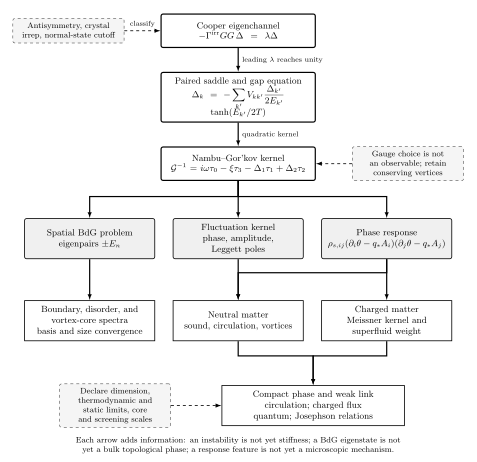
Winding fixes circulation and long-distance energetics. Gauge screening, core regularization, dimensionality, and the bulk topological class determine the stronger conclusions. Original schematic, not to scale.
The paired-matter claim test matrix states the corresponding failure tests.
Exercises
Section titled “Exercises”1. A vortex–antivortex dipole
Section titled “1. A vortex–antivortex dipole”In a neutral disk of radius , put a unit vortex and unit antivortex a distance apart, with . The outer boundary has zero total winding. Use the full two-vortex energy to find the leading logarithmic pair energy and force.
Solution
Set and . The two self terms and their cross term give
The outer radius cancels because the far fields of opposite windings cancel. Ignoring the slowly varying boundary term, the radial force on increasing the separation is
The negative sign denotes attraction.
2. One double vortex or two single vortices?
Section titled “2. One double vortex or two single vortices?”Compare two configurations in the same neutral disk of radius with fixed total boundary winding :
- one vortex at the center;
- two vortices at .
Assume , ignore core overlap, and keep the complete cross term. Which configuration has lower leading logarithmic energy?
Solution
The centered double vortex has
For the two single vortices, the self terms alone are not the full answer. Their same-sign cross term is positive:
For vortices symmetrically placed far from the boundary, the difference of boundary terms is nonlogarithmic. The leading difference is
Because , the far-field logarithm favors splitting the double vortex. The conclusion can be reversed only if core physics, confinement, multicomponent locking, pinning, or geometry supplies a sufficiently large compensating term. Omitting the cross term would incorrectly compare configurations with different far-field decompositions.
3. Recover the Pearl energy coefficient
Section titled “3. Recover the Pearl energy coefficient”For a film of thickness , use
to derive the leading energy of a unit Pearl vortex. State the infrared cutoff for both and .
Solution
Using ,
Substitution into the neutral logarithmic coefficient gives
The film current is logarithmic only until the first infrared cutoff. Hence
If , the sample boundary cuts off the logarithm. If , magnetic spreading into the surrounding space produces the Pearl crossover and is the logarithmic cutoff. The field and interaction do not vanish beyond ; they acquire algebraic tails whose energy contribution is nonlogarithmic.
References
Section titled “References”- Abrikosov, A. A. (1957). “On the magnetic properties of superconductors of the second group.” Soviet Physics JETP 5, 1174–1182. JETP archive.
- Berezinskii, V. L. (1971). “Destruction of long-range order in one-dimensional and two-dimensional systems having a continuous symmetry group I.” Soviet Physics JETP 32, 493–500. JETP archive.
- Caroli, C., de Gennes, P. G., and Matricon, J. (1964). “Bound fermion states on a vortex line in a type II superconductor.” Physics Letters 9, 307–309. doi:10.1016/0031-9163(64)90375-0.
- Kosterlitz, J. M., and Thouless, D. J. (1973). “Ordering, metastability and phase transitions in two-dimensional systems.” Journal of Physics C: Solid State Physics 6, 1181–1203. doi:10.1088/0022-3719/6/7/010.
- Lemberger, T. R., and Draskovic, J. (2013). “Theory of the lower critical magnetic field for a two-dimensional superconducting film in a nonuniform field.” Physical Review B 87, 064503. doi:10.1103/PhysRevB.87.064503.
- Mermin, N. D. (1979). “The topological theory of defects in ordered media.” Reviews of Modern Physics 51, 591–648. doi:10.1103/RevModPhys.51.591.
- Nelson, D. R., and Kosterlitz, J. M. (1977). “Universal jump in the superfluid density of two-dimensional superfluids.” Physical Review Letters 39, 1201–1205. doi:10.1103/PhysRevLett.39.1201.
- Pearl, J. (1964). “Current distribution in superconducting films carrying quantized fluxoids.” Applied Physics Letters 5, 65–66. doi:10.1063/1.1754056.
- Teo, J. C. Y., and Kane, C. L. (2010). “Topological defects and gapless modes in insulators and superconductors.” Physical Review B 82, 115120. doi:10.1103/PhysRevB.82.115120.
Original QFT.org content:CC BY 4.0, unless an item supplies different terms. Third-party material retains its own terms.