

Many-Body Correlators, Response, and Quasiparticles
The correct many-body analytic object is selected by the observable: a one-particle Green function describes addition and removal; a retarded density or current correlator describes linear response; a two-particle vertex organizes collective and pairing channels; and a screened interaction describes dielectric dressing. An approximation is credible only after its normalization, analytic structure, Ward identities, sum rules, and actual control regime have been tested separately. The conserving self-energy–vertex construction behind that separation is established in Baym 1962, pp. 1393–1397.
Helpful background. Quantum-Matter Correlators and Observable Conventions is the chapter’s working reference. Sources, Linear Response, and Kubo Formulae supplies the general response framework.
Enter this chapter
Section titled “Enter this chapter”This chapter connects exact spectral statements to practical many-body approximations. Its central distinction is between three layers:
- definition: which ordered correlator, spectral density, response, or vertex is being computed;
- analytic inference: what poles, cuts, moments, and limits imply about excitations or observables; and
- approximation: how a chosen truncation estimates that exact object and how the estimate can fail.
Universal KMS, Matsubara, Kubo, and real-time contour formalisms are developed in the thermal and nonequilibrium volume. Reusable functional hierarchies belong to the nonperturbative volume. Here they are specialized to finite-density matter, screening, quasiparticles, and consistency tests.
Choose the analytic object
Section titled “Choose the analytic object”| Question | Primary object | First independent check |
|---|---|---|
| What energy and weight are required to add or remove a particle? | and its one-particle spectral function | Positivity in the canonical single-particle channel and |
| How does a density respond to a weak source? | Retarded susceptibility | Causality, static/dynamic limit order, and an exact sum rule |
| Where is particle–hole spectral weight allowed? | Polarization | Phase-space boundaries and the sign of the static compressibility response |
| How is Coulomb interaction screened? | and | Neutrality, long-wavelength limits, and vertex corrections |
| Is a sharp feature a collective mode? | A pole of a response or zero of on the correct sheet | Residue, width, and separation from continua |
| Does a channel become strongly enhanced? | Bethe–Salpeter kernel and eigenvalues | Channel definition, grid convergence, crossing, and finite-size scaling |
| Is an approximation conserving? | A self-energy–vertex pair derived consistently from a functional | Ward identity and macroscopic conservation, tested apart from accuracy |
Readiness diagnostic
Section titled “Readiness diagnostic”- If you can distinguish retarded, time-ordered, lesser, greater, and Matsubara functions by their operator ordering, begin with the Lehmann representation. Otherwise start with the correlator dictionary.
- If you can locate poles and cuts of a complex function but have not worked at finite density, begin with diagrammatics at finite density.
- If you know Kubo response but not the electron gas, begin with the Lindhard function.
- If you use GW, ladder, or self-consistent approximations, first check Dyson equations and current vertices, then go to the chosen closure.
The structure map follows each observable from ordering to analytic continuation and physical interpretation.
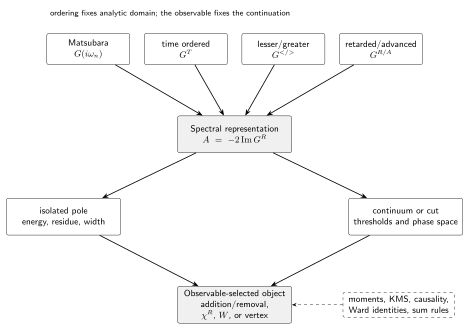
Operator ordering and analytic domain determine which continuation and observable are valid. Spectral support can contain both isolated poles and continua; only a pole with controlled width and residue supports a quasiparticle or collective-mode interpretation. The diagram is schematic and not to scale.
Guide to the pages
Section titled “Guide to the pages”- Quantum-Matter Correlators and Observable Conventions fixes signs, ordering, thermal factors, spectral normalization, and continuation.
- Lehmann Representations and Spectral Functions in Matter expresses addition, removal, and density spectra in exact many-body eigenstates.
- Dyson Equations and Self-Energies defines the exact self-energy and its pole, width, and incoherent contributions.
- Diagrammatics at Finite Density separates vacuum renormalization from medium occupation factors and particle–hole kinematics.
- Quasiparticle Poles, Residues, and Lifetimes gives the scale hierarchy required before calling a spectral feature a particle.
- Spectral Moments and Many-Body Sum Rules derives moment constraints from equal-time commutators and the -sum rule.
- Polarization, the Lindhard Function, and Particle–Hole Continua derives the free Fermi-gas density response and its noncommuting limits.
- Coulomb Screening, Dielectric Response, and RPA Validity resums polarization bubbles and states where that resummation is controlled.
- Plasmons and Collective Charge Modes derives two- and three-dimensional dispersions and the damping boundary.
- Current Vertices and Ward-Consistent Response ties self-energy and response vertices to the continuity equation.
- Irreducible Vertices and Bethe–Salpeter Equations defines channel reducibility and susceptibility eigenvalue problems.
- Hedin’s Equations, Screened Interactions, and the GW Approximation derives the coupled hierarchy and identifies the vertex truncation behind each GW scheme.
- Luttinger–Ward Functionals and Φ-Derivable Self-Energies constructs stationary functionals and conserving self-consistency.
- Baym–Kadanoff Conservation Laws and Approximation Validity separates conservation, thermodynamic consistency, Ward closure, crossing, positivity, and numerical accuracy.
Comparison of claims and tests
Section titled “Comparison of claims and tests”This table is the chapter’s canonical semantic record. The rows deliberately separate exact properties from approximation-dependent ones.
Table: correlator and approximation claims with independent validation.
| Claim | Object and convention | Necessary test | What the test establishes | What it does not establish |
|---|---|---|---|---|
| Spectral weight is normalized | Canonical one-particle | Zeroth moment from the equal-time anticommutator | Operator normalization and total one-particle weight | Correct placement of the weight |
| A peak is a quasiparticle | Retarded pole on the physical continuation | Small width, finite residue, stable pole, separated scales | Long-lived one-particle-like excitation | Transport lifetime or Landau-liquid behavior |
| A density approximation is consistent | with contact terms | Continuity Ward identity and -sum rule | Conservation and normalization | Quantitative accuracy at all |
| RPA screening is controlled | with neutral background | High-density or large-degeneracy counting plus vertex estimate | Parametric reason bubble chains dominate | Universal reliability at strong coupling |
| A loss peak is a plasmon | Pole of on the retarded sheet | Complex pole, residue, and continuum separation | Collective charge mode with a damping rate | A perfectly sharp excitation |
| A Bethe–Salpeter eigenvalue is large | Named irreducible channel and kernel | Grid, basis, crossing, and finite-size checks | Enhanced susceptibility in that approximation | Established broken symmetry |
| A scheme is Φ-derivable | solved self-consistently | Functional symmetry and consistent response vertex | Named macroscopic conservation laws | Crossing, positivity, uniqueness, or accuracy |
| GW gives a useful spectrum | Declared , eigenvalue-only, quasiparticle self-consistent, or fully self-consistent scheme | Starting point, self-consistency, vertex, sum-rule, and benchmark tests | Performance in the tested regime | A general controlled expansion |
From response to approximation
Section titled “From response to approximation”The validity map shows why no single badge certifies an approximation. A self-energy must be paired with a response vertex; screening must respect neutrality and limit order; a collective pole must be separated from the continuum; and conservation must be checked apart from positivity and benchmark error.
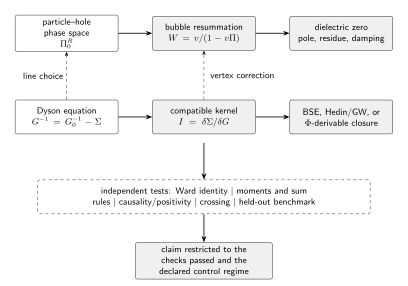
Bubble, ladder, Hedin/GW, and Φ-derivable constructions preserve different subsets of exact structure. Ward identities, moments, crossing, spectral positivity, and quantitative benchmarks are independent gates. The figure is schematic and does not rank computational cost or accuracy.
Review the chapter
Section titled “Review the chapter”Translation. Starting from for fermions, reconstruct the occupation number and verify the zeroth moment. A successful answer identifies every factor of and .
Analytic diagnosis. Given a retarded self-energy, solve the pole equation on the proper sheet, calculate and the width, and compare the width with all nearby energy scales. A real-axis maximum alone is insufficient.
Limit test. Derive both and . Their difference is required by number conservation and explains why static screening and uniform dynamics are not interchangeable.
Approximation checks. For a proposed self-consistent Born, RPA, or GW calculation, list the self-energy, polarization, and vertex actually used. Then test a Ward identity, a sum rule, spectral positivity, and a held-out benchmark separately.
Synthesis. Explain the chain from particle–hole phase space to screening and a plasmon pole, including where the mode enters the continuum and why a maximum of need not be a pole.
Continue
Section titled “Continue”Fermi Surfaces and Fermi Liquids applies the pole and response grammar to an interacting Fermi surface. Short-Range Scattering Data as Many-Body Inputs supplies the vacuum amplitude used in dilute-gas diagrams. Probe-specific matrix elements and inference belong to From Measured Intensity to Many-Body Claim.
References
Section titled “References”- Baym, Gordon. “Self-Consistent Approximations in Many-Body Systems.” Physical Review 127 (1962): 1391–1401. DOI.
Further reading
Section titled “Further reading”- Fetter, Alexander L., and John Dirk Walecka. Quantum Theory of Many-Particle Systems. Mineola, NY: Dover, 2003; originally published 1971. Publisher record.
- Hedin, Lars. “New Method for Calculating the One-Particle Green’s Function with Application to the Electron-Gas Problem.” Physical Review 139 (1965): A796–A823. DOI.
- Mahan, Gerald D. Many-Particle Physics. 3rd ed. New York: Springer, 2000. DOI.
Original QFT.org content:CC BY 4.0, unless an item supplies different terms. Third-party material retains its own terms.