

Symmetry Classes and Topological Localization
Disordered free-fermion localization is classified first by the antiunitary constraints acting on the single-particle or Bogoliubov–de Gennes Hamiltonian, and only then by dimension and topology. The same ten Altland–Zirnbauer classes organize random-matrix level statistics, sigma-model targets, and allowed topological terms, but a clean band label is insufficient when disorder closes the mobility gap or breaks the protecting symmetry.
Required background. Anderson scaling supplies mobility and localization diagnostics. Discrete and antiunitary symmetries fixes and antiunitary conventions. The free-fermion periodic table supplies the clean classification.
Helpful background. Characteristic classes and Chern–Weil theory supplies the invariant language.
Assigning the symmetry class
Section titled “Assigning the symmetry class”For a first-quantized Hamiltonian , test
with antiunitary and , recording whether each is absent or squares to or . If both exist, is a unitary chiral symmetry satisfying . These data give three Wigner–Dyson classes and seven Bogoliubov/chiral classes Altland and Zirnbauer 1997.
In a BdG Hamiltonian, is a redundancy of Nambu doubling, not necessarily a physical operation on the many-body Hilbert space. Nevertheless, the sign of is class data: writing , the matrix transforms by conjugation under a consistent unitary basis change, so its sign is invariant. One must compute that sign, and any additional physical symmetries, in a fixed representation rather than select it by changing Nambu notation. A random scalar, mass, pairing, or hopping term belongs to the class only if every realization preserves the required constraints.
The original validity diagram shows the full inference. Inspect the first gate: symmetry assignment precedes the topological term, localization flow, and boundary claim.
From Hamiltonian constraints to topological localization. A clean invariant survives disorder only while the relevant mobility gap and protecting symmetry persist. The diagram is schematic; it does not identify a phase from a finite density-of-states dip.
Sigma-model targets and topological terms
Section titled “Sigma-model targets and topological terms”Disorder averaging and retarded–advanced doubling produce a class-dependent symmetric-space target for . The ordinary gradient action governs weak localization, while the target’s homotopy can permit an additional term:
is integer- or -valued only under the appropriate dimension, target, and boundary conditions. In two-dimensional class A, the Pruisken term encodes integer Hall flow and prevents interpreting every state as an ordinary localized insulator at a plateau transition. Surface theories of higher-dimensional topological phases can carry Wess–Zumino or terms that obstruct localization while the protecting symmetry is intact.
The dimensional sequence is the same Bott-periodic structure appearing in the clean classification Kitaev 2009 and Schnyder et al. 2008. The disorder field theory adds a crucial distinction: a spectral gap may be filled by localized states while a mobility gap still protects quantized response.
Bulk, boundary, and rare-state checks
Section titled “Bulk, boundary, and rare-state checks”A defensible disordered topological claim specifies:
- the physical symmetry action and its square for each random realization;
- spatial dimension and whether the invariant concerns a spectral or mobility gap;
- boundary conditions and the thermodynamic scaling of boundary transport;
- rare localized states and finite-size hybridization;
- interaction strength, since the free-fermion table can reduce or fail entirely.
Localized in-gap spectral weight does not automatically destroy a mobility-gap invariant, while an extended rare-state network can. Conversely, a finite sample may show a robust boundary resonance even after the asymptotic protecting symmetry is broken weakly. Evers and Mirlin 2008, §§V–VI reviews the class-dependent localization field theories and critical points.
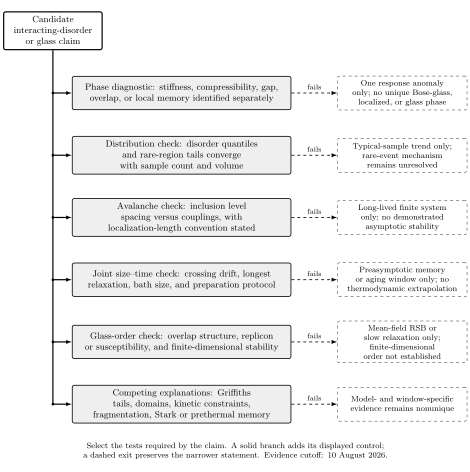
The canonical disorder and glass claim test matrix keeps symmetry, dimension, gap type, rare-state test, and interaction ceiling together.
Exercise
Section titled “Exercise”Classify a disordered Majorana chain. A one-dimensional BdG Hamiltonian has no time-reversal symmetry, has particle–hole symmetry with , and has no independent chiral symmetry. What class and free-fermion invariant apply?
Solution
The Hamiltonian is in class D. In one dimension its free-fermion classification is . Disorder that preserves the BdG particle–hole constraint can leave the invariant meaningful when a mobility gap remains. A finite zero-energy end peak alone does not establish that invariant; bulk mobility, length scaling, and end-to-end structure must also be checked.
References
Section titled “References”- Alexander Altland and Martin R. Zirnbauer, “Nonstandard Symmetry Classes in Mesoscopic Normal-Superconducting Hybrid Structures,” Physical Review B 55 (1997) 1142–1161. DOI
- Ferdinand Evers and Alexander D. Mirlin, “Anderson Transitions,” Reviews of Modern Physics 80 (2008) 1355–1417. DOI
- Alexei Kitaev, “Periodic Table for Topological Insulators and Superconductors,” AIP Conference Proceedings 1134 (2009) 22–30. DOI
- Andreas P. Schnyder, Shinsei Ryu, Akira Furusaki, and Andreas W. W. Ludwig, “Classification of Topological Insulators and Superconductors in Three Spatial Dimensions,” Physical Review B 78 (2008) 195125. DOI
Original QFT.org content:CC BY 4.0, unless an item supplies different terms. Third-party material retains its own terms.