

NMR, μSR, and Local Magnetic Probes
Nuclear magnetic resonance and muon spin spectroscopy infer local magnetic environments from the precession and relaxation of implanted spins. NMR resolves selected nuclei through hyperfine couplings; μSR follows an implanted muon’s polarization in the distribution of local fields. Both are exquisitely sensitive to weak or slow magnetism, but neither directly returns the bulk spin susceptibility without a coupling form factor, stopping-site model, and dynamical window.
Required background. The measurement-to-claim map supplies calibration and uncertainty standards. Spin correlations and structure factors supplies and magnetic sum rules.
Helpful background. Spin-liquid evidence supplies competing explanations for persistent dynamics and missing order.
Evidence cutoff. This method and evidence account covers primary and official sources available through 10 August 2026. Later calibrations, corrections, datasets, and changing assessments belong in the dated Quantum Matter and Emergence Research synthesis.
NMR shift and relaxation
Section titled “NMR shift and relaxation”For a resolved nucleus, the frequency shift can be written
with unit and molar factors absorbed into the declared hyperfine constant . A – plot can separate and only when the bulk susceptibility contains the same intrinsic component and the coupling is temperature independent. Impurities, multiple sites, orbital shifts, demagnetization, and anisotropic tensors can produce an apparent anomaly.
The spin-lattice relaxation rate samples transverse fluctuations near the Larmor frequency; the microscopic connection was established by Moriya 1956:
The hyperfine form factor can filter entire wavevectors. A small can therefore mean weak low-frequency spectral weight in the sampled channel, a gap, a shifted fluctuation rate, or a form-factor zero. Spin-spin relaxation , linewidth, Knight shift, and answer different questions and should not be collapsed into one magnetic scale.
The chapter diagram shows the coupling model between frequency record and correlator. Inspect that step before comparing different nuclei or muon sites.
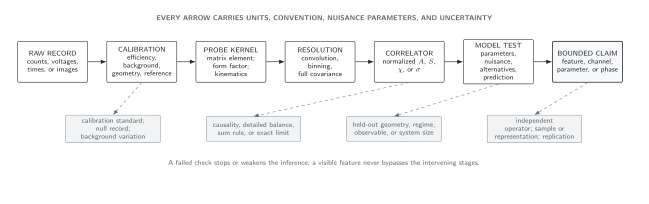
Local-spin probes within the common inference chain. Site occupancy, coupling tensor, field geometry, dead time, volume fraction, and dynamical window accompany any statement about static order, a gap, or persistent fluctuations. Schematic.
μSR polarization and field distributions
Section titled “μSR polarization and field distributions”The measured positron asymmetry is proportional to the ensemble muon polarization plus detector background; Hillier et al. 2022 review the experimental method, calibration, and limitations. For a static local-field distribution and initial spin along ,
For an isotropic zero-mean Gaussian distribution with component width , the static Gaussian Kubo–Toyabe form is
The long-time tail is a powder average for static randomly oriented fields, not a universal signature. Longitudinal-field decoupling tests whether relaxation is quasistatic; dynamic fluctuations change the tail and require a stochastic or microscopic model. Hayano et al. 1979 derive the standard treatment.
Muon stopping sites and the muon’s electrostatic perturbation must be calculated or constrained. Missing oscillations can reflect a broad distribution, a field beyond detector dead-time bandwidth, a small ordered volume, or dynamics—not necessarily absence of order. Conversely, a weak exponential relaxation is not by itself evidence for a spin liquid.
Time windows and evidence ceilings
Section titled “Time windows and evidence ceilings”Report applied field and orientation, pulse sequence, recovery model, fit interval, detector dead time, background fraction, sample volume fraction, site multiplicity, hyperfine or stopping-site calculation, and covariance among amplitudes and rates. Vary field and temperature through the proposed crossover and compare with bulk susceptibility, heat capacity, diffraction, or neutron dynamics; Curro 2009 illustrates this multi-observable practice in heavy-fermion systems.
The strongest local-probe conclusion may be “no static field larger than the calibrated sensitivity in the occupied sites over the stated time window.” Promoting it to absence of symmetry breaking requires coverage of volume fraction, field orientation, and fluctuation rates. The probe and computation claim test matrix preserves that ceiling.
Exercise
Section titled “Exercise”A hyperfine blind spot. Suppose for a nucleus between two equivalent spins. What does NMR see at the antiferromagnetic wavevector ?
Solution
, so the leading contribution of fluctuations exactly at is filtered from . Strong antiferromagnetic correlations can therefore coexist with a modest relaxation rate at this site. A different nuclear site, coupling anisotropy, incommensurability, or another probe is needed to test that wavevector.
References
Section titled “References”- Nicholas J. Curro, “Nuclear Magnetic Resonance in the Heavy Fermion Superconductors,” Reports on Progress in Physics 72 (2009) 026502. DOI
- R. S. Hayano, Y. J. Uemura, J. Imazato, N. Nishida, T. Yamazaki, and R. Kubo, “Zero- and Low-Field Spin Relaxation Studied by Positive Muons,” Physical Review B 20 (1979) 850–859. DOI
- Adrian D. Hillier, Stephen J. Blundell, Iain McKenzie, Izumi Umegaki, Lei Shu, Joseph A. Wright, Thomas Prokscha, Fabrice Bert, Koichiro Shimomura, Adam Berlie, Helena Alberto, and Isao Watanabe, “Muon Spin Spectroscopy,” Nature Reviews Methods Primers 2 (2022) 4. DOI
- Tôru Moriya, “Nuclear Magnetic Relaxation in Antiferromagnetics,” Progress of Theoretical Physics 16 (1956) 23–44. DOI
Original QFT.org content:CC BY 4.0, unless an item supplies different terms. Third-party material retains its own terms.