

Generalized-Hydrodynamic Riemann Problems and Trap Expansions
Generalized hydrodynamics (GHD) evolves a slowly varying local Bethe macrostate rather than a few thermal densities. At Euler order, every quasiparticle rapidity and species is advected with its state-dependent dressed velocity. Partitioning protocols become self-consistent Riemann problems; trap releases add an initial LDA map and, while the trap remains on, a model-specific force in rapidity space.
Required background. Root densities, macrostates, and observables fixes the dressing convention and effective velocity. Generalized hydrodynamics for integrable systems supplies the conservation-law framework.
Helpful background. Quench action and integrable steady states supplies microscopic initial macrostates for homogeneous regions.
Euler GHD and characteristic velocities
Section titled “Euler GHD and characteristic velocities”For quasiparticle species , the Euler equation without external force is
where at every
The local filling obeys the convective form
under the same regularity and convention assumptions. Dressing is recomputed from the local vector of fillings; using a velocity dressed in the initial state throughout the evolution is generally inconsistent.
Charge conservation follows by multiplying the root-density equation by a bare one-particle charge and integrating:
with
These equalities are essential numerical checks. Violating a charge at grid refinement can signal an inconsistent dressing solve, species truncation, flux discretization, or boundary treatment.
The partitioning Riemann problem
Section titled “The partitioning Riemann problem”Join two homogeneous GGEs at :
At Euler scale the solution depends on the ray . Substitution gives
The entropy solution is written implicitly as
with the equality set fixed by continuity or a numerical entropy prescription. Because depends on the unknown filling at the same ray, this is a nonlinear fixed-point problem. Iterating velocities without checking branch changes can converge to a spurious solution near characteristic crossings.
Bertini et al. 2016, main text and Castro-Alvaredo, Doyon, and Yoshimura 2016, §§2–4 independently established this Euler-scale hydrodynamics from local Bethe states and currents.
The validity figure places the Euler solution before diffusion, finite-size, resolution, and weak-breaking tests. Inspect the first dashed exit: agreement at microscopic time or across a discontinuity only a few correlation lengths wide is not an Euler-scale validation.
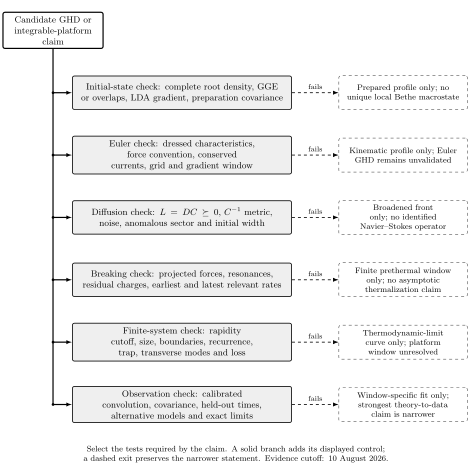
Validity map for Euler GHD. The exact velocity formula does not remove hydrodynamic scale separation, initial-state, boundary, force, numerical, or platform requirements. Original schematic, not to scale.
Traps and force terms
Section titled “Traps and force terms”For a Lieb–Liniger gas in a smooth one-body potential , the semiclassical acceleration of wave-number rapidity is
The forced kinetic equation is
For a generic integrable model or a field coupling to another charge, the rapidity force must be dressed and matched to the quasiparticle momentum; it cannot be copied from the Galilean formula. Doyon and Yoshimura 2017, §§3–4 formulate GHD in inhomogeneous external fields. Turning off a trap at sets the subsequent force to zero but leaves an inhomogeneous initial macrostate
only where LDA and preparation equilibrium were valid. A box edge, narrow cloud, or critical region can require gradient or microscopic treatment.
Euler GHD requires a separation
It gives ballistic-scale profiles. Front broadening, diffusion, fluctuations, finite-size recurrences, transverse excitations, and residual longitudinal trapping belong to later corrections.
The canonical integrable-matter claim test matrix records initial input, Euler observable, force, breaking scale, finite size, and validation. A reproducible verification workflow solves Riemann and trap protocols with charge and grid-convergence checks.
Exercise
Section titled “Exercise”Free-fermion partitioning solution. Let , so . Show that the Riemann solution is
Write the density on the ray.
Solution
With , the velocity is state independent, so each mode solves
Tracing the characteristic backward from gives initial coordinate . It originated on the left when and on the right when , yielding the displayed result. In the spinless convention, the particle density is
Interactions replace the fixed threshold by a self-consistent dressed-velocity condition.
References
Section titled “References”- Bertini, B., Collura, M., De Nardis, J., and Fagotti, M. (2016). “Transport in out-of-equilibrium XXZ chains: Exact profiles of charges and currents.” Physical Review Letters 117, 207201. doi:10.1103/PhysRevLett.117.207201.
- Castro-Alvaredo, O. A., Doyon, B., and Yoshimura, T. (2016). “Emergent hydrodynamics in integrable quantum systems out of equilibrium.” Physical Review X 6, 041065. doi:10.1103/PhysRevX.6.041065.
- Doyon, B., and Yoshimura, T. (2017). “A note on generalized hydrodynamics: Inhomogeneous fields and other concepts.” SciPost Physics 2, 014. doi:10.21468/SciPostPhys.2.2.014.
Original QFT.org content:CC BY 4.0, unless an item supplies different terms. Third-party material retains its own terms.