

Correlated Lattice Fermions and Mott Physics
A correlated-electron claim is supported only when four layers agree: a justified low-energy Hamiltonian, a mechanism-specific insulating or ordering diagnosis, a solver inside its validity domain, and observables that survive uncertainty and competing explanations. Large , a two-peak spectrum, or one successful fit is never sufficient by itself Imada, Fujimori, and Tokura 1998, §§ II–V, pp. 1047–1155.
This chapter covers downfolded lattice Hamiltonians, Hubbard and strong-coupling limits, spectral-weight transfer, insulator distinctions, DMFT and cluster interpretation, sign-free Hubbard applications, retarded phonons, Hund matter, competing orders, and bounded pseudogap inference. Generic lattice algorithms, sign-problem theory, and numerical certification remain with Volume VIII.
Helpful background. Effective lattice Hamiltonians supplies the orbital, screening, and downfolding choices; Hubbard symmetries and controlled limits supplies the interaction, filling, and strong-coupling conventions.
Enter this chapter
Section titled “Enter this chapter”Start with effective lattice Hamiltonians if orbital choice, screening, or double counting is unfamiliar. Then use Hubbard symmetries and limits before any solver or phase label. A reader prepared for the solver branch should also be able to identify a Green-function sum rule and propagate a correlated numerical error.
| Reader goal | Suggested route | Capability at the end |
|---|---|---|
| Strong-coupling core | Effective Hamiltonian → Hubbard limits → superexchange → spectral transfer | Derive and distinguish projected spin physics from charge localization |
| Insulator diagnosis | Hubbard limits → spectral transfer → insulator distinctions | Classify Mott, Slater, band, charge-transfer, and Anderson mechanisms using observables |
| DMFT route | Effective Hamiltonian → Hubbard limits → single-site DMFT → cluster DMFT | State the infinite-coordination control and measure cluster, bath, and periodization drift |
| Numerical evidence | Hubbard limits → sign-free QMC → competing orders | Make a finite-size phase statement with covariance and sign-free domain explicit |
| Hund and multiorbital matter | Effective Hamiltonian → Hubbard limits → single-site DMFT → Hund metals | Preserve basis, interaction-tensor, solver, and orbital-selectivity checks |
| Doped Mott pseudogap | Hubbard limits → spectral transfer → cluster DMFT → bounded pseudogap evidence | Separate an operational pseudogap observation from its mechanism attribution |
From reduction to inference
Section titled “From reduction to inference”The first map separates layers that are often conflated: Hamiltonian reduction, controlled low-energy matching, independent solver routes, observables, and mechanism comparison. In particular, Schrieffer–Wolff matching removes the high-energy charge sector, while the charge gap and transferred spectral weight remain properties of the full Hubbard model. DMFT, cluster methods, and sign-free QMC are independent routes with different controls; QMC is not a refinement of DMFT. The local DMFT mapping is controlled in the large-coordination limit, not merely at large interaction Georges et al. 1996, §§ II–III, pp. 19–50.
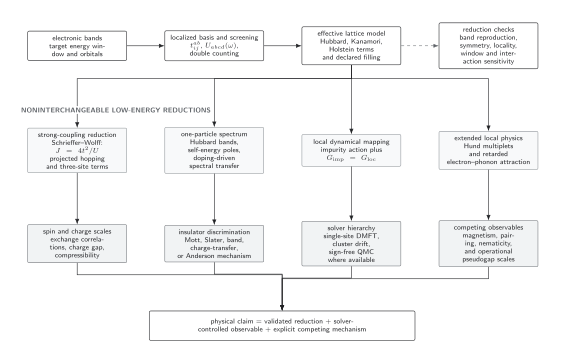
Reduction and inference layers for correlated lattice fermions. The map is schematic: downfolding is not unique, controls only the projected low-energy transformation, solver routes are independent rather than hierarchical, and a mechanism requires more than a converged spectrum.
Open the reduction map at full size. The superexchange derivation, spectral-weight analysis, and DMFT mapping supply the corresponding equations and limits.
The second map makes the decision logic explicit. Failing a method-specific control stops the claim; passing supports only a bounded observation. A mechanism attribution requires an additional comparison against live alternatives. Inspect the checks for bath and cluster drift, sign-free but finite-size QMC, analytic continuation, multiorbital basis dependence, and retarded-interaction assumptions. Cluster-size, boundary, and periodization dependence are independent controls Maier et al. 2005, §§ II–IV, pp. 1030–1059.
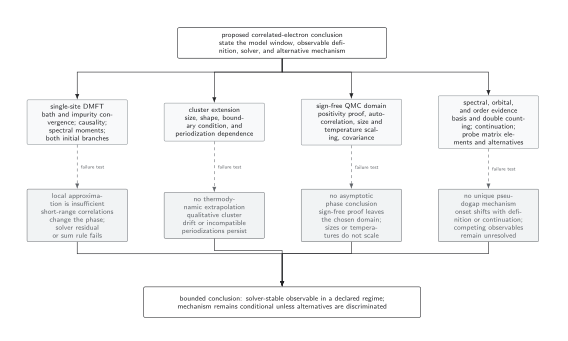
Validity and evidence ceiling for correlated-electron claims. The map is schematic: a method failure requires revision, method success supports an observation, and unresolved alternatives leave the mechanism open without erasing the observation.
Open the validity map at full size. The cluster-method protocol, sign-free-QMC protocol, and pseudogap evidence page develop the three most delicate inference boundaries.
Correlated-electron validity table
Section titled “Correlated-electron validity table”| Stage or decision | Required check | PASS permits | FAIL requires |
|---|---|---|---|
| Hamiltonian reduction | Reproduce target bands and symmetries while varying window, basis, range, screening, and double counting | A declared effective lattice Hamiltonian with reduction uncertainty | Revise the retained subspace or interaction model |
| Low-energy projection | Verify , match the low-energy spectrum and transformed observables, and retain same-order terms | A spin or projected model for low-energy observables | Return to the full Hubbard sector; do not infer its charge spectrum from the projection |
| Single-site DMFT | Converge both branches, impurity and bath, residuals, causality, and spectral moments | A local, solver-stable observable in the declared regime | No DMFT observation or phase inference |
| Cluster method | Test size, shape, boundary condition, solver error, and justified reconstructions | A cluster-stable nonlocal observation | No thermodynamic or nonlocal conclusion from that cluster sequence |
| Sign-free QMC | Prove nonnegative weight and control autocorrelation, time step or projection, covariance, temperature, and size | A finite-model observable with a bounded extrapolation | No asymptotic phase conclusion |
| Spectral, orbital, or retarded analysis | Control continuation, resolution, matrix elements, basis, interaction tensor, double counting, and vertex regime as applicable | An operational observable with stated method dependence | Report only an unresolved tendency |
| Insulator mechanism comparison | Test symmetry restoration, adiabatic continuity, orbital gap edges, spectral transfer, compressibility, and disorder scaling | A bounded Mott, Slater, band, charge-transfer, or Anderson attribution | Keep the insulating observation but list viable mechanisms |
| Pseudogap observation | Show stable low-energy suppression relative to a declared temperature or doping baseline in converged spectra and at least one corroborating observable | An operational pseudogap in the declared regime | Report a method-dependent suppression, not an established pseudogap |
| Pseudogap mechanism attribution | Measure discriminants for short-range magnetism, precursor pairing, intertwined order, zeros, disorder, and probe effects | A mechanism claim bounded to the tested model and regime | The pseudogap observation may stand, but its mechanism remains open |
This table is the nonvisual decision equivalent of both maps. It keeps model definition, method validity, operational observation, and causal attribution separate. For detailed observables and falsifiers of the five insulating mechanisms, use the insulator diagnostic matrix rather than duplicating it here.
Guide to the pages
Section titled “Guide to the pages”- From Bands and Orbitals to Effective Lattice Hamiltonians constructs hopping and interaction tensors while exposing basis and screening ambiguity.
- Hubbard Models: Symmetries and Controlled Limits fixes the Hamiltonian, particle–hole convention, atomic limit, and strong-coupling scale.
- Superexchange and the t–J Projection performs the Schrieffer–Wolff elimination and tracks transformed observables and three-site terms.
- Hubbard Bands and Spectral-Weight Transfer derives atomic poles, moments, coherent weight, and doping transfer.
- Mott, Slater, Band, and Charge-Transfer Insulators provides the mechanism-specific diagnostic matrix, with Anderson localization as a distinct comparison.
- DMFT Impurity Mapping and Self-Consistency derives the local impurity mapping and its infinite-coordination control.
- Cluster DMFT and Nonlocal-Correlation Validity compares cellular and dynamical-cluster constructions and periodization choices.
- Sign-Free Quantum Monte Carlo and Hubbard-Phase Inference proves two standard sign-free domains and builds a bounded finite-size claim.
- Electron–Phonon Fields and Retarded Interactions integrates a harmonic displacement to obtain a retarded attraction and competing channels.
- Multiorbital Correlations and Hund’s Metals connects Kanamori multiplets to orbital-dependent coherence.
- Competing Orders and Electronic Nematicity constructs coupled-order functionals and distinguishes primary from vestigial nematicity.
- Doped Mott Matter and the Pseudogap Evidence Problem triangulates a pseudogap while retaining alternative mechanisms.
Convention bridge
Section titled “Convention bridge”We write the one-band kinetic term as and the onsite repulsion as . On a bipartite nearest-neighbor lattice, particle–hole symmetry occurs at in this unshifted convention. As in the correlator dictionary, and . Every cluster page states whether it periodizes the self-energy, cumulant, or Green function.
Review the chapter
Section titled “Review the chapter”Mechanism diagnosis. A sample becomes insulating at the onset of antiferromagnetic order and its gap closes when that order is suppressed at fixed interaction. This supports a Slater component; it does not exclude mixed Mott physics without spectral-transfer and paramagnetic-gap tests.
Solver assessment. A four-site cluster shows an antinodal pseudogap. A successful conclusion must survive at least one different cluster geometry, periodization choice, bath/solver refinement, and analytic-continuation protocol, while retaining competing order and finite-temperature explanations.
Strong-coupling translation. Derive the bond singlet–triplet splitting , then explain why the electron creation operator also needs a Schrieffer–Wolff transformation. Matching the Hamiltonian alone is insufficient for spectral weight.
References
Section titled “References”- Antoine Georges, Gabriel Kotliar, Werner Krauth, and Marcelo J. Rozenberg, “Dynamical Mean-Field Theory of Strongly Correlated Fermion Systems and the Limit of Infinite Dimensions,” Reviews of Modern Physics 68 (1996) 13–125, doi:10.1103/RevModPhys.68.13.
- Masatoshi Imada, Atsushi Fujimori, and Yoshinori Tokura, “Metal–Insulator Transitions,” Reviews of Modern Physics 70 (1998) 1039–1263, doi:10.1103/RevModPhys.70.1039.
- Thomas Maier, Mark Jarrell, Thomas Pruschke, and Matthias H. Hettler, “Quantum Cluster Theories,” Reviews of Modern Physics 77 (2005) 1027–1080, doi:10.1103/RevModPhys.77.1027.
Original QFT.org content:CC BY 4.0, unless an item supplies different terms. Third-party material retains its own terms.