

Diffusive GHD Corrections as Model Benchmarks
Euler GHD fixes ballistic advection but not the broadening generated by hydrodynamic fluctuations of interacting quasiparticle trajectories. Diffusive GHD is a gradient expansion around a local Bethe macrostate. Its transport operator must conserve charges and be nonnegative in the inverse-susceptibility metric; fitting an error-function width without those structural checks does not identify integrable diffusion.
Required background. GHD Riemann problems and trap expansions supplies the Euler equation and local dressing convention.
Helpful background. Long-time tails and fluctuation renormalization supplies nonlinear fluctuation effects and anomalous transport.
Navier–Stokes order and the positivity metric
Section titled “Navier–Stokes order and the positivity metric”Let be conserved densities, their Euler currents, and local generalized potentials. To first gradient order,
The static susceptibility and Onsager matrices are
With thermodynamically stable sign conventions, the dissipative current is and entropy production is
Thus must be positive semidefinite. Since , writing gradients in charge variables gives
need not be symmetric in an ordinary Euclidean basis. Because with , it is self-adjoint and nonnegative in the inverse-susceptibility metric,
Equivalently, is symmetric positive semidefinite. This distinction matters whenever conserved densities have unequal susceptibilities or mix under a change of basis.
In rapidity space one writes schematically
The factor is conventional and must be included consistently in . Exact integrable diffusion kernels contain dressed scattering shifts, fillings, state densities, relative effective velocities, and species sums. De Nardis, Bernard, and Doyon 2018, main text and supplemental formulas derive the diffusion matrix from quasiparticle scattering fluctuations and establish its positive structure.
Fluctuations, front widths, and anomalous sectors
Section titled “Fluctuations, front widths, and anomalous sectors”A fluctuating form adds conserved noise,
with local-equilibrium covariance proportional to :
in the displayed normalization. The same matrix that dissipates gradients fixes noise; choosing them independently violates fluctuation–dissipation consistency.
For a regular isolated characteristic with effective scalar diffusivity , a front broadens as
while its Euler position is . Other mechanisms can mimic or replace this scaling:
- free lattice dispersion can produce Airy-type edges without diffusion;
- unresolved initial width gives ;
- trap averaging and imaging convolution add fixed or time-dependent widths;
- a distribution of velocities produces ballistic broadening;
- nonlinear fluctuating modes can be superdiffusive.
Gopalakrishnan et al. 2018, main text connect integrable quasiparticle fluctuations to operator-front broadening, providing a complementary route to the hydrodynamic diffusion kernel.
At the isotropic Heisenberg point and zero magnetization, spin transport exhibits Kardar–Parisi–Zhang-type superdiffusive scaling rather than a finite ordinary diffusion constant. Ljubotina, Žnidarič, and Prosen 2019, main text give a microscopic numerical identification. Symmetry sector, field, charge, and order of limits must therefore be fixed before applying diffusive GHD.
The validity figure shows this decision. Inspect the diffusion gate: conservation and positivity precede a comparison of broadened profiles, and anomalous sectors exit to a different hydrodynamic theory.
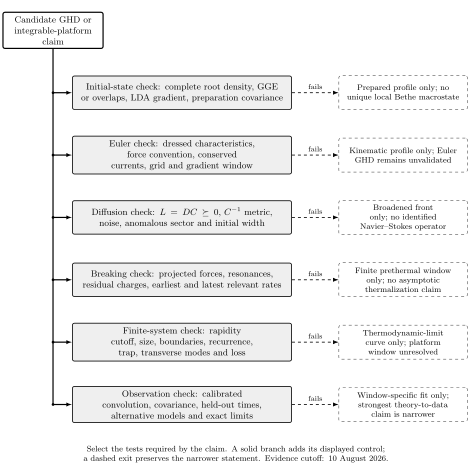
Validity map for diffusive GHD. A fitted front width is weaker than a conserved, positive, convention-matched Navier–Stokes correction tested against exact and numerical limits. Original schematic, not to scale.
Benchmark design
Section titled “Benchmark design”A trustworthy benchmark uses several independent anchors:
- Thermodynamics: recompute and dressed functions with species and rapidity cutoffs varied.
- Structure: verify , nonnegative quadratic forms, exact null modes, and charge conservation.
- Limits: recover free, dilute, high-temperature, symmetry, or large-coupling limits where known.
- Numerics: refine rapidity and spatial grids, time step, flux method, and boundaries independently.
- Observables: convolve theory with the same initial profile, trap, finite size, and measurement kernel as the comparison data.
- Alternatives: fit ballistic dispersion, anomalous exponents, and weak-breaking kinetics on held-out times.
A diffusion parameter inferred only from the same profile used to set its initial width is circular. Prefer multiple times and observables, with a shared diffusion operator and a covariance matrix. The maximum conclusion is then a model-specific Navier–Stokes correction in a declared state and time window.
The canonical integrable-matter claim test matrix keeps Euler, diffusion, breaking, finite-size, and validation data aligned. A reproducible verification workflow checks conservation, entropy production, positivity, and grid convergence.
Exercise
Section titled “Exercise”A positive diffusive step. Solve
for at and at . Show that the transition width scales as . Then, for a separate square-integrable perturbation on the line, or a periodic perturbation with zero mean, show that its quadratic norm decays.
Solution
Convolution with the heat kernel gives
Any fixed pair of percentile levels occurs at , hence the width scales as . The integral of for this infinite step diverges, so it cannot be used as a Lyapunov functional. Instead let obey the same diffusion equation and be square-integrable with vanishing boundary flux, or periodic. Then
after integration by parts. A negative would sharpen short wavelengths and make the initial-value problem unstable, illustrating the physical importance of positivity.
References
Section titled “References”- De Nardis, J., Bernard, D., and Doyon, B. (2018). “Hydrodynamic diffusion in integrable systems.” Physical Review Letters 121, 160603. doi:10.1103/PhysRevLett.121.160603.
- Gopalakrishnan, S., Huse, D. A., Khemani, V., and Vasseur, R. (2018). “Hydrodynamics of operator spreading and quasiparticle diffusion in interacting integrable systems.” Physical Review B 98, 220303(R). doi:10.1103/PhysRevB.98.220303.
- Ljubotina, M., Žnidarič, M., and Prosen, T. (2019). “Kardar–Parisi–Zhang physics in the quantum Heisenberg magnet.” Physical Review Letters 122, 210602. doi:10.1103/PhysRevLett.122.210602.
Original QFT.org content:CC BY 4.0, unless an item supplies different terms. Third-party material retains its own terms.