

Mean-Field Quantum Spin Glasses and Replica Symmetry Breaking
Mean-field quantum spin glasses combine quenched random exchange with quantum dynamics and an infinite-range limit in which a replica saddle becomes exact. Their order parameter is a two-time overlap ; its off-diagonal structure diagnoses frozen correlations, while replica-symmetry breaking resolves the multitude of pure states. This construction does not establish replica-symmetry breaking in a finite-dimensional material.
Required background. Replica methods supplies the representation. Scaling directions supplies stability language. Thermal density operators supplies imaginary-time equilibrium correlators.
Infinite-range quantum model
Section titled “Infinite-range quantum model”For the transverse-field Sherrington–Kirkpatrick model, choose
The scaling makes the energy extensive. Replicating the imaginary-time path integral and averaging generates a term coupling every pair of replicas and times. A Hubbard–Stratonovich field becomes
The diagonal contains genuine quantum dynamics. For , a time-independent equilibrium component measures the overlap between thermodynamic states. The Edwards–Anderson parameter is the long-time diagonal limit, equivalently an appropriate off-diagonal overlap at the saddle Edwards and Anderson 1975.
The original validity map locates the exact statement. Inspect the separation between the infinite-range saddle and the finite-dimensional evidence branch.
Mean-field glass order and its boundary. The saddle can support replica symmetry breaking after a replicon instability; finite-dimensional aging or slow response requires separate spatial and dynamical evidence. Schematic.
Replica-symmetric saddle and instability
Section titled “Replica-symmetric saddle and instability”In the classical limit and zero field, the replica-symmetric ansatz gives the self-consistency equation
The solution loses stability at . Below the Almeida–Thouless stability boundary, a replica-symmetric ansatz has a negative replicon eigenvalue; it must not be used merely because it solves the saddle equation.
Parisi’s hierarchical ansatz replaces one off-diagonal number by a function , , encoding an ultrametric overlap distribution Parisi 1980. The order of limits is essential: solve the finite- combinatorics, continue, and only then minimize. Permuting these steps can select the wrong saddle.
Quantum dynamics and controlled scope
Section titled “Quantum dynamics and controlled scope”For , makes the diagonal order parameter time dependent. A static approximation that replaces by a constant can locate qualitative regimes but misses quantum dynamics and is not generally controlled near a quantum critical point. Solving the effective single-site retarded problem, its replica saddle, and the replicon spectrum is the full mean-field task.
Quantum infinite-range models can show critical local dynamics distinct from the classical SK limit; Miller and Huse 1993 analyzed the transverse-field transition, while Read, Sachdev, and Ye 1995 developed a quantum Heisenberg glass with nontrivial dynamics. Model, spin symmetry, and large- limit must therefore accompany any exponent.
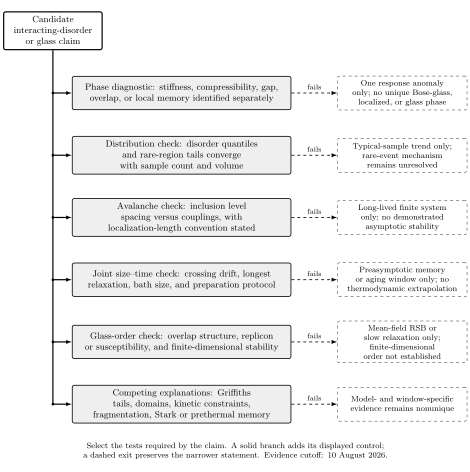
The exact ceiling is with the declared coupling distribution and replica continuation. Finite-range droplets, lower critical dimension, activated dynamics, baths, and experimental waiting times are separate questions. The disorder and glass claim test matrix records that mean-field-to-finite-dimensional boundary.
Exercise
Section titled “Exercise”Locate the classical instability. Expand the replica-symmetric equation for small and determine when a nonzero solution can first appear.
Solution
For small , . Therefore
The linearized eigenvalue crosses one at , or . This finds the onset of the replica-symmetric order parameter; stability below it still requires the replicon test and ultimately replica symmetry breaking.
References
Section titled “References”- S. F. Edwards and Philip W. Anderson, “Theory of Spin Glasses,” Journal of Physics F: Metal Physics 5 (1975) 965–974. DOI
- Jonathan Miller and David A. Huse, “Zero-Temperature Critical Behavior of the Infinite-Range Quantum Ising Spin Glass,” Physical Review Letters 70 (1993) 3147–3150. DOI
- Giorgio Parisi, “A Sequence of Approximated Solutions to the S-K Model for Spin Glasses,” Journal of Physics A: Mathematical and General 13 (1980) L115–L121. DOI
- N. Read, Subir Sachdev, and Jinwu Ye, “Landau Theory of Quantum Spin Glasses of Rotors and Ising Spins,” Physical Review B 52 (1995) 384–410. DOI
Original QFT.org content:CC BY 4.0, unless an item supplies different terms. Third-party material retains its own terms.