

Integrable Quantum Matter and Generalized Hydrodynamics
Integrable quantum matter has infinitely many hydrodynamic degrees of freedom: the local occupation of every stable Bethe quasiparticle species and rapidity. Turning exact scattering data into a prediction requires a consistent finite-volume convention, thermodynamic root densities, a complete charge or overlap description of the state, dressing, Euler and diffusive hydrodynamic order, weak-breaking scales, and a finite-system observation map.
Helpful background. Bethe-integrable gases and spin chains is the recommended microscopic entry. Generalized hydrodynamics for integrable systems supplies the general conservation-law viewpoint.
Enter integrable quantum matter
Section titled “Enter integrable quantum matter”For quasiparticle species and rapidity , the thermodynamic Bethe equations determine available states:
where is physical momentum and rapidity has inverse-length units in the continuum examples, so the factors are explicit. The filling is . With the dressing convention below, this equation implies . A wave-number convention is equally valid, but it must remove the corresponding factors everywhere: root densities, dressing, TBA, charges, currents, and diffusion.
Define dressing by
The central Euler velocity is
Derivatives are taken before dressing. This identity, the species content, and the filling at the local spacetime point jointly define a characteristic.
| Reader goal | Suggested route | Capability at the end |
|---|---|---|
| Build an integrable macrostate | Bethe models → root densities and dressing → complete charges | Translate scattering data into entropy, conserved densities, susceptibilities, and effective velocities |
| Determine a quench steady state | Complete charges → quench action | Compare charge reconstruction with overlap and entropy selection |
| Predict inhomogeneous evolution | Root densities → Riemann/trap GHD → diffusion | Solve ballistic profiles and test positive Navier–Stokes broadening |
| Interpret a platform | Weak breaking → finite-size experimental validation | Separate ideal integrable, prethermal, crossover, finite-system, and measured-observable statements |
From microscopic data to characteristics
Section titled “From microscopic data to characteristics”An integrable model begins with bare momentum, energy, charge eigenvalues, scattering phases, boundary conditions, and quasiparticle species. Finite-volume Bethe equations fix the quantum-number branches. Their thermodynamic limit gives particle and hole root densities and Yang–Yang entropy. A complete charge family maps the macrostate to a GGE; a quench action instead combines initial-state overlaps with entropy. When both descriptions are valid and complete, they select the same root density.
The structure figure makes these dependencies explicit. Inspect the two routes into the macrostate: matching a few charges and computing an overlap saddle are independent checks, not interchangeable labels.
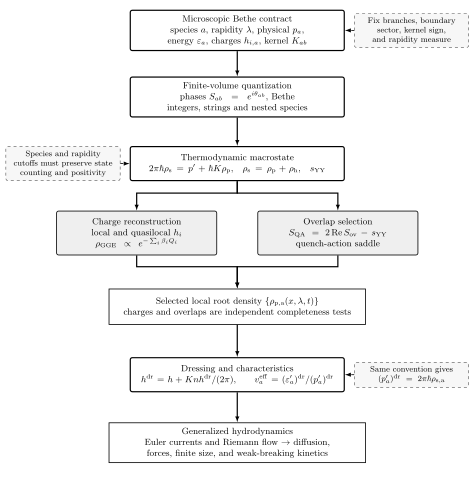
The Bethe-to-GHD dictionary. Rapidity measure, species, kernel sign, entropy, charge completeness, initial-state overlaps, and dressing convention remain linked from finite volume to hydrodynamic characteristics. Original schematic, not to scale.
Nonvisual description of the Bethe-to-GHD structure figure
Section titled “Nonvisual description of the Bethe-to-GHD structure figure”| Figure element or arrow | Relation encoded | Condition or resulting statement |
|---|---|---|
| Microscopic Bethe contract | Specify species , rapidity , physical , energy , charges , and kernel . | The dashed side condition fixes phase branches, boundary sector, kernel sign, and rapidity measure. |
| Microscopic contract → finite-volume quantization | The same data determine phases , Bethe integers, string families, and nested species. | Changing one convention without the others changes the spectrum. |
| Finite volume → thermodynamic macrostate | The thermodynamic limit gives , , and Yang–Yang entropy. | The factors and kernel sign are inherited from the microscopic contract. |
| Thermodynamic side condition | Species and rapidity cutoffs must preserve state counting and positivity. | A nonconverged species truncation is not a complete macrostate. |
| Macrostate → charge-reconstruction branch | Local and quasilocal charge eigenvalues define . | Charge completeness is tested by whether the chosen family reconstructs the root density. |
| Macrostate → overlap-selection branch | Initial-state overlaps and Yang–Yang entropy form . | The quench-action saddle requires normalized overlaps and the correct entropy multiplicity. |
| Charge and overlap branches → selected local root density | Independent charge and overlap descriptions converge on when both are complete. | Agreement is a completeness test; the two inputs are not interchangeable assumptions. |
| Local root density → dressing and characteristics | Dressing gives and . | The dashed identity must hold in the same convention. |
| Dressing → generalized hydrodynamics | The dressed characteristics determine Euler currents and Riemann flow, followed by separately controlled diffusion, forces, finite-size effects, and weak-breaking kinetics. | Each later correction has its own gradient, positivity, rate, or platform window. |
For a local macrostate,
at Euler order. The local-state formulation was independently established for lattice and continuum integrable systems by Bertini et al. 2016, main text and Castro-Alvaredo, Doyon, and Yoshimura 2016, §§2–4. In a partitioning protocol the solution depends on and is selected by the self-consistent sign of . Trap release requires an initial LDA map; a retained trap adds a model-specific rapidity force. Microscopic times, discontinuities only a few correlation lengths wide, and fronts at a boundary lie outside the pure Euler limit.
Diffusion, breaking, and validation
Section titled “Diffusion, breaking, and validation”At first gradient order, interacting quasiparticle fluctuations generate a diffusion operator De Nardis, Bernard, and Doyon 2018, main text and supplemental formulas. In charge variables,
where is the static susceptibility and must be symmetric positive semidefinite. Ordinary diffusion is not universal: symmetry can produce superdiffusion, free dispersion can give edges, and finite resolution can mimic a nonzero intercept or width.
Weak breaking, , adds collision terms and charge relaxation. Rates are often only when force correlators decay rapidly, resonances are resolved inside the slow subspace, and the kinetic Markov approximation is controlled. Doyon et al. 2025, §§I–IV review the current scope of Euler, diffusive, and weakly broken generalized hydrodynamics. The useful hierarchy is
for integrable prethermal dynamics. A later crossover is not automatically the final thermal state.
The validity figure shows the complete escalation from an ideal Euler profile to a platform claim. Inspect the dashed exits: a finite-time prethermal agreement, a diffusion fit, and asymptotic thermalization are different conclusions.
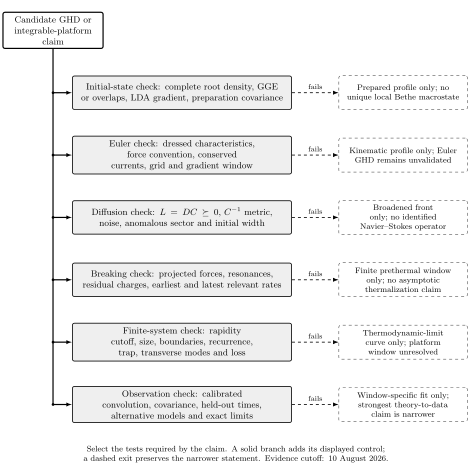
Validity map for integrable hydrodynamics. Euler flow, diffusive broadening, prethermal persistence, weak-breaking crossover, and experimental validation require progressively more controls. Original schematic, not to scale; mutable experimental evidence is assessed through 10 August 2026.
Nonvisual description of the integrable-matter validity figure
Section titled “Nonvisual description of the integrable-matter validity figure”A candidate GHD or integrable-platform claim branches to the checks required by its scope. Each solid branch adds the stated control, while the corresponding dashed exit preserves the strongest narrower conclusion when the check fails.
| Test selected | Control added by the solid branch | Dashed-exit conclusion when the test fails |
|---|---|---|
| Initial-state check | Establish a complete root density, GGE or overlaps, LDA gradient, and preparation covariance. | A prepared profile does not uniquely determine a local Bethe macrostate. |
| Euler check | Test dressed characteristics, the force convention, conserved currents, grid convergence, and the gradient window. | A kinematic profile alone does not validate Euler GHD. |
| Diffusion check | Require , the metric, noise convention, anomalous-sector analysis, and calibrated initial width. | A broadened front alone does not identify a Navier–Stokes operator. |
| Breaking check | Project forces onto slow modes and resolve resonances, residual charges, and the earliest and latest relevant rates. | The result is a finite prethermal window, not an asymptotic thermalization claim. |
| Finite-system check | Converge rapidity cutoff and size while bounding boundaries, recurrence, trap, transverse modes, and loss. | A thermodynamic-limit curve does not determine the experimental platform window. |
| Observation check | Calibrate convolution and covariance and test held-out times, alternatives, and exact limits. | A window-specific fit supports only a narrower theory-to-data statement. |
The validity relations above use the evidence cutoff 10 August 2026.
Integrable-matter claim test matrix
Section titled “Integrable-matter claim test matrix”| Description or claim | Quasiparticles and charges | Dressing and entropy | Initial-state input | Euler or diffusive observable | Breaking and finite size | Validation test |
|---|---|---|---|---|---|---|
| Cross-chapter contract | Species, rapidity measure, physical , , , and charge basis fixed | One kernel sign and explicit convention; Yang–Yang counting stated | GGE, overlap, LDA, or measured root density identified | Hydrodynamic order and measured quantity declared | Earliest and latest relevant breaking times, , boundaries, and losses bounded | Exact charge, entropy, grid, held-out, and observation-map checks |
| Finite-volume Bethe model | Real roots or declared string/nested species; branch quantum numbers | No thermodynamic dressing yet | Boundary condition and symmetry sector | Spectrum, energy, momentum, and form-factor input | Exponential/string and algebraic corrections | Exact diagonalization and state counting at several |
| Root-density macrostate | , for every retained species | ; | Thermodynamic eigenstate or local ensemble | Charge densities, currents, susceptibilities, | Species and rapidity cutoff; finite-volume spacing | Bethe equation, positivity, sum rules, cutoff convergence |
| Charge-complete GGE | Local and quasilocal span root-density space | TBA saddle and covariance from the same convention | Initial charge densities and symmetries | Stationary local observables | Finite charge set leaves inverse null directions | Rank, held-out charges, quench-action or time-evolution comparison |
| Quench-action steady state | Bethe species allowed by nonzero overlaps | Normalized initial-state overlaps and selection rules | Stationary local observables and excitations | Subextensive overlap, degeneracy, recurrence | Finite-size diagonal sums, charge reconstruction, direct dynamics | |
| Euler Riemann or trap GHD | Local fillings for all species and dressed velocities | Left/right GGE or calibrated initial LDA profile | Ballistic density and current profile | Gradient, boundary, force, , breaking time | Charge conservation, grid refinement, alternate initial reconstruction | |
| Diffusive GHD | Same species plus scattering-shift fluctuations | symmetric positive; entropy production nonnegative | Smooth local macrostate and calibrated initial width | broadening and Navier–Stokes currents | Anomalous sector, free dispersion, finite time and resolution | Positivity, null modes, exact limits, multi-time shared fit |
| Weakly broken integrability | Nearly conserved charges plus exact residual charges | Slow-mode susceptibility and collision entropy | Prepared prethermal macrostate | Rate matrix or collision-corrected GHD | Resonances, secular terms, rare processes, bath, heating | scaling, size scaling, several modes and late times |
| Experimental integrable matter | Platform-calibrated quasiparticle model and observable | Thermodynamic and hydrodynamic solver covariance | Trap, temperature, interaction, preparation, transverse modes | Convolved density, momentum, correlation, or current data | Atom number, boundaries, loss, breaking, recurrence | Independent calibration, held-out times, alternative model, exact cutoff |
The two artifact-specific tables above are the nonvisual equivalents of the figures and preserve their nodes, arrows, conditions, and failed-test exits. The claim test matrix is a chapter-level comparison of descriptions and validation ceilings; it does not reproduce either figure’s graph topology.
Guide to the pages
Section titled “Guide to the pages”- Bethe-Integrable Quantum Gases and Spin Chains fixes scattering, quantization, rapidity, string, energy, momentum, and boundary conventions.
- Root Densities, Macrostates, and Model Observables derives thermodynamic Bethe equations, dressing, entropy, charges, and the effective velocity.
- Integrable Charges and Generalized-Ensemble Model Tests tests whether local and quasilocal charges reconstruct the full macrostate.
- Quench Action and Integrable Steady States combines overlap large deviations and Yang–Yang entropy to select a stationary root density.
- Generalized-Hydrodynamic Riemann Problems and Trap Expansions solves Euler characteristics for bipartitions and trapped gases.
- Diffusive GHD Corrections as Model Benchmarks adds positive Navier–Stokes and fluctuation corrections and separates anomalous sectors.
- Weak Integrability Breaking and Hydrodynamic Crossover derives slow-charge rates and collision terms with a controlled prethermal window.
- Finite-Size and Experimental Validation of Integrable Matter propagates platform, boundary, finite-size, resolution, and covariance into evidence.
Review the chapter
Section titled “Review the chapter”Dressing check. In the Tonks–Girardeau limit of the repulsive Lieb–Liniger gas, . Then , dressing is the identity, and
This simultaneously checks the state measure and the momentum derivative.
Hydrodynamic order. A front moves a distance and has measured variance . Euler GHD controls the center at order ; diffusion controls the width only after initial and imaging widths are fixed. A fit over one time cannot separate the three terms.
Evidence limits. The durable experimental conclusion is tied to the calibrated model, initial state, size, time, and observable map. Current evidence is assessed through 10 August 2026. The dated Quantum Matter and Emergence Research synthesis carries later platform results and corrections. A reproducible verification workflow should cover dressing, Riemann flow, diffusion, weak breaking, finite size, and resolution.
References
Section titled “References”- Bertini, B., Collura, M., De Nardis, J., and Fagotti, M. (2016). “Transport in out-of-equilibrium XXZ chains: Exact profiles of charges and currents.” Physical Review Letters 117, 207201. doi:10.1103/PhysRevLett.117.207201.
- Castro-Alvaredo, O. A., Doyon, B., and Yoshimura, T. (2016). “Emergent hydrodynamics in integrable quantum systems out of equilibrium.” Physical Review X 6, 041065. doi:10.1103/PhysRevX.6.041065.
- De Nardis, J., Bernard, D., and Doyon, B. (2018). “Hydrodynamic diffusion in integrable systems.” Physical Review Letters 121, 160603. doi:10.1103/PhysRevLett.121.160603.
- Doyon, B., Gopalakrishnan, S., Møller, F. S., Schmiedmayer, J., and Vasseur, R. (2025). “Generalized hydrodynamics: A perspective.” Physical Review X 15, 010501. doi:10.1103/PhysRevX.15.010501.
Original QFT.org content:CC BY 4.0, unless an item supplies different terms. Third-party material retains its own terms.