

Resonant Interactions and Universal Quantum Gases
A resonant quantum gas is universal only relative to a declared hierarchy of scales. The scattering length may dominate two-body physics, but effective range, resonance width, a three-body parameter, confinement, temperature, density, and loss can enter at the same accuracy. This chapter turns measured few-body information into bounded many-body predictions and identifies when a new physical input is required. The zero-range hierarchy and its three-body exception are reviewed in Braaten and Hammer 2006, §§2–3.
Helpful background. Short-Range Scattering Data as Many-Body Inputs is the working starting point. Power Counting and Predictive Order explains how a scale hierarchy becomes an error estimate.
Enter this chapter
Section titled “Enter this chapter”The basic workflow has four steps:
- match regulator-dependent couplings to observable few-body data;
- identify all dimensionless expansion parameters at the many-body scale;
- propagate range, three-body, thermal, confinement, and loss effects to the observable; and
- stop at the strongest conclusion supported by that combined uncertainty.
The two-body amplitude is developed here only to the extent needed as a many-body input. General scattering theory and few-body effective-field-theory machinery are treated in their dedicated volumes. Current experimental records and unstable-phase claims require separate evidence review.
Choose the physical inputs
Section titled “Choose the physical inputs”| Regime or question | Minimal inputs | Small parameters or hierarchy | First failure signal |
|---|---|---|---|
| Broad three-dimensional two-component Fermi gas | , mass, density, temperature | or | range sensitivity or new channel |
| Finite-width resonance | , effective range or , detuning, coupling convention | for broad-resonance reduction | closed-channel and energy dependence become leading |
| Resonant identical bosons | , three-body parameter , inelasticity | separation of range, density, and loss times | three-body loss or dependence at leading order |
| Quasi-one-dimensional gas | three-dimensional scattering data and transverse spectrum | collision energy below transverse gap | excited transverse modes or confinement-induced range |
| High-temperature dilute gas | two- and three-body spectra and phase shifts | fugacity | successive virial terms cease to decrease |
| Universal relation | declared contact normalization and zero-range limit | probe momentum between many-body and range scales | range operators or final-state interactions contaminate tail |
Readiness diagnostic
Section titled “Readiness diagnostic”- If a bare contact coupling still appears in a proposed observable, begin with scattering-length matching.
- If or an energy-dependent detuning may be important, continue through effective range and two-channel models.
- If identical bosons or three distinguishable particles are resonant, establish the three-body parameter before making a many-body universality claim.
- If the gas is dilute and hot, the virial expansion may be more controlled than a low-temperature resummation.
- If loss competes with equilibration, treat the state as time dependent and use the metastable Bose analysis.
The structure map shows how independently measured two- and three-body inputs reach a many-body observable.
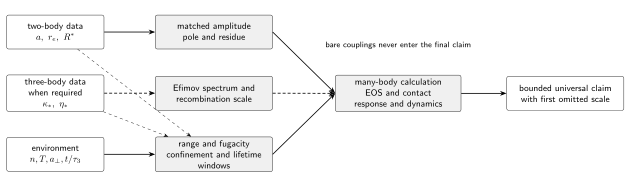
Observable scattering data replace bare couplings. The many-body prediction is universal only after range, thermal, and environmental scales are compared with the momentum or energy probed. The dashed three-body branch applies only when the species and resonant channels require Efimov or inelasticity data. The diagram is schematic and not to scale.
Guide to the pages
Section titled “Guide to the pages”- Short-Range Scattering Data as Many-Body Inputs matches a cutoff contact interaction to and the shallow dimer pole.
- Effective Range, Shallow Poles, and Universality Windows adds and shape parameters with a controlled momentum domain.
- Two-Channel Resonance Models makes resonance width and closed-channel dynamics explicit.
- Efimov Physics and the Three-Body Parameter derives discrete scaling and explains why is insufficient for resonant bosons.
- Universal Relations and Tan Contact links a short-distance operator to momentum tails, energy derivatives, and pressure.
- Dimensional Crossover and Confinement-Induced Resonances matches three-dimensional scattering through a transverse-mode Green function.
- Few-Body Data in the Virial Expansion relates phase shifts and cluster spectra to high-temperature thermodynamics.
- Resonant Bose Matter and Metastable Branches compares equilibration, many-body, range, and loss times before assigning an equilibrium interpretation.
- From Few-Body Inputs to Many-Body Predictions constructs a combined uncertainty and a stopping rule.
Comparison of claims and validity conditions
Section titled “Comparison of claims and validity conditions”This is the chapter’s canonical semantic table. Each row states the physical input, the domain in which it controls a many-body quantity, and the first omitted effect that can invalidate the claim.
Table: resonant-gas claims, controlling inputs, and independent checks.
| Claim | Required physical input | Declared control regime | Independent check | Ceiling on the conclusion |
|---|---|---|---|---|
| A contact theory predicts two-body scattering | and a fixed regulator prescription | cutoff independence after matching and pole position | Leading zero-range amplitude only | |
| A shallow pole is universal beyond leading order | , , and retained shape terms | omitted terms small at | pole and residue stable under next-order variation | Stated effective-range order |
| A resonance is broad for the gas | width parameter such as | and relevant collision energies small | compare one- and two-channel predictions | Broad-resonance observables in tested window |
| A bosonic observable is universal | , , and inelasticity information | range separated and observation precedes loss | three-body-parameter and lifetime variation | Metastable, protocol-specific result |
| A tail measures contact | contact convention and probe response | adiabatic or pressure relation using same contact | Leading short-distance coefficient | |
| A confined gas is effectively one dimensional | 3D scattering data and transverse spectrum | energy and temperature below transverse gap | include the first omitted transverse mode | Low-energy effective coupling |
| A virial result is controlled | cluster data through order | with decreasing terms | next coefficient or fugacity-window stability | Thermodynamics through the retained order |
| Few-body data suffice for an equation of state | all symmetry-allowed inputs at target order | every range, thermal, loss, and medium ratio bounded | regulator/order/parameter covariance and benchmark | Observable and regime explicitly tested |
From hierarchy to bounded prediction
Section titled “From hierarchy to bounded prediction”The validity map emphasizes that the unitary limit removes one length but does not remove every length. Effective range and resonance width remain in two-body physics; enters resonant three-body sectors; confinement supplies a geometric length; and loss supplies a time scale.
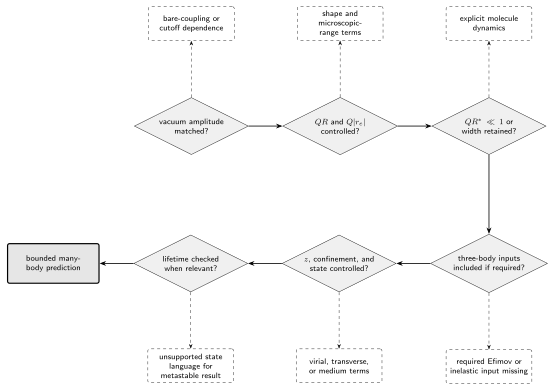
Unitarity is one gate rather than the endpoint. A prediction is bounded by the largest unresolved correction among range, width, thermal, confinement, and numerical effects, together with three-body or loss effects when the species, channel, and protocol make them relevant. The figure is schematic and does not rank their typical size.
Review the chapter
Section titled “Review the chapter”Matching. Derive from the zero-energy amplitude and show that the shallow pole is independent of at the matched order.
Scale assessment. Given , , , , and , form every dimensionless ratio relevant to a specified observable. Explain which parameter controls the leading omitted operator.
Cross-check. Extract a contact from a momentum tail and from an energy derivative using one normalization. Disagreement beyond range and experimental uncertainty rules out a universal interpretation.
Metastability. Compare , an estimated equilibration time, and . State whether equilibrium, prethermal, or only short-time language is justified.
Synthesis. Propagate correlated uncertainties in , , and through a chosen equation of state, add truncation and loss effects, and give the strongest surviving claim.
Continue
Section titled “Continue”Cooper Instability and Pairing uses the matched amplitude in the particle–particle channel. Few-Body and Nuclear EFT develops the three-body renormalization framework. Open QFT and Driven Dynamics treats loss and reduced evolution systematically.
References
Section titled “References”- Braaten, Eric, and Hans-Werner Hammer. “Universality in Few-Body Systems with Large Scattering Length.” Physics Reports 428 (2006): 259–390. DOI.
Further reading
Section titled “Further reading”- Chin, Cheng, Rudolf Grimm, Paul Julienne, and Eite Tiesinga. “Feshbach Resonances in Ultracold Gases.” Reviews of Modern Physics 82 (2010): 1225–1286. DOI.
- Tan, Shina. “Energetics of a Strongly Correlated Fermi Gas.” Annals of Physics 323 (2008): 2952–2970. DOI.
- Werner, Félix, and Yvan Castin. “General Relations for Quantum Gases in Two and Three Dimensions. II. Bosons and Mixtures.” Physical Review A 86 (2012): 053633. DOI.
Original QFT.org content:CC BY 4.0, unless an item supplies different terms. Third-party material retains its own terms.