

Pairing, Superfluidity, and Superconductivity
Pairing, superfluidity, and superconductivity answer different questions. Pairing describes a correlated two-fermion channel or a paired saddle. Superfluidity additionally requires phase rigidity—the free-energy cost of a slow twist—while superconductivity requires the gauge-invariant electromagnetic response of charged matter. A spectral gap alone does not establish phase coherence, Meissner screening, a microscopic mechanism, or topology. This chapter develops those layers from the weak-coupling instability to vortices, retarded interactions, unconventional and topological pairing, and the evidence standards for Majorana platforms.
The chapter applies response theory to paired matter; general Kubo and limit-order methods are developed separately. Holographic superconductors are distinct large- constructions, and rapidly changing device claims remain on the dated Majorana evidence page.
Helpful background. The Cooper instability is the quickest entry if pairing eigenchannels are new. Landau Fermi-liquid theory supplies the normal-state quasiparticle and density-of-states language used in weak coupling.
Enter paired matter
Section titled “Enter paired matter”The main route is constructive: derive the instability and saddle, encode it in Nambu space, identify physical response, and only then ask what further evidence is needed for a mechanism or topological claim. Comfort with diagonalizing a two-level Hermitian matrix is enough to begin. The chapter itself teaches how to distinguish global-symmetry breaking from a gauge choice and how to identify the scale hierarchy controlling an approximation.
Arrows in the table indicate a useful reading order within one branch, not a logical implication between different claims. Semicolons separate branches that can be studied independently.
| Reader goal | Suggested route | Capability at the end |
|---|---|---|
| Graduate core | Cooper instability → BCS saddle → Nambu propagator → collective modes → stiffness | Derive the gap equation and quasiparticle spectrum, then distinguish order, stiffness, and observable poles |
| Electromagnetic and defect response | Stiffness → Meissner response; vortices → fluxoid and Josephson effects | Use gauge-covariant phase gradients, Ward identities, and winding to predict response |
| Retarded and crossover pairing | Migdal validity → Eliashberg equations; separately, BCS–BEC crossover | State the controlling scale hierarchy and identify where weak-coupling, quasiparticle, or saddle-point assumptions fail |
| Unconventional and topological claims | Symmetry diagnostics and mechanism comparison; independently, topological BdG theory → Majorana evidence | Separate a relative gap phase, crystal representation, mechanism, bulk invariant, boundary mode, and platform demonstration |
From the Cooper channel to gauge-invariant response
Section titled “From the Cooper channel to gauge-invariant response”For an illustrative translation-invariant, even-parity spin-singlet saddle, choose the reduced Nambu block
The Pauli matrices act in this particle–hole space, and is a fermionic Matsubara frequency. In the site’s natural units, writing gives
This compact matrix does three jobs but proves only conditional statements. Its off-diagonal entries encode anomalous propagation: they transform under the physical global number symmetry of a neutral fluid and are gauge covariant in a charged theory. Its determinant gives Bogoliubov–de Gennes (BdG) poles, and its vertices enter response functions. A change of Nambu basis can reverse off-diagonal signs, while a single global gauge rotation removes only one common gap phase; multiband, spin–orbit-coupled, or intrinsically complex order generally requires a larger pairing matrix. The partners are redundant labels in the enlarged Nambu description, so thermodynamic traces must remove that duplication exactly once. Bardeen, Cooper, and Schrieffer 1957, §§II–V and Nambu 1960, §§II–IV give the foundational saddle and gauge-covariant matrix constructions.
A physical superfluid or superconducting claim still requires phase rigidity. Under and , where is the signed pair charge, the invariant combination is . A phase-only free energy therefore begins as
Here is the helicity-modulus tensor for the pair phase, not a particle-number or mass density. For a neutral phase with conserved , nonzero stiffness, and no explicit phase locking, the long-wavelength phase mode is gapless. In charged matter, long-range Coulomb forces reorganize the longitudinal phase–density mode—raising it to the plasma scale in a three-dimensional bulk—whereas a nonzero static transverse current kernel produces Meissner screening. Anderson 1958, pp. 827–835 and Nambu 1960, §§III–IV establish this response distinction; lower-dimensional electromagnetic environments can have different collective-mode dispersions.
Winding quantizes circulation in a neutral superfluid and the gauge-invariant fluxoid in a charged ring. Bare magnetic flux approaches an integer multiple of the flux quantum only when the contour-current contribution is negligible, as distinguished in Byers and Yang 1961, pp. 46–49 and Tinkham 2004, §4.5.1, pp. 127–128. Amplitude, relative-phase, vortex-core, and boundary modes require additional dynamical and spatial information. The figure traces these dependencies and marks the points where a new hypothesis enters.
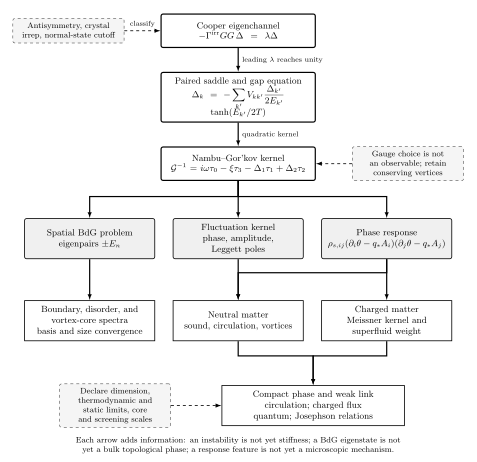
The paired-matter dictionary. A Cooper eigenvalue licenses an instability, the saddle licenses a conditional quasiparticle spectrum, and gauge-invariant stiffness licenses phase response. Defects, electromagnetic screening, fluxoid sectors, and boundary spectra require the additional dimensional, charge, and boundary data shown. Original schematic, not to scale.
Download the structure map as SVG or inspect its machine-readable relations.
Where stronger claims can fail
Section titled “Where stronger claims can fail”Three transitions in reasoning deserve special care. First, Migdal suppression of selected vertex corrections is a scale-and-kinematics statement, not a universal consequence of a small phonon frequency: the phonon-to-electronic recoil ratio, coupling, momentum transfer, bandwidth, and starting electronic state must be checked. Migdal 1958, pp. 996–998, Eqs. (7)–(9), PDF gives the original expansion, while Carbotte 1990, §§I–III relates the controlled retarded framework to strong-coupling observables. Second, an unconventional gap symmetry restricts the pairing kernel but does not uniquely identify a microscopic interaction; Sigrist and Ueda 1991, §II, pp. 240–252 makes the representation-level statement precise. Third, a BdG bulk invariant implies the corresponding boundary or defect spectral flow only for a local, ultraviolet-complete gapped Hamiltonian with the protecting symmetry and an interface across which the invariant changes. It does not establish that a particular device realizes that Hamiltonian or protects a resolvable zero mode; the minimal model construction in Kitaev 2001, §§2–3 and the dated platform evidence record keep those claims separate.
The validity map is organized as seven independent claim-specific stopping rules selected from a shared spine. Follow a solid branch only while that branch’s declared controls and negative tests pass; its dashed exit means that a narrower statement may remain true while the stronger conclusion is no longer licensed. The layout does not make one branch a prerequisite for another.
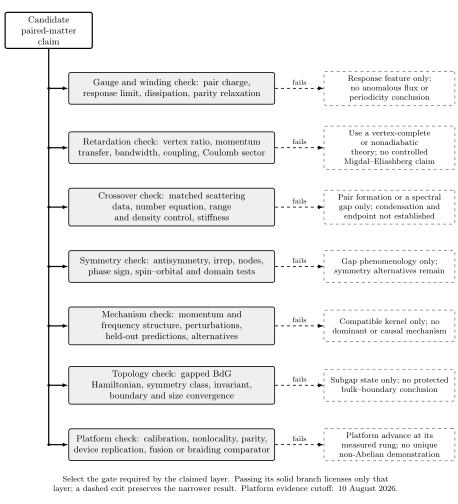
Validity and failure map for paired matter. Gauge and winding, controlled Migdal–Eliashberg theory, BCS–BEC interpretation, symmetry, microscopic mechanism, a topological BdG phase, and a protected Majorana platform are independent claim-specific tests rather than a temporal sequence. Original schematic, not to scale; platform evidence is bounded through 23 August 2026.
Download the validity map as SVG or inspect its machine-readable gates.
Paired-matter claim test matrix
Section titled “Paired-matter claim test matrix”Read each row from left to right. For example, an attractive Cooper eigenvalue is the input; a growing pair susceptibility is the calculated consequence; fixed cutoff and normalization are the controls; and pair breaking that stops the logarithm is the negative test that lowers the claim. The same grammar prevents a spectrum, response feature, or fitted model from being promoted beyond what its controls establish.
| Claim or regime | Defining input | Observable or invariant | Necessary control | Decisive negative test or ceiling |
|---|---|---|---|---|
| Cooper instability | Attractive eigenvalue of the antisymmetrized Fermi-surface kernel | Diverging normal-state pair susceptibility and instability scale , or mean-field within a saddle approximation | Density-of-states, cutoff, and channel normalization fixed | Pair breaking or competing flow cuts off the logarithm before the claimed scale |
| BCS paired saddle | Gap function, dispersion, interaction, and ensemble | , coherence factors, gap and number equations | Saddle stability and ultraviolet matching | Negative fluctuation mode, violated number constraint, or cutoff-dependent observable |
| Nambu or BdG spectrum | Pairing matrix, Nambu convention, and boundary conditions | Poles, local density of states, and particle–hole-related eigenpairs | No double counting; complete basis and converged geometry | The complete numerical BdG eigenspectrum lacks its -related partner, finite-size splitting is unresolved, or a claimed observable is gauge dependent |
| Collective mode | Zero of the analytically continued fluctuation kernel | Phase, amplitude, or relative-phase pole and residue | Conserving vertices, continuum threshold, and damping included | Response maximum moves with background model or lies inside an unresolved continuum |
| Superfluid stiffness | Free-energy curvature under a twist | Pair-phase helicity modulus or static transverse phase response | Thermodynamic and static limits declared | Curvature vanishes after size extrapolation although a pairing gap remains |
| Meissner response | Gauge-invariant current kernel | Static transverse screening kernel and penetration depth; optical delta or missing-area weight only after translating the limit order | Set before ; retain contact and paramagnetic terms; enforce Ward and sum rules; separate ballistic weights | A normal-state kernel survives spuriously, spectral weight is unaccounted for, or the result changes under a gauge-consistent reformulation |
| Vortex, fluxoid, or Josephson response | Compact phase, pair charge, geometry, and weak-link model | Winding, fluxoid sectors, current–phase relation, and voltage–frequency relation | Core scale, screening, capacitance, dissipation, and parity relaxation stated | Phase slips, trapped flux, ordinary harmonics, or poisoning explain the signal |
| Migdal–Eliashberg regime | Retarded interaction spectrum and electronic structure | Frequency-dependent , , gap, and thermodynamics | Vertex ratio, momentum structure, bandwidth, coupling, and Coulomb treatment controlled | Vertex or nonadiabatic corrections are not small, or inversion is nonunique |
| BCS–BEC crossover | Matched scattering data, density, and number equation | Chemical potential, pair size, and excitation spectrum; the condensation transition only after a fluctuation or stiffness calculation | Range and density parameters; pairing distinguished from condensation | Pseudogap or molecular population is promoted to phase coherence without stiffness |
| Unconventional symmetry | Antisymmetry, crystal irrep, and spin–orbital structure | Nodes, relative phase sign, spin response, and symmetry-resolved perturbations | Domains, matrix elements, disorder, and surface reconstruction modelled | A different irrep or accidental-node state fits the same joint data |
| Microscopic mechanism | Irreducible pairing kernel and competing channels | Momentum- and frequency-resolved predictions under controlled perturbations | Common likelihood, calibrated nuisance terms, and held-out observables | Only or gap symmetry is fitted, or mixed mechanisms remain viable |
| Topological BdG phase | Local ultraviolet-complete gapped BdG Hamiltonian, protecting symmetry, and an interface or defect to a phase with a different invariant | Bulk invariant and boundary or defect spectral flow | Gap, locality, interface, symmetry, and finite-size convergence | The relevant gap closes, the protecting symmetry is absent, or the state is removable by a local symmetry-preserving perturbation |
| Majorana platform | Calibrated device forward model and parity sector | Nonlocal end correlation, parity dynamics, fusion, or braiding operation | Parent gap, disorder, temperature, transfer function, device replication, and trivial comparators | Local zero-bias, tune-up, or minimal-chain parity signal remains reproducible by Andreev, Kondo, disorder, or ordinary dynamics |
The surrounding prose, relationship-oriented alternative text, and matrix together provide a nonvisual account of both diagrams. They preserve the difference between a model calculation, a gauge-invariant response, a controlled approximation, a topological statement, and a date-bounded platform inference. Download the matrix as machine-readable JSON.
Guide to the pages
Section titled “Guide to the pages”Paired saddle, propagators, and collective modes
Section titled “Paired saddle, propagators, and collective modes”- The Cooper Instability and Pairing Channels derives the logarithmic instability and classifies antisymmetrized pairing eigenfunctions.
- BCS Mean-Field Theory and the Gap Equation constructs the paired saddle, spectrum, coherence factors, thermodynamics, and self-consistency equations.
- Nambu–Gor’kov Green Functions and Anomalous Propagators organizes normal and anomalous propagation while keeping gauge-dependent quantities distinct from observables.
- Bogoliubov–de Gennes Theory in Inhomogeneous Systems treats boundaries, vortices, disorder, and the particle–hole redundancy of real-space eigenproblems.
- Phase, Amplitude, and Leggett Collective Modes derives fluctuation kernels and the conditions for observable poles.
Phase rigidity, electromagnetic response, and defects
Section titled “Phase rigidity, electromagnetic response, and defects”- Superfluid Order and Phase Stiffness separates paired order, helicity modulus, phase stiffness, and neutral response.
- Gauge-Invariant Meissner Response and Superfluid Weight combines current vertices, Ward identities, and sum rules to establish charged response.
- Vortices and Topological Defects in Paired Matter develops winding, core structure, energetics, and dimensional dependence.
- Phase Winding, Flux Quantization, and Josephson Effects derives fluxoid sectors and weak-link dynamics from the gauge-covariant phase.
Retardation, crossover, and unconventional pairing
Section titled “Retardation, crossover, and unconventional pairing”- Migdal’s Theorem and Vertex-Correction Validity states the scale and kinematic conditions suppressing selected electron–phonon vertex corrections.
- Eliashberg Equations and Retarded Pairing derives frequency-dependent normal and anomalous self-energies with a controlled interpretation boundary.
- The BCS–BEC Crossover follows pairs from overlapping Cooper states to composite bosons without conflating pair formation and condensation.
- Unconventional Pairing Symmetries and Diagnostics classifies gap structure and combines phase-, node-, and spin-sensitive tests.
- Unconventional Pairing Mechanisms and Competing Evidence compares phonon, spin, charge, excitonic, orbital, and mixed kernels using discriminating observations.
Topology and platform evidence
Section titled “Topology and platform evidence”- Topological BdG Superconductors and Boundary Modes relates symmetry class and bulk invariant to boundary and defect solutions.
- Majorana Platforms and Evidence Standards evaluates platform observables against Andreev, Kondo, disorder, and device-specific alternatives.
Review the chapter
Section titled “Review the chapter”1. Locate the quasiparticle poles
Section titled “1. Locate the quasiparticle poles”Starting from the displayed Nambu matrix, compute its determinant, continue , and show that its retarded poles occur at . Explain why those poles establish the spectrum of the assumed saddle but do not alone establish phase stiffness.
Solution
Using and gives . After , the retarded denominator vanishes at . The calculation assumes a paired saddle and fixes only its conditional quasiparticle spectrum. Stiffness is instead the curvature of the free energy under a spatial twist, or the corresponding gauge-invariant response; fluctuations can destroy that curvature even when a local pairing scale survives.
2. Translate a Nambu convention
Section titled “2. Translate a Nambu convention”Change the sign of the hole component by defining . Which entries of change sign? Show that the determinant, poles, and rule for removing Nambu double counting are unchanged.
Solution
The transformed kernel is . Since while , both off-diagonal gap terms reverse sign and the frequency and dispersion terms do not. Conjugation by the unitary matrix leaves the determinant and eigenvalues invariant. The change is only a basis convention: it neither adds a state nor removes the redundant representation, so the same de-duplication rule applies to thermodynamic traces.
3. Separate relative phase from mechanism
Section titled “3. Separate relative phase from mechanism”Phase-sensitive evidence establishes a sign reversal between specified Fermi-surface regions, and a sharp spin resonance appears below . What is established, and what remains unproved?
Solution
Together, the observations constrain the relative gap phase—conditional on the probe forward models—and are compatible with a spin-exciton or spin-fluctuation description. They do not by themselves select a nontrivial crystal representation: a sign-changing state can transform trivially. Nor do they show that spin fluctuations caused the pairing, because the resonance may be feedback from the superconducting state. A mechanism claim additionally needs calibrated normal-state spectra, quantitative momentum- and frequency-dependent predictions, controlled perturbations, held-out observables, and comparisons with phonon, charge, orbital, feedback, and mixed-channel alternatives.
4. Set the ceiling on a zero-bias signal
Section titled “4. Set the ceiling on a zero-bias signal”A finite device shows a stable zero-bias peak at one end. What additional evidence is needed before calling it a protected Majorana pair or a non-Abelian platform?
Solution
First require a calibrated gapped regime, the opposite-end and bulk response, length and independent local-gate tests, parity lifetime and readout, and replication across devices. A non-Abelian claim additionally needs order-dependent noncommuting operations reconstructed on a protected degenerate subspace, with splitting, leakage, readout backaction, and ordinary dynamical phases bounded. Spectra and response must be compared with smooth Andreev states, Kondo physics where applicable, disorder, orbital gap collapse, and instrumental alternatives. The dated Majorana Platforms and Evidence Standards page carries the changing evidence record.
References
Section titled “References”- Altland, A., and Simons, B. (2023). Condensed Matter Field Theory, 3rd ed. Cambridge University Press, chs. 6 and 9. doi:10.1017/9781108781244.
- Anderson, P. W. (1958). “Coherent excited states in the theory of superconductivity: Gauge invariance and the Meissner effect.” Physical Review 110, 827–835. doi:10.1103/PhysRev.110.827.
- Bardeen, J., Cooper, L. N., and Schrieffer, J. R. (1957). “Theory of superconductivity.” Physical Review 108, 1175–1204. doi:10.1103/PhysRev.108.1175.
- Byers, N., and Yang, C. N. (1961). “Theoretical considerations concerning quantized magnetic flux in superconducting cylinders.” Physical Review Letters 7, 46–49. doi:10.1103/PhysRevLett.7.46.
- Carbotte, J. P. (1990). “Properties of boson-exchange superconductors.” Reviews of Modern Physics 62, 1027–1157. doi:10.1103/RevModPhys.62.1027.
- de Gennes, P. G. (1999). Superconductivity of Metals and Alloys. Westview Press. doi:10.1201/9780429497032.
- Kitaev, A. Y. (2001). “Unpaired Majorana fermions in quantum wires.” Physics-Uspekhi 44, 131–136. doi:10.1070/1063-7869/44/10S/S29.
- Leggett, A. J. (2006). Quantum Liquids: Bose Condensation and Cooper Pairing in Condensed-Matter Systems. Oxford University Press. doi:10.1093/acprof:oso/9780198526438.001.0001.
- Migdal, A. B. (1958). “Interaction between electrons and lattice vibrations in a normal metal.” Soviet Physics JETP 7, 996–1001. Open PDF.
- Nambu, Y. (1960). “Quasi-particles and gauge invariance in the theory of superconductivity.” Physical Review 117, 648–663. doi:10.1103/PhysRev.117.648.
- Sigrist, M., and Ueda, K. (1991). “Phenomenological theory of unconventional superconductivity.” Reviews of Modern Physics 63, 239–311. doi:10.1103/RevModPhys.63.239.
- Tinkham, M. (2004). Introduction to Superconductivity, 2nd ed. Dover Publications, chs. 3–6. Publisher record.
Original QFT.org content:CC BY 4.0, unless an item supplies different terms. Third-party material retains its own terms.