

Fermi Surfaces and Fermi Liquids
A claim about a Fermi system is controlled by one of three logically different structures: a measured Fermi-surface observable, a theorem with explicit symmetry and topology hypotheses, or a channel-specific instability criterion. Landau theory connects the first structure to thermodynamics and collective response; patch methods organize the third. Neither supplies the hypotheses of the second automatically Baym and Pethick 1991, chs. 1–3.
This chapter covers Fermi-surface kinematics, Landau quasiparticles, microscopic pole criteria, Luttinger counting, collisionless response, patch scaling, and weak-coupling instability analysis. Mott physics, paired phases, and generic RG formalism are developed in separate chapters.
Helpful background. Fermi-gas and Fermi-surface kinematics supplies density-of-states and phase-space conventions; quasiparticles, lifetimes, and sum rules supplies the Green-function pole criterion used below.
Enter this chapter
Section titled “Enter this chapter”Begin with Fermi-gas kinematics if you cannot yet translate between , , and the spin-resolved or total density of states. Readers who already know the free surface but need a pole criterion should review quasiparticle poles and lifetimes before Landau theory.
| Reader goal | Suggested route | Capability at the end |
|---|---|---|
| Graduate core | Fermi gas → Landau liquid → microscopic self-energy → response | Translate , , Landau parameters, compressibility, susceptibility, and zero sound |
| Theorem validity | Fermi gas → self-energy → Luttinger theorem | State the volume count and identify broken-symmetry, topological, and singular failure modes |
| Weak-coupling instabilities | Fermi gas → patch scaling → functional RG → instability criteria | Separate a regulated flow tendency from a thermodynamic ordered phase |
| Focused nematic or density-wave diagnosis | Landau liquid → response → Pomeranchuk/density waves | Distinguish a shape deformation from finite- order |
From a surface to observables
Section titled “From a surface to observables”The first map follows the durable chain: Pauli filling creates a codimension-one surface; interactions produce a pole only if its width is parametrically smaller than its energy; the forward vertex becomes Landau parameters; response and volume counting then require different limits and hypotheses.
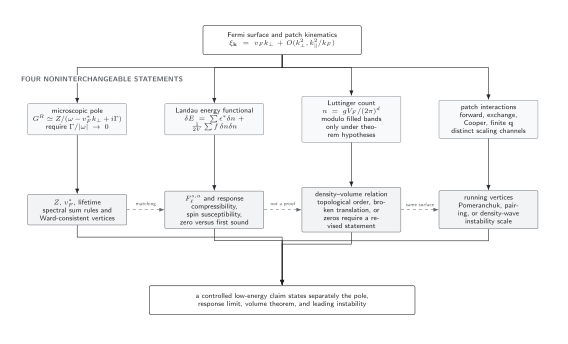
The Fermi-liquid dictionary. The diagram is schematic: quasiparticle residue, effective mass, thermodynamic density of states, and Fermi volume are related only under the displayed symmetry and Ward-identity conditions.
The second map begins with low-energy patches and separates forward, Cooper, and finite-wavevector channels. Its terminal boxes are tests, not phase labels: angular stability, pole location relative to a continuum, truncation drift, or a susceptibility divergence with finite-size and symmetry evidence. The scaling and exceptional-channel logic can be checked against Polchinski 1993, pp. 235–276, Open PDF and Shankar 1994, §§ II–VI, pp. 133–171.
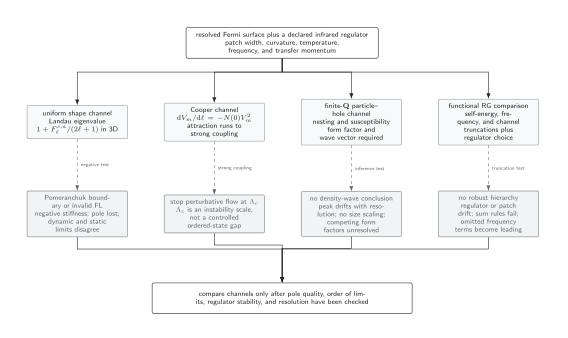
Instability channels and their validity boundaries. The figure is schematic; van Hove points, nesting, long-range forces, strong damping, or loss of a quasiparticle pole require a different low-energy description.
Fermi-liquid claim table
Section titled “Fermi-liquid claim table”| Claim | Necessary input | Convention or limit | Invariant observable | Control or hypothesis | Falsifying signature |
|---|---|---|---|---|---|
| Well-defined quasiparticle | Pole of near the surface | Retarded function and momentum normal to the interacting surface | Peak position and width with | Smooth self-energy and Ward-consistent vertex | Width comparable to energy or loss of the pole without an alternative sharp excitation |
| Landau thermodynamics | Quasiparticle energy functional | Total or per-species DOS declared; static response limit | , compressibility, and spin susceptibility | Stable Landau parameters and adiabatic low-energy states | A stability inequality fails or properly translated responses disagree |
| Zero sound | Collisionless kinetic equation | at fixed with | Pole outside the particle–hole continuum | Suitable interaction eigenvalue and a sharp fermion pole | Continuum damping or crossover to hydrodynamic first sound |
| Luttinger volume | Charge conservation, translations, and theorem topology | Physical unit cell, flavor factor, and filled-band equivalence fixed | Density modulo filled bands compared with the singular surface | No unaccounted symmetry enlargement or topological momentum sector | Count fails after including the correct cell and every theorem sector |
| Pomeranchuk tendency | Forward-scattering eigenvalue | Normalized lattice harmonic at | Thermodynamic shape susceptibility | Stable quasiparticles and the appropriate point-group channel | A finite- peak dominates or there is no thermodynamic size growth |
| fRG leading channel | Regulated many-patch vertex flow | Regulator, patching, frequency grid, and stopping rule declared | Converged eigenmode and stopping scale | Weak coupling plus regulator, discretization, self-energy, and feedback convergence | Reordering under admissible truncations or pole breakdown before the stop scale |
Together with the preceding relationship-centered explanations and alt text, the table supplies the nonvisual account of both figures. It keeps phenomenological parameters, theorem hypotheses, approximation control, and physical observables distinct. Regulator and truncation tests for the last row are reviewed in Metzner et al. 2012, §§ II–IV, pp. 303–337.
Guide to the pages
Section titled “Guide to the pages”- The Fermi Gas and Fermi-Surface Kinematics derives , density of states, linearization, and particle–hole phase space.
- Landau Fermi-Liquid Theory defines the quasiparticle energy functional, response coefficients, and Pomeranchuk stability inequalities.
- Microscopic Quasiparticles and Fermi-Liquid Self-Energy connects and vertices to , , and lifetime scaling.
- Luttinger’s Theorem, Fermi Volume, and Failure Modes states the count with its symmetry, unit-cell, analyticity, and topology qualifications.
- Fermi-Liquid Response and Zero Sound derives static response and the collisionless collective pole in the correct order of limits.
- Fermi-Surface Patch Theory and Low-Energy Scaling power-counts the curved surface and identifies exceptional marginal channels.
- Functional RG for Competing Fermi-Surface Instabilities compares many-patch channels while exposing regulator and truncation dependence.
- Pomeranchuk and Density-Wave Instabilities separates distortions from charge- and spin-density waves at finite .
Convention bridge
Section titled “Convention bridge”Unless stated otherwise, denotes the total density of states including all declared spin or flavor species; in the three-dimensional Legendre convention. With this choice, stability reads . A source using the per-spin density of states changes the numerical but not a measured susceptibility. We always distinguish the static limit before from the dynamic limit at nonzero .
Review the chapter
Section titled “Review the chapter”Translation. A paper quotes using a per-spin density of states while another uses the total density of states. Translate both to the measured compressibility before comparing them. The invariant is , not the bare number printed as .
Failure diagnosis. A vertex component grows rapidly in a 24-patch flow. What is still needed before naming an ordered phase? A complete answer includes patch and frequency convergence, regulator and self-energy feedback, a stopping rule, an order-parameter susceptibility or continuation below the stopping scale, and checks for competing eigenmodes.
Synthesis. Can a system satisfy a Fermi-volume count while lacking Landau quasiparticles? Yes: the volume theorem and pole longevity have different hypotheses. Conversely, observing a sharp pole over a finite window does not prove the global topological count.
References
Section titled “References”- Gordon Baym and Christopher Pethick, Landau Fermi-Liquid Theory: Concepts and Applications, Wiley-VCH (1991), chs. 1–3, doi:10.1002/9783527617159.
- Walter Metzner, Manfred Salmhofer, Carsten Honerkamp, Volker Meden, and Kurt Schönhammer, “Functional Renormalization Group Approach to Correlated Fermion Systems,” Reviews of Modern Physics 84 (2012) 299–352, doi:10.1103/RevModPhys.84.299.
- Joseph Polchinski, “Effective Field Theory and the Fermi Surface,” in Recent Directions in Particle Theory, World Scientific (1993) 235–276, doi:10.1142/9789814503577_0001, Open PDF.
- Ramamurti Shankar, “Renormalization-Group Approach to Interacting Fermions,” Reviews of Modern Physics 66 (1994) 129–192, doi:10.1103/RevModPhys.66.129.
Original QFT.org content:CC BY 4.0, unless an item supplies different terms. Third-party material retains its own terms.