

Feshbach Control and Resonance Calibration
A Feshbach-control setting is not itself a scattering length. The conversion requires a resonance parameterization, a calibrated local field, collision energy and confinement, and a loss and sweep protocol. The result is a many-body interaction window only after the range scale and density have also been specified.
Required background. Contact interactions and scattering length defines the low-energy amplitude and effective-range expansion. Nonrelativistic power counting and universality identifies the density and range parameters that control the contact limit. Tree-level matching and classical elimination supplies the logic for eliminating a detuned closed channel.
Field-to-scattering calibration
Section titled “Field-to-scattering calibration”For an isolated magnetic resonance, a common signed convention is
Here is the pole position, is a signed width, is the background scattering length, and the zero crossing is . Some experimental tables quote an unsigned width and encode the sign elsewhere; importing such a value without its convention can reverse which side is attractive. Chin et al. 2010, §§II–III review the two-channel origin, parameter conventions, and broad-versus-narrow classification.
Near the pole, field uncertainty is amplified:
where and includes their covariance. Spatial field curvature makes position dependent; temporal noise makes it stochastic. The relevant calibration is therefore the field distribution sampled by the atoms, not only a magnet power-supply reading.
The two-body amplitude at relative momentum is
At density scale , the contact description requires and in addition to the desired value of . For a two-channel resonance, a useful positive range scale is
where is the open–closed-channel magnetic-moment difference. A broad resonance has over the sample; a narrow resonance retains appreciable energy dependence and closed-channel physics. At the pole one often has only within the isolated-resonance, low-energy approximation.
The structure diagram locates this calibration before the many-body Hamiltonian. Inspect the range branch: setting removes one relevant inverse length but does not set , confinement, or loss to zero.
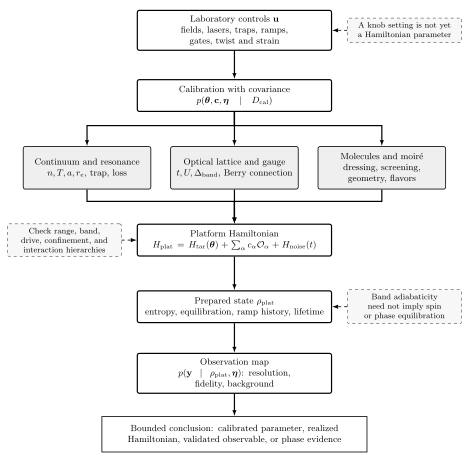
Resonance calibration within the platform-to-model chain. A pole in , the unitary many-body regime, and an acceptably long-lived preparation are separate statements. Original schematic, not to scale; experimental status is bounded through 10 August 2026.
Many-body unitarity, confinement, and losses
Section titled “Many-body unitarity, confinement, and losses”For a homogeneous three-dimensional gas, “unitarity” at finite density means
over the occupied momentum and spatial distributions. The pole field need not coincide with the field that minimizes an observable correction in a trapped, finite-temperature, or narrow-resonance sample. Thermal momentum can replace in a dilute wing, so one must bound both and where relevant.
Tight confinement changes the scattering problem. In a harmonic transverse potential with oscillator length , virtual transverse excitations renormalize the effective low-dimensional coupling and can generate a confinement-induced resonance Olshanii 1998, pp. 938–941. Using the free-space directly in a one-dimensional or quasi-two-dimensional Hamiltonian misses this matching step.
Loss supplies an independent clock. For a three-body loss coefficient in a locally homogeneous gas,
A coherent many-body process of scale requires over the actual density history, not merely at the final central density. Two-body molecular loss, photon scattering for optical resonances, and heating during a field ramp enter analogously. Loss can also bias the surviving ensemble toward lower density, so a postselected equation of state is not automatically the closed-system one.
Association sweeps and calibration evidence
Section titled “Association sweeps and calibration evidence”Sweeping through the pole can associate atom pairs into weakly bound dimers, but conversion is protocol dependent; Köhler, Góral, and Julienne 2006, §§V–VI review the two-body and many-body sweep regimes. In a two-level Landau–Zener reduction, the diabatic probability has the form
This expression identifies the adiabaticity parameter; a many-body gas adds pair correlations, density inhomogeneity, Pauli blocking, loss, and nonisolated levels. Molecule fraction therefore cannot be inverted into a unique temperature or closed-channel fraction without a forward model.
Precision coupled-channel spectroscopy can fix , , and bound-state energies jointly. Zürn et al. 2013, main text and supplemental analysis demonstrated such a calibration for lithium by combining molecular binding energies and scattering information. Current platform-specific parameters, overlapping-resonance fits, and optical-resonance loss budgets remain mutable. The evidence considered here is current through 10 August 2026; updated determinations belong in the Quantum Matter and Emergence Research synthesis.
The canonical cold-atom and synthetic-matter claim test matrix records field covariance, range, confinement, loss, preparation, and the maximum justified claim. A reproducible workflow should carry the few-body matching and its calibration uncertainties through to the platform observable.
Exercise
Section titled “Exercise”Uncertainty near a resonance. Take , , , and an uncorrelated field uncertainty . Find and the field-induced standard uncertainty . Does quoting the pole position alone determine whether the gas is universal?
Solution
The signed formula gives
The derivative magnitude is
so from field noise alone. Parameter covariance, field gradients, and calibration bias would add further uncertainty. The pole position does not determine universality: one must also evaluate , or , thermal and trap distributions, confinement, and loss.
References
Section titled “References”- Chin, C., Grimm, R., Julienne, P., and Tiesinga, E. (2010). “Feshbach resonances in ultracold gases.” Reviews of Modern Physics 82, 1225–1286. doi:10.1103/RevModPhys.82.1225.
- Köhler, T., Góral, K., and Julienne, P. S. (2006). “Production of cold molecules via magnetically tunable Feshbach resonances.” Reviews of Modern Physics 78, 1311–1361. doi:10.1103/RevModPhys.78.1311.
- Olshanii, M. (1998). “Atomic scattering in the presence of an external confinement and a gas of impenetrable bosons.” Physical Review Letters 81, 938–941. doi:10.1103/PhysRevLett.81.938.
- Zürn, G., Lompe, T., Wenz, A. N., Jochim, S., Julienne, P. S., and Hutson, J. M. (2013). “Precise characterization of Li Feshbach resonances using trap-sideband-resolved RF spectroscopy of weakly bound molecules.” Physical Review Letters 110, 135301. doi:10.1103/PhysRevLett.110.135301.
Original QFT.org content:CC BY 4.0, unless an item supplies different terms. Third-party material retains its own terms.