

Weak Integrability Breaking and Hydrodynamic Crossover
Weak integrability breaking creates a hierarchy rather than an immediate replacement of GHD. Nearly conserved charges first support an integrable prethermal regime, then relax through perturbation-dependent collision processes, and only later—if no additional obstruction, bath, drive, or rare process intervenes—can ordinary hydrodynamics or thermal equilibrium emerge.
Required background. Integrable charges and generalized-ensemble tests supplies the slow charge basis and completeness question. Diffusive GHD corrections supplies the gradient expansion inside the integrable window.
Helpful background. Prethermalization and generalized ensembles supplies the general intermediate-time logic.
Nearly conserved charges and rates
Section titled “Nearly conserved charges and rates”Let
in units fixed by a microscopic scale. Then
The operator change is first order in , but a Markovian relaxation rate is often second order because the leading secular contribution contains a force–force correlator. Let be the reference stationary state of and define the connected Kubo–Mori product and slow-charge susceptibility by
Let be the orthogonal projector, in this product, onto the retained exact and slow charges, and set . A schematic projected memory matrix and rate operator are
The zero-frequency projected force spectrum makes positive semidefinite, so the generalized relaxation eigenvalues are nonnegative. The correlator must decay on a time much shorter than the relaxation times being described, and resonant degeneracies must be retained inside the slow subspace rather than perturbatively divided by a small energy denominator. The charge basis must also be normalized: rescaling changes matrix entries even though physical eigenrates do not.
Linearizing near the eventual stationary state gives
Exact charges are null eigenvectors. Positive relaxation requires the susceptibility-weighted rate operator to have nonnegative eigenvalues. A fitted exponential for one observable does not determine the full matrix and can miss a parametrically slower combination of charges.
GHD with a collision term
Section titled “GHD with a collision term”At kinetic scale, weak breaking adds a collision functional:
For every charge still exactly conserved by ,
A physically admissible collision term also preserves positivity of particle and hole densities and should produce the entropy appropriate to the remaining exact constraints. Relaxation-time approximations can be useful, but they must project onto the correct conserved subspace and be benchmarked against a microscopic golden-rule or direct-evolution calculation.
Let denote the nonzero relaxation eigenrates that have overlap with the prepared state and observable. Treating all of those modes as conserved requires
Thus the fastest relevant nonzero rate sets the earliest departure from ideal integrable GHD. Charges then relax progressively; only near
have all relevant nonzero-rate modes had time to decay. Exact zero modes remain hydrodynamic. These crossover times depend on the prepared state and observable because a mode with zero overlap is not probed. Observing an intermediate crossover does not prove the state: finite size, bath coupling, Floquet heating, kinetic constraints, or rates nonanalytic in can dominate later.
Bertini et al. 2015, main text benchmark a quantum-Boltzmann description of prethermalization and thermalization in weakly nonintegrable fermion models. Lopez-Piqueres and Vasseur 2023, main text show that backscattering can control integrability breaking in a way not captured by a naive single relaxation time.
The validity figure shows the sequence from ideal GHD to a breaking claim. Inspect the rate gate: a small Hamiltonian coefficient is not a small rate when resonant phase space or a slowly decaying correlator invalidates the expansion.
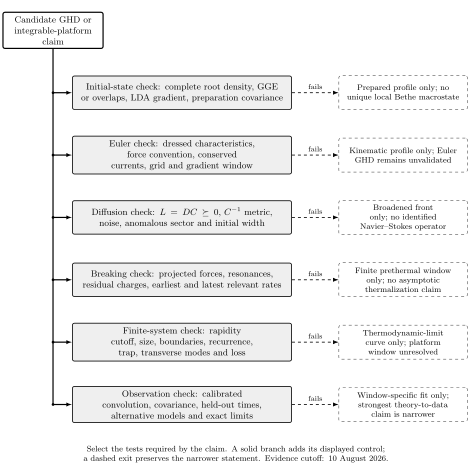
Validity map for weak integrability breaking. Perturbation size, charge-relaxation rate, prethermal window, hydrodynamic crossover, and asymptotic state are different statements. Original schematic, not to scale.
Regime checks and competing limits
Section titled “Regime checks and competing limits”Several limits do not commute:
whenever every nonzero ultimately relaxes charges. Similarly, a local impurity and an extensive perturbation have different thermodynamic scaling. A finite system can show Wigner–Dyson level statistics before transport loses all integrable signatures, or vice versa; spectral chaos is not itself a kinetic rate.
Required checks include:
- vary and test the predicted power or nonanalytic dependence of eigenrates;
- increase size until the scattering phase space and slowest mode stabilize;
- resolve all exact residual symmetries before comparing level or relaxation data;
- test several initial states and observables against one rate matrix;
- distinguish closed-system heating from coupling to an external bath;
- extend beyond the selected prethermal window or state explicitly that the asymptotic regime is unresolved.
Žnidarič 2020, main text gives a concrete warning: weak impurity density produces diffusion with a nontrivial remnant of integrable dynamics rather than a simple Matthiessen-rule rate. The strongest safe conclusion is model-, perturbation-, state-, observable-, and time-window specific.
The canonical integrable-matter claim test matrix records breaking scale, exact residual charges, finite size, and validation. A reproducible verification workflow adds collision terms and tests charge conservation, entropy, and rate scaling.
Exercise
Section titled “Exercise”Two slow modes. Let
Find its relaxation rates and discuss the limit .
Solution
The characteristic polynomial is
so
Both are nonnegative. For ,
At , is exactly conserved and has zero rate, while relaxes at . Fitting only an observable aligned mostly with the fast mode would miss the long prethermal time .
References
Section titled “References”- Bertini, B., Essler, F. H. L., Groha, S., and Robinson, N. J. (2015). “Prethermalization and thermalization in models with weak integrability breaking.” Physical Review Letters 115, 180601. doi:10.1103/PhysRevLett.115.180601.
- Lopez-Piqueres, J., and Vasseur, R. (2023). “Integrability breaking from backscattering.” Physical Review Letters 130, 247101. doi:10.1103/PhysRevLett.130.247101.
- Žnidarič, M. (2020). “Weak integrability breaking: Chaos with integrability signature in coherent diffusion.” Physical Review Letters 125, 180605. doi:10.1103/PhysRevLett.125.180605.
Original QFT.org content:CC BY 4.0, unless an item supplies different terms. Third-party material retains its own terms.