

Weak Localization and Weak Antilocalization
Weak localization is the negative quantum correction produced when a diffusive path interferes constructively with its time reverse. A magnetic field or dephasing destroys that Cooperon interference; strong spin–orbit coupling reverses the relevant channel signs and gives weak antilocalization. The calculation is controlled only while the dimensionless conductance is large and the elastic, dephasing, magnetic, and sample-size cutoffs are separated.
Required background. The disorder sigma model supplies diffusons and Cooperons. Linear response and Kubo formulae fixes the conductivity convention. Diffusion and conductivity supplies the Einstein relation.
Time-reversed paths and the Cooperon
Section titled “Time-reversed paths and the Cooperon”For scalar, time-reversal-invariant disorder without spin–orbit coupling, a closed multiple-scattering path and its reverse have equal phase. Their return amplitudes add, enhancing backscattering. Disorder averaging sums the ladder of maximally crossed diagrams into
where is an inelastic coherence time. This pole is distinct from the particle–hole diffuson: both are diffusive, but only the Cooperon is cut off by time-reversal breaking.
Let count equivalent scalar orthogonal Cooperon channels. A single spinless channel contributes
In two dimensions this becomes
For equivalent channels, multiply these expressions by . In particular, two spin-degenerate channels with negligible spin relaxation give the familiar . Spin and valley multiplicities count only after their symmetry-breaking rates are included. Lee and Ramakrishnan 1985, §IV derives the interference correction and its dimensional dependence.
The original diagram locates this result between the diffusive saddle and scaling theory. Inspect the cutoff labels: extrapolating the logarithm until exceeds the derivation.
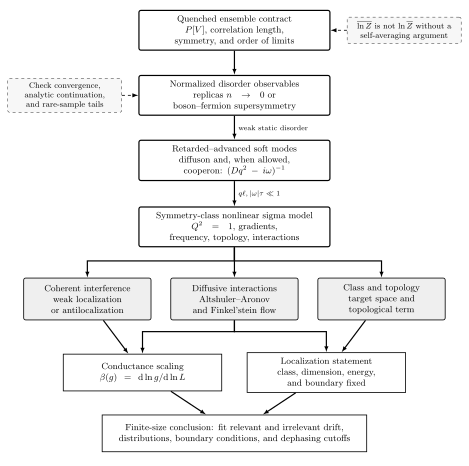
Weak localization is a symmetry-resolved correction within the diffusive window. Orthogonal channels lower conductance; symplectic spin–orbit structure can reverse the sign. Infrared cutoffs and channel multiplicities must be fitted or measured, not inferred from the sign alone. The diagram is schematic and not to scale.
Magnetic and spin–orbit cutoffs
Section titled “Magnetic and spin–orbit cutoffs”The Cooperon carries the phase of two oppositely traversed electron amplitudes, so its covariant momentum contains charge magnitude . In a perpendicular field, the diffusive Landau spectrum and the characteristic Hikami–Larkin–Nagaoka field are
Thus is the characteristic level-spacing scale, while the lowest eigenvalue is in this convention. Boundary geometry can modify the spectrum. Replacing the continuum integral by these Landau levels gives the digamma magnetoconductance form derived by Hikami, Larkin, and Nagaoka 1980. Its prefactor is not universally : it counts coherent modes after intervalley, intersurface, magnetic, and spin-relaxation gaps.
With strong spin–orbit scattering, singlet and triplet Cooperons acquire different signs and masses. The surviving symplectic interference reduces return probability and raises conductivity, producing weak antilocalization. A positive low-field cusp is therefore evidence for a coherent symplectic channel within a model, not by itself proof of a topological surface state.
Validity and conductance convention
Section titled “Validity and conductance convention”Let for a specified sample geometry. Perturbation theory requires , , and . Electron–electron interaction corrections, magnetic impurities, classical orbital magnetoresistance, multiband transport, and current-jetting can overlap the same field window. The original one-parameter scaling argument Abrahams et al. 1979 uses ; changing to resistance reverses the flow sign.
The canonical disorder and glass claim test matrix keeps conductance units, symmetry class, channel count, and infrared cutoff adjacent to every interpretation.
Exercise
Section titled “Exercise”Recover the two-dimensional logarithm. Evaluate the spinless orthogonal correction between and .
Solution
Using polar coordinates,
Multiplication by the single-channel factor gives . Since for the same , the equivalent time form follows. Multiply by for additional coherent channels.
References
Section titled “References”- Elihu Abrahams, P. W. Anderson, Donald C. Licciardello, and T. V. Ramakrishnan, “Scaling Theory of Localization: Absence of Quantum Diffusion in Two Dimensions,” Physical Review Letters 42 (1979) 673–676. DOI
- Shinobu Hikami, Anatoly I. Larkin, and Yosuke Nagaoka, “Spin–Orbit Interaction and Magnetoresistance in the Two Dimensional Random System,” Progress of Theoretical Physics 63 (1980) 707–710. DOI
- Patrick A. Lee and T. V. Ramakrishnan, “Disordered Electronic Systems,” Reviews of Modern Physics 57 (1985) 287–337. DOI
Original QFT.org content:CC BY 4.0, unless an item supplies different terms. Third-party material retains its own terms.