

Diffusive Modes and the Disorder Nonlinear Sigma Model
The disorder nonlinear sigma model is the long-distance field theory of retarded–advanced rotations that remain soft after elastic scattering. In a weakly disordered metal it converts the microscopic mean free path and density of states into a diffusion constant , a constrained field , and a controlled expansion for and . It does not describe the strongly localized regime by the bare saddle alone.
Required background. Replica and supersymmetry methods supplies normalized disorder averaging. Dyson equations and self-energies supplies the elastic Born self-energy. Sigma-model target geometry supplies the constrained-field language.
Helpful background. Diffusion, conductivity, and susceptibility supplies the hydrodynamic endpoint.
Retarded–advanced saddle and soft rotations
Section titled “Retarded–advanced saddle and soft rotations”Consider noninteracting fermions with short-range scalar disorder,
Here is the density of states in the explicitly declared spin/flavor convention. The self-consistent Born saddle has
Disorder averaging couples retarded and advanced bilinears. A Hubbard–Stratonovich matrix decouples that quartic term. At zero frequency the saddle is degenerate under rotations , with and . Rotations commuting with are redundant coordinates; the quotient target depends on time reversal, particle–hole, chiral symmetry, and the replica or supersymmetric representation. For class A with replicas it is before .
The original chapter diagram places every ingredient in order. Inspect the separation between physical Altland–Zirnbauer symmetry and the auxiliary replica or graded indices.
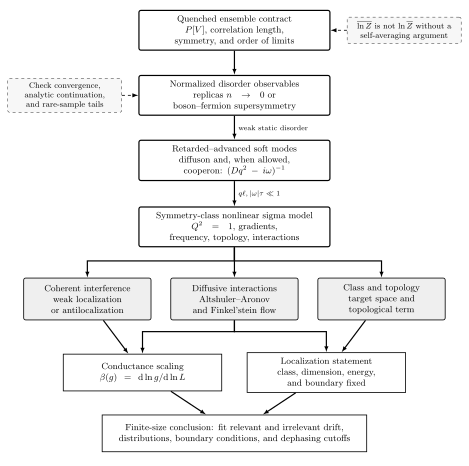
Microscopic disorder to the diffusive sigma model. The target is fixed by physical symmetries; the coupling is fixed by the Drude conductance; and the gradient expansion requires , , and . Schematic, not to scale.
Gradient expansion and normalization
Section titled “Gradient expansion and normalization”Integrating massive longitudinal fluctuations and expanding the fermion determinant gives, in one common real-frequency convention,
The trace includes retarded–advanced and auxiliary indices. A different normalization of , , or the trace moves factors of two; the invariant checkpoints are the diffusion pole and the Drude conductivity. Expanding with yields the quadratic inverse propagator .
The density response consequently has the hydrodynamic form
where is the thermodynamic compressibility in the same flavor convention. At fixed nonzero , expresses number conservation; taking before gives . This noncommuting limit is an independent check on the frequency term.
Wegner’s replica derivation identifies the localization problem with a nonlinear sigma model Wegner 1979, while Efetov 1983, §§4–6 gives the supersymmetric construction and observable insertions.
Coupling and stopping scale
Section titled “Coupling and stopping scale”With , define the scale-dependent dimensionless conductance by
for the stated boundary geometry and total density of states. At the bare scale , licenses perturbation theory. Interference renormalizes as grows. When , the weak-coupling gradient expansion ceases to be quantitative even though the sigma model may still encode symmetry and topology nonperturbatively.
Ballistic modes above , spatial structure below , band-edge physics, rare deep wells, and interaction channels not included in the action lie outside this derivation. The disorder and glass claim test matrix records these cutoffs and the needed negative tests.
Exercise
Section titled “Exercise”Check the order of limits. Evaluate the two iterated limits of .
Solution
At fixed , , and the subsequent limit remains . At fixed , , and the subsequent limit remains zero. The first is the static compressibility; the second is the uniform finite-frequency response of a conserved total charge.
References
Section titled “References”Original QFT.org content:CC BY 4.0, unless an item supplies different terms. Third-party material retains its own terms.