

Disorder, Localization, and Glasses
Disorder changes a quantum theory in two logically distinct ways: it introduces a probability ensemble, and it creates spatially atypical samples whose effects may survive averaging. This chapter develops the controlled chain from quenched ensembles to diffusive field theory and Anderson scaling, then adds interactions, bosons, rare regions, many-body dynamics, and glass order. At every stage the conclusion is tied to a stated symmetry class, scaling variable, system-size and time window, interaction content, and coupling to external baths.
Helpful background. Quenched disorder and disorder averaging is the recommended technical entry to the chapter. Probability spaces, random variables, and conditional expectation supplies the ensemble and expectation language used throughout.
Enter disorder, localization, and glasses
Section titled “Enter disorder, localization, and glasses”The first question is always what is random and what is held fixed. For a disorder realization , a quenched free energy is
not . The overbar is an expectation over a declared probability law ; it is neither a spatial average nor a thermal trace unless a separate self-averaging argument makes those operations interchangeable. Replica and supersymmetry methods are devices for evaluating normalized quenched observables. They do not remove the need to specify the ensemble, take limits in a controlled order, or check rare-sample tails.
For weak static disorder in a metal, elastic scattering produces the hierarchy
where is the elastic mean free path. Conservation laws and retarded–advanced interference then generate the diffusion pole . Its slow matrix field obeys and, in a standard normalization, has long-wavelength action
The target space is fixed by antiunitary, particle–hole, and chiral symmetries; topology may add ; interactions add new running couplings and Ward-identity constraints. Thus the phrase “the sigma model” is incomplete without class, dimension, frequency prescription, replica or supersymmetry convention, and interaction sector. Efetov 1997, chs. 3–6 develops the supersymmetric construction and its symmetry-dependent target spaces.
| Reader goal | Suggested route | Capability at the end |
|---|---|---|
| Build the disorder field theory | Quenched ensemble → replica/SUSY normalization → diffusive modes → nonlinear sigma model | Derive the slow-mode action and state its symmetry, frequency, and weak-disorder limits |
| Diagnose single-particle localization | Weak localization → interaction corrections → Anderson scaling → symmetry and topology | Translate interference or conductance flow into a class- and dimension-specific localization statement |
| Treat interacting bosons and rare regions | Dirty bosons → Griffiths distributions → avalanche stability | Separate compressible insulation, broad relaxation, and destabilization by a growing thermal inclusion |
| Evaluate many-body memory and glass claims | MBL diagnostics → mean-field RSB → finite-dimensional glass evidence | Distinguish a finite window of slow dynamics from a thermodynamic localized or glass phase |
From interference to scale-dependent conductance
Section titled “From interference to scale-dependent conductance”For a hypercubic sample of size , let
This convention matters: some literature instead differentiates itself. An ordinary diffusive metal has and therefore at large . For one spinless orthogonal Cooperon channel in two dimensions, the correction is
with dephasing length cutting off the infrared divergence. Two independent spin-degenerate channels double this coefficient. Breaking time-reversal symmetry suppresses the cooperon; strong spin–orbit coupling changes its sign structure and permits weak antilocalization. Abrahams et al. 1979, pp. 673–676 formulate one-parameter scaling, while Wegner 1979, §§2–4 connects scaling to the disorder field theory.
The structure figure shows which statements follow from ensemble averaging, which require the diffusive limit, and which require a separate scaling or topological argument. Inspect especially the handoffs: a disorder-averaged propagator is not yet a localization theory, and a perturbative logarithm is not yet an Anderson critical point.
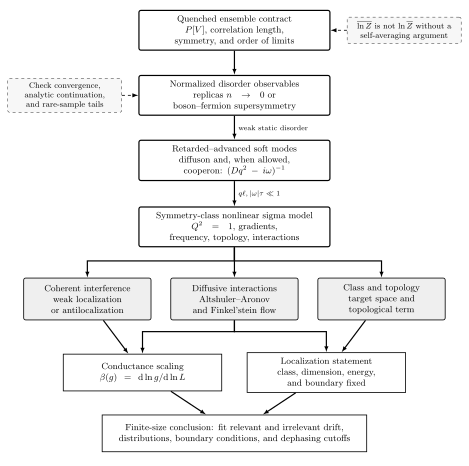
The disorder-to-localization dictionary. Each arrow adds an assumption: quenching and normalization precede the diffusive limit; symmetry fixes the soft-mode manifold; interactions and topological terms extend rather than merely rename the noninteracting theory. Original schematic, not to scale.
Nonvisual description of the disorder structure figure
Section titled “Nonvisual description of the disorder structure figure”| Figure element or arrow | Relation encoded | Condition or resulting statement |
|---|---|---|
| Quenched ensemble | The construction begins with , its correlation length and symmetries, and the order of thermodynamic and disorder limits. | The dashed side condition states that unless a self-averaging argument justifies equality. |
| Ensemble → normalized observables | Disorder observables are normalized by replicas with or by boson–fermion supersymmetry. | The representation is fixed before any diffusive or localization approximation. |
| Normalization side condition | Convergence, analytic continuation, and rare-sample tails constrain the normalization step. | Failure preserves only the directly defined disorder average, not a controlled replica or supersymmetric continuation. |
| Normalized observables → retarded–advanced soft modes | Weak static disorder produces diffusons and, when symmetry permits, cooperons with pole . | This arrow assumes the weak-disorder regime. |
| Soft modes → nonlinear sigma model | The long-wavelength modes are organized into a symmetry-class field with and gradient, frequency, topological, and interaction terms. | The displayed expansion requires and . |
| Sigma model → interference branch | Cooperon structure produces weak localization or antilocalization. | The sign and channel count depend on symmetry, dephasing, magnetic field, and spin–orbit scales. |
| Sigma model → interaction branch | Diffusive density and spin modes produce Altshuler–Aronov corrections and Finkel’stein flow. | Interaction amplitudes and frequency renormalization must use the same normalization as the diffusive action. |
| Sigma model → class and topology branch | The target space and allowed topological term follow from the symmetry class. | The conclusion remains dimension-, boundary-, and energy-specific. |
| Interference and interaction branches → conductance scaling | Their controlled corrections feed . | A perturbative logarithm is not itself a critical point. |
| Interaction plus class/topology branches → localization statement | These branches determine which class-, dimension-, energy-, and boundary-fixed localization statement is admissible. | Conductance scaling and localization statements jointly require finite-size fits of relevant and irrelevant drift, distributions, boundary conditions, and dephasing cutoffs. |
In the noninteracting Anderson problem, localized eigenstates have an exponential envelope with localization length , while a mobility edge separates localized from extended energies only in dimensions and symmetry classes that admit it. A finite-size crossing becomes a critical estimate only after irrelevant-variable drift, boundary conditions, energy resolution, and the full disorder distribution have been controlled. Interactions are not a small annotation: Altshuler–Aronov corrections couple density-of-states and transport anomalies, and the Finkel’stein theory makes diffusion, interaction amplitudes, and frequency renormalization run together Finkel’stein 1983, pp. 97–108.
Rare events, many-body memory, and glass order
Section titled “Rare events, many-body memory, and glass order”Rare regions demand distributions, not only means. If a rare segment of length occurs with probability but relaxes on , then eliminating gives
The resulting power-law tail can generate anomalous transport without a distinct thermodynamic phase. Conversely, a thermal inclusion in an interacting localized background has a level spacing that falls exponentially with its volume. Its ability to absorb neighboring localized degrees of freedom is a stability question, not merely another slow relaxation channel. De Roeck and Huveneers 2017, §§2–4 formulate the avalanche mechanism; the dedicated pages state the localization-length convention because a factor of two shifts when wave-function amplitudes are replaced by probabilities.
Many-body localization and quantum glassiness are therefore evidence-limited subjects. Level statistics, entanglement growth, imbalance plateaus, aging, memory, nonlinear response, and overlap distributions are valuable diagnostics, but each has finite-size, finite-time, preparation, bath, and competing-mechanism tests. For disordered interacting bosons, compressibility and stiffness separate the Bose glass from the Mott insulator and superfluid Fisher et al. 1989, §§I–III. Mean-field replica-symmetry breaking is a precise statement about an overlap order parameter in a specified infinite-connectivity limit Mézard, Parisi, and Virasoro 1987, chs. 2–4. It does not by itself establish a stable finite-dimensional quantum glass. The second figure organizes the required escalation of claims.
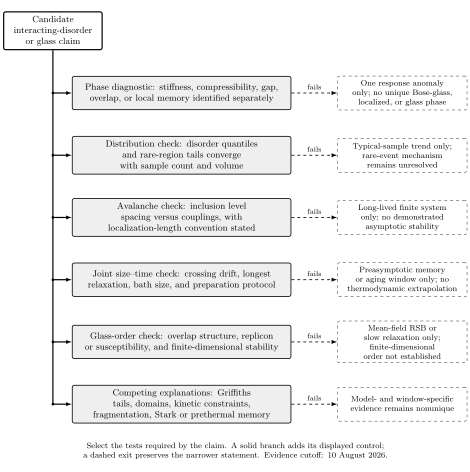
Validity map for interacting disordered matter. Compressibility, slow memory, Poisson-like spectra, an overlap hierarchy, and aging answer different questions. A thermodynamic conclusion requires drift tests in size and time, a declared bath limit, rare-inclusion stability, and a comparison with nonunique slow mechanisms. Original schematic, not to scale; mutable MBL and finite-dimensional glass evidence is assessed through 10 August 2026.
Nonvisual description of the disorder validity figure
Section titled “Nonvisual description of the disorder validity figure”A candidate interacting-disorder or glass claim branches to whichever tests its scope requires. Each solid branch adds the displayed control; the corresponding dashed exit states the strongest conclusion retained when that control fails.
| Test selected | Control added by the solid branch | Dashed-exit conclusion when the test fails |
|---|---|---|
| Phase diagnostic | Identify stiffness, compressibility, a gap, overlap order, and local memory separately. | One response anomaly does not uniquely establish a Bose glass, localized phase, or glass phase. |
| Distribution check | Converge disorder quantiles and rare-region tails with both realization count and volume. | A typical-sample trend leaves the rare-event mechanism unresolved. |
| Avalanche check | Compare inclusion level spacing with couplings in a stated localization-length convention. | A long-lived finite system does not demonstrate asymptotic stability. |
| Joint size–time check | Track crossing drift, the longest relaxation, bath size, and preparation protocol. | The result is a preasymptotic memory or aging window, not a thermodynamic extrapolation. |
| Glass-order check | Combine overlap structure, a replicon or susceptibility test, and finite-dimensional stability. | Mean-field replica-symmetry breaking or slow relaxation alone does not establish finite-dimensional order. |
| Competing-explanation check | Test Griffiths tails, domains, kinetic constraints, fragmentation, Stark localization, and prethermal memory. | The evidence remains model- and window-specific and nonunique. |
The validity relations above use the evidence cutoff 10 August 2026.
Disorder and glass claim test matrix
Section titled “Disorder and glass claim test matrix”| Claim or regime | Ensemble and symmetry | Scaling variable or interaction effect | Rare-event diagnostic and size requirement | Competing explanation | Evidence ceiling |
|---|---|---|---|---|---|
| Quenched thermodynamics | Fixed during equilibration; declared | and cumulants, not | Distribution over samples; increase sample count and volume separately | Annealed disorder or nonstationary preparation | Exact only for the stated ensemble and order of limits |
| Replica or SUSY representation | Replica number or balanced boson–fermion fields; convergence prescription stated | continuation or exact normalization cancellation | Compare moments and tails before analytic continuation | Wrong saddle, broken convergence contour, or nonunique continuation | A computational representation, not an independent physical phase |
| Diffusive nonlinear sigma model | Altland–Zirnbauer class fixed; | , ; | Sample dimensions must exceed but remain within coherence window | Ballistic modes, additional soft channels, or strong disorder | Long-wavelength theory inside the declared class and cutoff |
| Weak localization or antilocalization | Orthogonal, unitary, or symplectic interference sector | and magnetic or spin–orbit crossover | Magnetoconductance shape over several coherent scales | Interaction correction, classical memory effect, or inhomogeneity | Perturbative coherent correction, not a phase diagnosis |
| Interaction correction | Diffusive fermions with specified singlet/triplet channels | Running resistance, , and interaction amplitudes | Temperature and field scaling beyond one logarithmic window | Heating, phonons, granularity, or band-structure anomaly | Controlled only while conductance and retained couplings justify the expansion |
| Anderson transition | Noninteracting class and boundary conditions fixed | , | Several sizes, disorder quantiles, and irrelevant-drift fit | Crossover, mobility-edge averaging, or contact resistance | Critical point only after stable scaling collapse and uncertainty analysis |
| Topological localization | Symmetry class plus bulk topological term or invariant | Mass, conductance, localization length, and boundary response | Bulk and boundary scaling with symmetry-breaking controls | Clean band transition or finite-size edge hybridization | Class- and dimension-specific delocalization statement |
| Bose glass | Quenched potential with interacting bosons and symmetry | Vanishing stiffness, nonzero compressibility, no spectral gap | Size and trap scaling of , , and gap proxies | Inhomogeneous superfluid puddles or Mott crossover | Compressible insulating phase only in the homogeneous thermodynamic limit |
| Griffiths dynamics | Spatial rare regions in a declared disorder ensemble | Tail exponent or dynamical exponent from full distributions | Rare-sample count grows with both volume and realization number | Broad but ordinary relaxation-rate distribution | Anomalous dynamics; does not alone imply localization or glass order |
| Thermal avalanche | Localized background plus an ergodic seed and local couplings | Inclusion entropy versus distance-dependent matrix element | Seed size and growth followed beyond the crossing scale | Long transient from a subcritical inclusion | Instability criterion under the stated localization-length convention |
| Many-body localization | Isolated interacting system with conserved quantities fixed | Level ratios, transport, entanglement, and local memory | Symmetry-resolved sizes, long times, bath-size drift, and rare seeds | Prethermalization, fragmentation, Stark localization, or finite-size crossover | No thermodynamic phase claim from accessible finite-size crossing alone |
| Mean-field quantum spin glass | Infinite-range or large-connectivity quenched couplings | Replicon stability and overlap distribution | Replica limit, imaginary-time discretization, and system-size convergence | Replica-symmetric solution or competing ordered saddle | Controlled mean-field RSB statement; finite-dimensional stability separate |
| Finite-dimensional quantum glass | Short-range model or material with declared preparation and bath | Aging, memory, nonlinear susceptibility, overlaps, and relaxation spectrum | Joint size–time scaling and protocol variation | Rare regions, domains, disorder pinning, MBL-like memory, or critical slowing | Model- and window-specific evidence through 10 August 2026 |
The two artifact-specific tables above are the nonvisual equivalents of the figures and preserve their nodes, arrows, conditions, and failed-test exits. The claim test matrix is a chapter-level comparison of regimes and evidence ceilings; it does not reproduce either figure’s graph topology.
Guide to the pages
Section titled “Guide to the pages”- Quenched Disorder and Disorder Averaging defines random couplings, quenched versus annealed averages, self-averaging, correlations, and rare samples.
- Replica and Supersymmetry Methods for Disorder derives the normalization tricks and states the replica-limit and convergence qualifications.
- Diffusive Modes and the Disorder Nonlinear Sigma Model obtains diffusons, cooperons, the constraint, and the class-dependent long-wavelength action.
- Weak Localization and Weak Antilocalization evaluates the coherent return correction and its magnetic, spin–orbit, dephasing, and dimensional cutoffs.
- Interaction Corrections and Finkel’stein Scaling couples density-of-states and transport anomalies to the interacting diffusive RG.
- Anderson Localization and Scaling Theory relates exponential localization, mobility edges, conductance flow, and finite-size critical fitting.
- Symmetry Classes and Topological Localization connects the tenfold classification, sigma-model targets, topological terms, and protected delocalization.
- Dirty Bosons and the Bose Glass distinguishes superfluid, Mott-insulating, and compressible Bose-glass diagnostics.
- Griffiths Effects, Rare Regions, and Avalanches derives broad relaxation tails and tests whether an ergodic inclusion grows.
- Many-Body Localization: Diagnostics and Evidence compares spectral, eigenstate, transport, and memory diagnostics with avalanche and finite-size limits.
- Mean-Field Quantum Spin Glasses and Replica Symmetry Breaking develops the overlap order parameter, replicon instability, and mean-field scope.
- Finite-Dimensional Quantum Glass Dynamics and Evidence evaluates aging, memory, susceptibilities, overlaps, and relaxation against competing slow mechanisms.
Review the chapter
Section titled “Review the chapter”Order of averages. Let with weak sample-to-sample free-energy fluctuations , . Expanding to second order gives
whereas . The annealed free energy is lower at this order because it overweights realizations with anomalously small . Equality requires more than a large sample: the fluctuation contribution per thermodynamic degree of freedom must vanish in the relevant limit.
Scaling convention. If with , then
This exercise also shows why quoting a beta function without saying whether it is or is ambiguous.
Evidence limits. A persistent local imbalance or aging curve is a durable observation only within its measured size, time, preparation, and bath window. Thermodynamic MBL and finite-dimensional glass conclusions require stable joint extrapolations and rare-region alternatives. The dated Quantum Matter and Emergence Research synthesis carries changing experimental and numerical status through 10 August 2026. A reproducible verification should include finite-size scaling and avalanche-sensitive controls.
References
Section titled “References”- Abrahams, E., Anderson, P. W., Licciardello, D. C., and Ramakrishnan, T. V. (1979). “Scaling theory of localization: Absence of quantum diffusion in two dimensions.” Physical Review Letters 42, 673–676. doi:10.1103/PhysRevLett.42.673.
- De Roeck, W., and Huveneers, F. (2017). “Stability and instability towards delocalization in many-body localization systems.” Physical Review B 95, 155129. doi:10.1103/PhysRevB.95.155129.
- Efetov, K. B. (1997). Supersymmetry in Disorder and Chaos. Cambridge University Press. doi:10.1017/CBO9780511573057.
- Finkel’stein, A. M. (1983). “Influence of Coulomb interaction on the properties of disordered metals.” Soviet Physics JETP 57, 97–108. Stable record and PDF.
- Fisher, M. P. A., Weichman, P. B., Grinstein, G., and Fisher, D. S. (1989). “Boson localization and the superfluid-insulator transition.” Physical Review B 40, 546–570. doi:10.1103/PhysRevB.40.546.
- Mézard, M., Parisi, G., and Virasoro, M. A. (1987). Spin Glass Theory and Beyond. World Scientific. doi:10.1142/0271.
- Wegner, F. J. (1979). “The mobility edge problem: Continuous symmetry and a conjecture.” Zeitschrift für Physik B 35, 207–210. doi:10.1007/BF01319839.
Original QFT.org content:CC BY 4.0, unless an item supplies different terms. Third-party material retains its own terms.