

Anderson Localization and Scaling Theory
Anderson localization is the absence of diffusion for single-particle eigenstates in a random potential, diagnosed by exponential spatial decay, vanishing thermodynamic conductance, and scale flow rather than by a finite-sample participation ratio alone. One-parameter scaling organizes this with for a declared dimensionless conductance ; symmetry class and dimension determine whether a mobility edge can occur.
Required background. Weak localization supplies the metallic-side correction. Universality and scaling functions and beta functions supply the flow language.
Helpful background. Complete lattice error budgets supplies correlated finite-size-fit practice.
Localization length and Thouless conductance
Section titled “Localization length and Thouless conductance”For a localized eigenstate centered near ,
where the typical logarithm and the ensemble are part of the definition. The Thouless energy measures sensitivity to a boundary twist, and
compares it with the mean level spacing . In a diffusive hypercube, , so agrees with conductance in units of up to geometry and degeneracy conventions. In an insulator, falls exponentially.
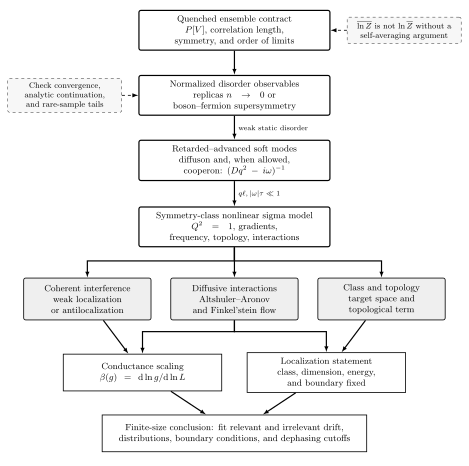
The chapter’s original structure diagram shows how this scaling variable descends from the diffusive theory. Inspect the final arrow: the weak-coupling calculation motivates a flow, but a mobility edge requires size scaling beyond the perturbative region.
Conductance scaling in a declared convention. Large is diffusive, exponentially small is localized, and a critical fixed point is inferred only from crossings with irrelevant-field and covariance control. Schematic, not a numerical beta function.
Beta convention and limiting flows
Section titled “Beta convention and limiting flows”We use
For an Ohmic metal, and at large . For , . In two-dimensional orthogonal class, weak localization gives with whose numerical value depends on the definition of . Thus the perturbative flow is toward smaller conductance; this does not prove a universal beta function at .
Abrahams et al. 1979 proposed one-parameter scaling. In , a zero separates metallic and insulating flows in classes that admit the transition. If , linearization gives
for one relevant scaling field. Extra relevant variables, broad distributions, or long-range correlations invalidate a single-parameter collapse.
Transfer-matrix finite-size scaling
Section titled “Transfer-matrix finite-size scaling”For a bar of transverse width , compute its quasi-one-dimensional localization length and the dimensionless ratio . Near a mobility edge,
At leading order curves cross near ; irrelevant fields shift the apparent crossing with . A defensible fit varies the minimum width, expansion orders, disorder samples, boundary condition, energy window, and covariance treatment. MacKinnon and Kramer 1981 introduced this recursive scaling strategy.
At criticality, inverse participation ratios
show multifractal scaling. This is a critical-eigenfunction diagnostic, not a replacement for transport or a mobility-gap test. Evers and Mirlin 2008, §§II–III reviews symmetry-class dependence, multifractality, and controlled field-theory limits.
The canonical disorder and glass claim test matrix keeps beta convention, ensemble, irrelevant fields, size range, and alternative scaling hypotheses together.
Exercise
Section titled “Exercise”Localized beta function. If , compute and its large- form.
Solution
, so
For , the additive constant is negligible and . The result depends on using ; a beta function for resistance would have the opposite flow direction.
References
Section titled “References”- Elihu Abrahams, P. W. Anderson, Donald C. Licciardello, and T. V. Ramakrishnan, “Scaling Theory of Localization: Absence of Quantum Diffusion in Two Dimensions,” Physical Review Letters 42 (1979) 673–676. DOI
- Ferdinand Evers and Alexander D. Mirlin, “Anderson Transitions,” Reviews of Modern Physics 80 (2008) 1355–1417. DOI
- Angus MacKinnon and Bernhard Kramer, “One-Parameter Scaling of Localization Length and Conductance in Disordered Systems,” Physical Review Letters 47 (1981) 1546–1549. DOI
Original QFT.org content:CC BY 4.0, unless an item supplies different terms. Third-party material retains its own terms.