

Migdal's Theorem and Vertex-Correction Validity
Migdal’s theorem is conditional diagrammatic power counting. In a regular broad-band Fermi liquid, a phonon transfers energy much more slowly than a generic electronic recoil, so the phase space in which two internal electron lines are simultaneously near shell is small. For typical momentum transfer in three dimensions, the first electron–phonon vertex correction is then of relative order . The estimate fails if the interaction is concentrated at small momentum, the relevant pocket is shallow, the Fermi velocity or bandwidth is small, the density of states is singular, or the starting metal or phonon spectrum is already unstable.
The theorem does not say that the retained self-energy is small, that every conserved response vertex may be left bare, or that an Eliashberg calculation remains physically controlled at arbitrary coupling. Its job is narrower: identify a small crossed-diagram parameter in stated kinematics, and stop when that parameter is absent.
Required background. Retarded electron–phonon interactions supplies the microscopic fields and coupling conventions. Fermi-surface kinematics supplies the electronic recoil and regular-patch expansion.
Helpful background. Current vertices and Ward consistency distinguishes a small generic pairing vertex correction from the vertex required in a conserved long-wavelength response.
A conditional theorem, not a universal slogan
Section titled “A conditional theorem, not a universal slogan”Use in this page. Consider quasiparticles with dispersion coupled to phonons,
Let denote the interaction-weighted phonon scale and
the Fermi-surface Eliashberg coupling in the normalization used on the next page. The commonly quoted estimate has the following contract.
Hypotheses. The normal state is a stable Fermi liquid. Every electronic sector carrying appreciable weight has nonzero , a smooth density of states throughout the phonon window, and no controlling band edge, flat direction, van Hove point, or nesting singularity. The screened interaction is nonsingular and is not dominated by transfers satisfying , unless that sector is analyzed separately. The effective coupling does not grow rapidly enough to cancel the recoil suppression, and phonon softening, lattice reconstruction, polarons, or another instability have not invalidated the starting propagators.
Conclusion. For generic external kinematics, the leading crossed electron–phonon vertex and the associated crossed self-energy contribution are parametrically smaller than the noncrossing terms. In a regular three-dimensional metal whose relevant transfers are ,
Here is the pocket depth or curvature scale of the participating states, not automatically the full bandwidth and not the Fermi energy of a different sheet. Migdal’s original expansion uses the electron–ion mass hierarchy and isolates the exceptional small- region Migdal 1958, pp. 996–998, Eqs. (7)–(9).
Three non-conclusions are as important as the conclusion:
- the noncrossing self-energy can be and produce ;
- a Ward identity can require an correction to a conserved uniform vertex; and
- a small first vertex correction does not certify phonon stability or a Fermi-liquid starting point at strong coupling.
The word “theorem” therefore names an asymptotic diagrammatic statement with hypotheses. It is not a material label.
The first triangle exposes the recoil scale
Section titled “The first triangle exposes the recoil scale”Let an external electron absorb . Up to convention-dependent signs and normalization, the first correction divided by the bare external vertex contains
The two electron denominators are the key. For a regular Fermi-surface patch,
If , both electron propagators cannot remain near shell over an extended frequency-and-angle region. A representative nonsingular result can be organized as
Thus
and only after setting a typical transfer does the denominator become an electronic scale of order . Numerical factors and the sign are model-dependent. In a regular two-dimensional model, the narrow angular sector can also produce a logarithm, schematically
so dimension is part of the estimate rather than a cosmetic label. Chubukov et al. 2020, §IV.C, pp. 15–16, Eqs. (21)–(25) separates these vertex, self-energy, and dimensional limits.
The left panel of the figure turns that power count into a decision. The right panel previews the calculation that is licensed only after the decision passes.
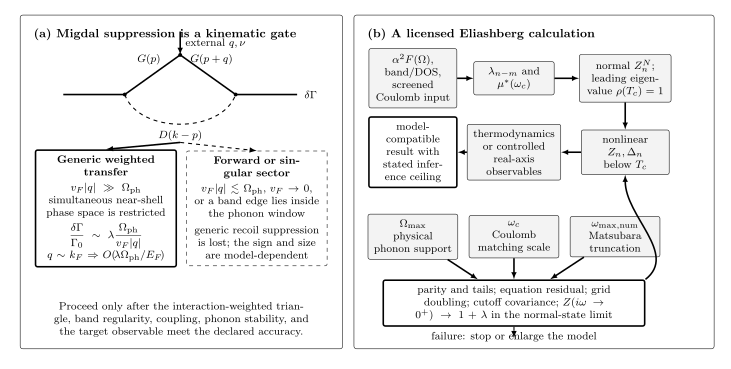
Migdal control and the downstream Eliashberg workflow. For a regular generic transfer, restricted simultaneous near-shell phase space produces ; forward or singular sectors require their own expansion or an explicit vertex calculation. Passing that gate licenses the isotropic noncrossing equations, whose phonon support , Coulomb matching scale , and numerical Matsubara cutoff remain distinct. Original schematic, not to scale.
Long-wavelength limits do not commute
Section titled “Long-wavelength limits do not commute”At small transfer, rather than is the recoil scale. The limits
need not agree. In a spatially uniform dynamic limit, a Ward identity relates the density vertex to the frequency derivative of the self-energy,
which can differ from one by . This does not contradict the generic- theorem: it is a different kinematic limit and a conservation requirement, not an unsuppressed crossed contribution to the same observable.
The correction also has no universal sign. Even simple models change sign as and the band structure are varied. Grimaldi, Pietronero, and Scattoni 1999, §2, pp. 247–251 resolves the nonanalytic momentum-frequency structure and its distinct physical pieces.
Forward scattering is a different expansion
Section titled “Forward scattering is a different expansion”Suppose the coupling is concentrated near . Then and can remain near shell together, so the generic factor no longer follows. The limiting model
is an explicit counterexample to using a global in the estimate.
The correct conclusion is not “every forward problem is uncontrolled.” A forward-focused model may possess another small coupling and may require an elastic ladder resummation rather than a first-order vertex. What fails is the generic-recoil proof. One must state the new expansion, evaluate its inelastic and elastic sectors separately, and test the target observable. A model-specific nonadiabatic correction cannot be promoted into a universal positive enhancement.
Shallow pockets and singular bands remove the same protection
Section titled “Shallow pockets and singular bands remove the same protection”The dangerous quantity is not a pointwise minimum of : ordinary Fermi surfaces can intersect their translates and make that minimum vanish. Nor is a global average safe, because it can hide a shallow sheet that dominates the pairing kernel. The audit must be resolved by band and by interaction-weighted momentum sector.
Warning conditions include:
- a pocket depth comparable to ;
- appreciable weight with ;
- a band edge within the phonon window;
- a flat or small- sector;
- van Hove or nesting-enhanced simultaneous near-shell phase space; and
- a narrow band for which the constant-density-of-states and infinite-band reductions fail.
A peak in the density of states can increase a fitted while simultaneously shrinking the electronic scale that was supposed to control the vertex. Cappelluti and Pietronero 1996, pp. 932–944 gives a representative van-Hove analysis; its enhancement is model-specific, while the loss of a regular broad-band hypothesis is general.
A material-level stop rule
Section titled “A material-level stop rule”For every band and momentum sector that contributes materially to the intended observable, report the following.
| Check | Quantity that must be resolved | Stop or enlarge the method when |
|---|---|---|
| Electronic recoil | pocket depth, curvature, and the weighted distribution of | phonon-scale weight samples a band edge or an unresolved small-recoil sector |
| Phonons | branch-resolved spectrum and the support of | softening, anharmonicity, or reconstruction changes the input propagator |
| Coupling | pocket- and channel-resolved | the effective crossed-diagram parameter is not small at the required accuracy |
| Momentum structure | , screening, forward width, and nesting | generic- power counting does not represent the weighted interaction |
| Electronic regularity | , density of states, quasiparticle width, and normal-state stability | the Fermi-liquid patch expansion or smooth-DOS integration fails |
| Observable sensitivity | explicit leading vertex effect or an independent benchmark | the correction changes the claimed result beyond its declared uncertainty |
A practical diagnostic such as “below ten percent” may be chosen for a calculation, but it is a tolerance, not Migdal’s theorem. If the weighted correction is not parametrically small—or if the starting phonon or electronic state is unstable—the canonical noncrossing calculation stops. The successor must retain momentum, finite bandwidth, and vertex structure, or be benchmarked against an independent nonperturbative method.
The chapter-wide validity map records this as one independent gate rather than as evidence for a pairing mechanism.
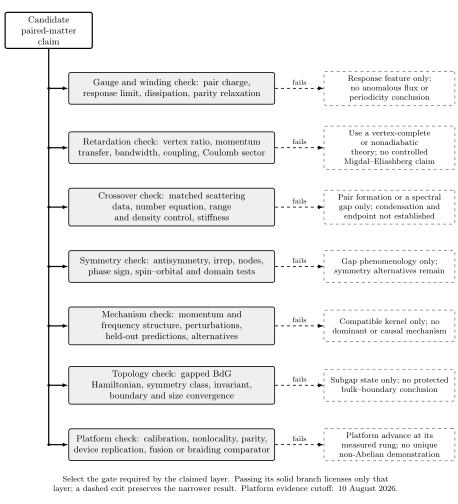
The retardation branch licenses a controlled Migdal–Eliashberg approximation only after the relevant band, phonon, momentum-transfer, coupling, and Coulomb scales are resolved. Failure does not erase the electron–phonon interaction; it requires a vertex-complete or nonadiabatic treatment and lowers the claim ceiling. The other branches test different paired-matter statements. Original schematic, not to scale.
The paired-matter claim test matrix keeps this control separate from evidence that a particular boson is the dominant cause of pairing.
Common pitfalls
Section titled “Common pitfalls”Using the largest band scale in a multiband material. The states and transfers carrying the kernel set the recoil scale. A broad spectator band cannot certify a shallow active pocket.
Treating as the whole theorem. Coupling, momentum concentration, dimension, band regularity, and starting-state stability are independent hypotheses.
Calling every vertex a violation. A uniform conserved vertex may be fixed by a Ward identity. Compare the same vertex, kinematic limit, and observable before applying generic- power counting.
Assuming a positive nonadiabatic correction. The sign and even the useful expansion depend on kinematics and band structure. Calculate them rather than borrowing a sign from another model.
Exercises
Section titled “Exercises”Generic-transfer power counting
Section titled “Generic-transfer power counting”Assume a regular patch with phonon scale and a coupling convention in which the remaining dimensionless loop weight is . Explain why two internal electron lines separated by momentum give when . What additional assumption recovers ?
Solution
After the internal frequency is restricted to the phonon window, one electron denominator can be of order . The second is shifted by the recoil . For generic angles and , its denominator supplies rather than another . The dimensionless coupling collects the remaining density-of-states, matrix-element, and phonon normalization, leaving
Taking the interaction-weighted momentum to be in a regular band makes an electronic scale of order (twice for a quadratic continuum). That extra kinematic assumption yields the familiar order estimate. It is unavailable in a forward-focused problem.
Two pockets with different recoil
Section titled “Two pockets with different recoil”A phonon has . Pocket A has , , and generic . Pocket B has depth , , and most of its coupling at . Estimate the nominal vertex parameters and decide which pocket controls validity.
Solution
For A,
This is parametrically small if the other hypotheses hold. For B, , so the asymptotic formula is not itself controlled; its formal value merely signals the loss of generic recoil suppression. Pocket B therefore sets the stop rule. Averaging the two Fermi energies or couplings would conceal the active uncontrolled sector.
Ward limit versus Migdal limit
Section titled “Ward limit versus Migdal limit”Suppose a normal-state self-energy satisfies at low frequency. What does the uniform Ward identity give for the density vertex? Why is this not inconsistent with a small generic- crossed vertex?
Solution
The uniform dynamic Ward identity gives
The correction is required so that the dressed propagator and conserved vertex transform together. Migdal power counting concerns the first crossed electron–phonon vertex in generic recoil kinematics. The two statements take different limits and answer different questions, so no contradiction follows.
References
Section titled “References”- Cappelluti, E., and Pietronero, L. (1996). “Nonadiabatic superconductivity: The role of van Hove singularities.” Physical Review B 53, 932–944. doi:10.1103/PhysRevB.53.932.
- Chubukov, A. V., Abanov, A., Esterlis, I., and Kivelson, S. A. (2020). “Eliashberg theory of phonon-mediated superconductivity—when it is valid and how it breaks down.” Annals of Physics 417, 168190. doi:10.1016/j.aop.2020.168190.
- Grimaldi, C., Pietronero, L., and Scattoni, M. (1999). “The physical origin of the electron–phonon vertex correction.” The European Physical Journal B 10, 247–255. doi:10.1007/s100510050852.
- Migdal, A. B. (1958). “Interaction between electrons and lattice vibrations in a normal metal.” Soviet Physics JETP 7, 996–1001; English translation of ZhETF 34, 1438. Official JETP PDF.
Original QFT.org content:CC BY 4.0, unless an item supplies different terms. Third-party material retains its own terms.