

Strong-Coupling Screening, Phase Shifts, and the Friedel Sum Rule
The one-channel spin- Kondo model does not remain a gas of weakly coupled moments as the exchange grows. Its impurity spin and one conduction-electron combination form a singlet, and the surviving low-energy particles scatter from a new boundary condition. At the spin-symmetric, particle–hole-symmetric fixed point that boundary condition is a phase shift modulo . The Friedel sum rule turns the phase shift into a count of all charge displaced by the impurity, while Nozières’ local Fermi liquid organizes the first corrections. Quadratic frequency dependence is special to the unitary point: away from particle–hole symmetry, a linear spectral term is generally allowed even though the ground state remains a Fermi liquid.
Required background. Kondo RG flow supplies the strong-coupling destination.
Helpful background. Landau Fermi-liquid theory supplies quasiparticle scattering and thermodynamic parameters.
From the screened singlet to a π/2 phase shift
Section titled “From the screened singlet to a π/2 phase shift”Only the local, -wave combination of a three-dimensional metal reaches a point impurity; after radial reduction it behaves like a one-dimensional channel ending at the impurity. In the formal limit, the impurity spin and the electron on the end orbital make
Low-energy electrons cannot occupy that singlet orbital. Relative to the free chain, their standing-wave quantization is shifted by half a level. Equivalently, the elastic quasiparticle -matrix at the Fermi energy is
The changed boundary condition gives , hence modulo . This strong-coupling picture is not a controlled expansion at finite , but the one-channel antiferromagnetic model is adiabatically connected to it: no symmetry or level crossing intervenes between the Kondo limit and the infrared fixed point. Potential scattering adds a nonuniversal charge-sector phase without destroying the local Fermi liquid.
The phrase “modulo ” matters. Scattering determines , so and are indistinguishable in . A charge count is not modulo anything. Fix its branch by following the phase continuously from a stated reference, such as the empty-orbital limit of the Anderson model.
Friedel counting and spectral pinning
Section titled “Friedel counting and spectral pinning”Put a large radial system in a box. If an allowed wave number obeys , then turning on a one-body scatterer shifts the number of levels below the Fermi surface by . For an interacting Anderson impurity, define the displaced charge by
This is the impurity-induced change in the whole system, not just the charge on the local orbital. In Green-function language,
With the Dyson convention and the phase chosen continuously from the empty-orbital branch, the generalized Friedel–Luttinger identity is
For the ordinary adiabatically connected Fermi liquid, . A wide, flat hybridization also has , so and the familiar shortcut follows on the continuously chosen branch. With energy-dependent hybridization, a pseudogap, a degenerate non-Fermi-liquid ground state, or a nonzero Luttinger integral, one or both steps can fail. Langreth 1966, pp. 516–518 proves the interacting Anderson-model relation under its stated analyticity assumptions; Mitchell, Logan, and Krishnamurthy 2011, §III E, Eqs. (58)–(62) explicitly keeps the displaced bath charge and Luttinger integral in the generalized identity.
For a spin-symmetric screened Kondo impurity, one electron is displaced in total. Equal spin sectors therefore give and recover . For a wide-band Anderson orbital with retarded hybridization , the same phase fixes the zero-energy local spectrum,
Thus particle–hole symmetry pins . This is a zero-energy statement, not a claim that the entire Kondo resonance is a noninteracting Lorentzian.
Local Fermi-liquid expansion
Section titled “Local Fermi-liquid expansion”Nozières describes the fixed point using quasiparticles that already include the constant phase shift. Their residual scattering is encoded in a phase-shift functional. To first order in energy and in the change of the opposite-spin distribution,
Here measures the elastic energy dependence and the residual interaction with an added opposite-spin quasiparticle; both have dimensions of inverse energy. If the reference Fermi level is shifted by , then and the filled quasiparticle sea both shift. The physical phase cannot depend on this bookkeeping choice. At the symmetric Kondo fixed point the two first-order changes cancel, giving . Away from particle–hole symmetry, two additional second-order parameters are needed. Nozières 1974, pp. 31–42 constructs the local Fermi liquid; Mora et al. 2015, §§II–III gives the asymmetric Anderson-model expansion in terms of susceptibilities.
To see why the unitary spectrum begins quadratically, first isolate its elastic origin. At , scattering at a local-Fermi-liquid fixed point is elastic, so define
with the bath density of states per spin in the active channel. At nonzero energy or temperature, residual interactions also open inelastic channels, and the full one-particle matrix is no longer a pure phase. Expanding only the elastic phase-shift contribution, write . Then
At and the particle–hole-symmetric unitary point, : the linear elastic term vanishes, while elastic curvature and inelastic quasiparticle collisions together give the full low-energy matrix
The positive constants depend on the definition of . A small bias produces another even correction proportional to . If potential scattering or Anderson-level asymmetry makes , the term is generally present. “Fermi liquid” therefore means analytic low-energy scattering; it does not by itself mean an even spectrum.
Wilson ratio and quantum-dot conductance
Section titled “Wilson ratio and quantum-dot conductance”Two thermodynamic coefficients probe the same local quasiparticles. With the impurity contribution to the uniform spin susceptibility and , define
In the normalization of the phase-shift functional above, the spin-symmetric flat-band Ward identities give . Thus for noninteracting spin- quasiparticles, where , while suppressed charge fluctuations in the Kondo limit give and . Mora et al. 2015, Supplemental §S-II derives these relations from the spin and charge susceptibilities. A quoted number is meaningful only when the bulk subtraction, factor, and definition of are the same in numerator and reference.
For a dot coupled proportionally to left and right leads, form even and odd combinations
Only couples to the dot; is a spectator. Recombining an even wave with phase and an unchanged odd wave gives the transmission probability
Landauer’s formula then yields
At and , . Lead asymmetry lowers the measured conductance even at perfect screening; nonproportional contacts, extra paths, finite bias, and finite temperature require more than this one-channel formula. Meir and Wingreen 1992, Eqs. (4)–(6), pp. 2512–2514 gives the interacting current formula from which this equilibrium limit follows.
The fixed-point map contrasts this analytic endpoint with underscreened and overscreened alternatives, and shows where a perturbed two-channel system ultimately returns to a Fermi liquid.
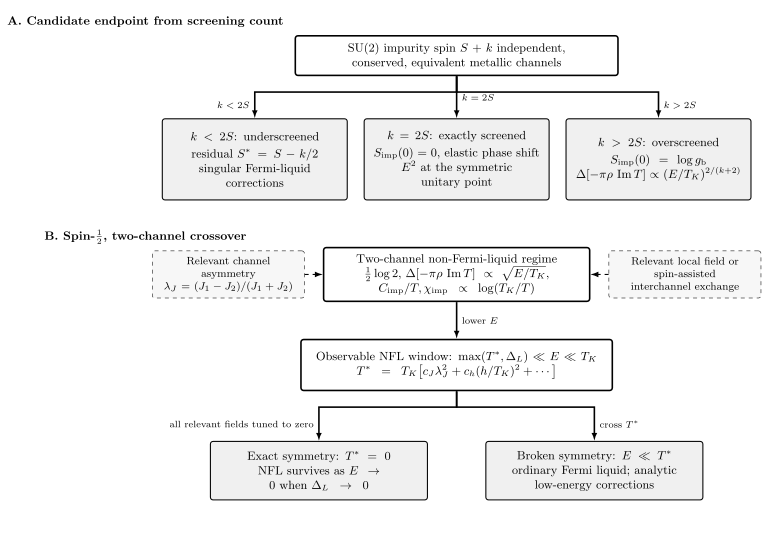
Screening count selects the candidate infrared endpoint. The exactly screened branch has zero residual entropy and an elastic phase shift; at its symmetric unitary point the first spectral corrections are quadratic. The overscreened branch instead has fractional boundary entropy and nonanalytic corrections, but a finite two-channel device shows that behavior only in the window . At exact symmetry, the non-Fermi-liquid endpoint persists to only in the thermodynamic limit . Original schematic for metallic SU(2) channels; not to scale.
When the conclusion changes
Section titled “When the conclusion changes”The local-Fermi-liquid argument needs a unique screened ground state and a bath with finite low-energy density of states. It changes in three important ways:
- leaves a residual moment and singular corrections;
- with exact channel symmetry can reach the overscreened non-Fermi-liquid fixed point developed next; and
- a pseudogapped or superconducting bath can prevent ordinary metallic screening or create a phase transition.
Even within a Fermi liquid, particle–hole asymmetry shifts , energy-dependent hybridization separates displaced charge from local occupancy, and an extra transmission path invalidates the single-phase conductance formula.
The broader chapter diagram locates this endpoint after charge matching and weak-coupling RG.
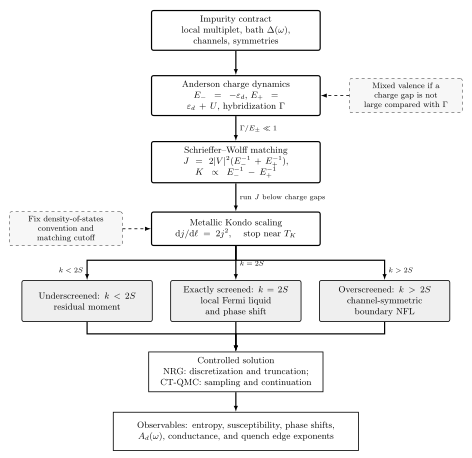
The exactly screened branch is the destination analyzed on this page. The one-orbital Anderson route supplies one active hybridization eigenchannel; genuinely multichannel branches require a channel-preserving microscopic realization. Original workflow schematic, not to scale.
The impurity claim test matrix lists the exceptions.
Common pitfalls
Section titled “Common pitfalls”Counting only the dot charge. Friedel’s count concerns the impurity-induced charge of the full system. Replacing it by is justified in the conventional wide-flat-band Anderson Fermi liquid, not by the name “impurity model” alone.
Calling every Fermi-liquid spectrum quadratic. Analyticity permits a linear term when . The linear term disappears at the symmetric unitary point because .
Equating perfect screening with perfect transmission. The impurity can have while lead asymmetry or a parallel path makes the measured conductance nonunitary.
Exercises
Section titled “Exercises”Use the Friedel branch. A spin-symmetric wide-band Anderson impurity has and is continuously connected to the empty-orbital limit. Find and .
Solution
Spin symmetry gives . On the branch that starts from at zero occupancy,
Therefore . Choosing would reproduce the same -matrix but the wrong continuously tracked charge.
Locate the linear spectral term. Let . Expand through first order. Compare with .
Solution
Using gives
For , , so the first correction is quadratic. For , the coefficient is and a linear term is allowed.
Separate screening from lead asymmetry. Evaluate the zero-temperature conductance for and .
Solution
The asymmetry factor is . Thus . The impurity can be fully screened with a phase shift even though the measured two-terminal conductance is below the unitary symmetric-lead value.
References
Section titled “References”- Langreth, D. C. (1966). “Friedel sum rule for Anderson’s model of localized impurity states.” Physical Review 150, 516–518. doi:10.1103/PhysRev.150.516.
- Meir, Y., and Wingreen, N. S. (1992). “Landauer formula for the current through an interacting electron region.” Physical Review Letters 68, 2512–2515. doi:10.1103/PhysRevLett.68.2512.
- Mitchell, A. K., Logan, D. E., and Krishnamurthy, H. R. (2011). “Two-channel Kondo physics in odd impurity chains.” Physical Review B 84, 035119. doi:10.1103/PhysRevB.84.035119.
- Mora, C., Moca, C. P., von Delft, J., and Zaránd, G. (2015). “Fermi-liquid theory for the single-impurity Anderson model.” Physical Review B 92, 075120. doi:10.1103/PhysRevB.92.075120.
- Nozières, P. (1974). “A ‘Fermi-liquid’ description of the Kondo problem at low temperatures.” Journal of Low Temperature Physics 17, 31–42. doi:10.1007/BF00654541.
Original QFT.org content:CC BY 4.0, unless an item supplies different terms. Third-party material retains its own terms.