

Quantum Phase Transitions and Critical Metals
A quantum critical point can organize gaps, finite-temperature crossovers, metallic self-energies, and transport without making all of them one scale or one mechanism. This chapter develops the scale dictionary, LGW and Hertz–Millis reductions, hot-spot and patch theories, dangerous variables, SYK local criticality, strange-metal transport, and a hierarchy for discriminating models. Every exponent is tied to retained fields, a controlled limit, and an observable.
Helpful background. Quantum Phase Transitions and Competing Scales provides a direct diagnostic of , , finite size, and crossover order; Patch Renormalization and Competing Instabilities supplies the local Fermi-surface coordinates used for metallic theories.
Enter this chapter
Section titled “Enter this chapter”For one relevant tuning field , the basic zero-temperature scales are
These relations do not yet specify the critical fields. If all non-order-parameter modes are gapped, a local LGW theory may suffice. A metal retains a Fermi surface: integrating it out generates Landau damping and may also generate singular higher vertices, so hot fermions or patches often have to remain explicit. A dangerously irrelevant coupling can split the thermal shift exponent from , while hyperscaling violation uses a separate exponent .
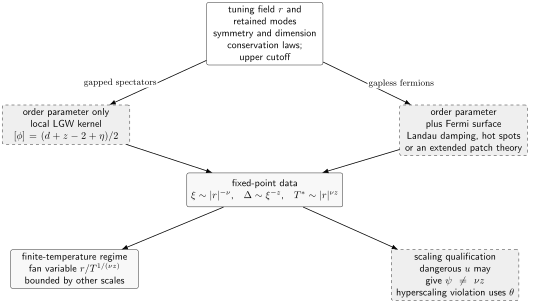
Critical scaling begins by deciding which modes remain. The fixed-point relations for , , and are then supplemented—not replaced—by thermal, dangerous-variable, or hyperscaling-violation data. The diagram is schematic.
A route through the subject
Section titled “A route through the subject”Quantum Phase Transitions and Competing Scales defines tuning, correlation length, gap, temperature, size, and avoided criticality. Landau–Ginzburg–Wilson Quantum Criticality derives and and states the order-parameter-only assumptions. Quantum-Critical Fans and Finite-Temperature Scaling turns the fixed point into testable crossover functions with backgrounds and corrections.
Hertz–Millis Theory and Landau Damping derives clean and finite- damping and explains why integrating out gapless fermions can fail; the underlying reduction and its finite-temperature extension were formulated by Hertz 1976, §§ II–IV and Millis 1993, §§ II–III. Spin-Fermion and Hot-Spot Theories retains the coupled fermions and order parameter with explicit momentum conventions and control limits, including the singular higher-loop structure exhibited by Metlitski and Sachdev 2010, §§ III–VI. Dangerously Irrelevant Couplings and Hyperscaling Violation separates singular irrelevant variables, thermal shift exponents, and the free-energy exponent .
Metallic Non-Fermi Liquids and Quasiparticle Breakdown gives the pole-residue and linewidth criteria. Critical Fermi Surfaces and Patch Theories develops antipodal-patch scaling, curvature, coupling signs, and the self-energy. SYK Models and Local Quantum Criticality fixes the Majorana normalization and the boundary between a solvable dot and spatial quantum matter, following the large- conformal solution and finite-temperature correlators of Maldacena and Stanford 2016, §§ 2–3.
Strange-Metal Transport and Planckian Claims separates dc slope, Drude weight, momentum relaxation, and several inequivalent rates. Evidence and Model Discrimination at Quantum Criticality closes the chapter by comparing momentum structure, Fermi volume, optical weight, disorder, field response, and held-out predictions.
Mechanism and evidence table
Section titled “Mechanism and evidence table”This is the canonical mechanism comparison for the chapter. refers to the declared Gaussian or patch scaling and is not silently transferred between rows.
| Mechanism | Retained low-energy fields | Dynamics | Controlled limit | Dangerous variable or hyperscaling issue | Transport assumption | Finite-temperature scope | Evidence ceiling |
|---|---|---|---|---|---|---|---|
| Relativistic LGW | local -component order parameter | in the displayed kernel | expansion, large , or known fixed point | quartic dangerous above | transport requires a separately defined current | fan below UV and above other gaps | identifies an order-parameter universality class |
| Antiferromagnetic Hertz–Millis | damped order parameter after fermions are removed | , Gaussian | regular generated vertices; often above upper critical dimension | controls thermal mass and | momentum relaxation not supplied by the boson action alone | can be preempted by pairing | establishes damping kinematics, not harmless fermion removal |
| Clean ferromagnetic Hertz theory | small- order parameter | , Gaussian | weak-coupling reduction before nonanalytic feedback | dangerous; soft fermion modes add nonlocality | small-angle scattering weakly relaxes current | first-order or modulated order may intervene | a fit does not prove a continuous local action |
| Spin-fermion hot spots | order parameter plus discrete hot fermions | coupled, generally beyond fixed one-loop picture | , emergent velocity ratio, or specified model | pairing and composite channels introduce lower scales | cold regions and momentum sinks must be included | above superconducting and curvature crossovers | identifies hot-region breakdown within the stated control |
| Gauge or nematic patches | extended Fermi surface plus low- boson | anisotropic | controlled deformation; naive large is nonuniform | patch count produces hyperscaling issues | vertex corrections and antipodal coupling sign matter | often hidden by pairing | supports a critical Fermi surface, not a unique global metal |
| SYK dot or array | all-to-all large- fermions; spatial couplings added for arrays | local conformal time, no dot momentum | before deep infrared | residual entropy and finite- scale depend on limits | dot has no conductivity; arrays require explicit current | for conformal dot window | proves solvable local criticality for the specified model |
| Planckian transport fit | current response and fitted weight | optical/DC consistency and covariance, not an RG limit | changing Drude weight can mimic a rate | explicit umklapp, disorder, phonons, or other momentum sink | declared linear window | establishes an order-one fitted rate, not a universal bound | |
| Evidence comparison | predictions from several mechanisms | model-specific | common covariance and held-out tests | corrections and analytic backgrounds retained | compare DC, optical, Hall, thermal, and one-particle channels | searched windows reported | mechanism only when alternatives make and fail distinct predictions |
Shared symptoms and distinguishing observables
Section titled “Shared symptoms and distinguishing observables”Power laws, broad spectra, scaling, and linear resistivity appear in multiple mechanisms. Model discrimination begins only after those shared symptoms: hot-spot versus small- momentum structure, reconstructed versus unreconstructed Fermi volume, changing versus fixed optical weight, sample-disorder trends, and cross-observable amplitudes. The second diagram summarizes this boundary.
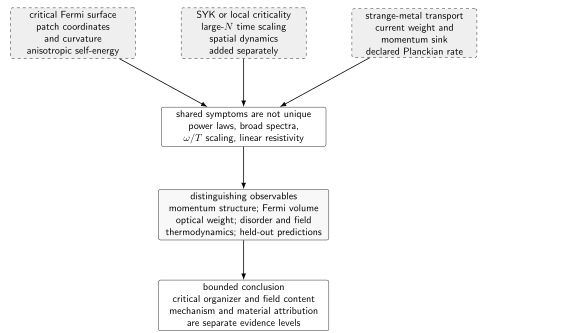
Shared exponents establish at most a common phenomenology. Field content, microscopic mechanism, and attribution to a material require progressively more distinguishing evidence. The diagram is schematic and keeps those levels separate.
Review the chapter
Section titled “Review the chapter”- Starting from , derive and construct a finite-size scaling variable that includes temperature.
- Compare in relativistic LGW, antiferromagnetic Hertz, and ferromagnetic Hertz theories.
- Derive and from their damping kernels, then state why either result can survive even when a local boson-only theory fails.
- For a two-dimensional antipodal patch pair, verify the anisotropic scaling and explain the gauge/nematic coupling-sign difference.
- Distinguish a dangerously irrelevant from a hyperscaling-violation exponent using free energy and ordered amplitude.
- Design a joint optical, spectral, and disorder test that separates a linear dc resistivity from a uniquely defined Planckian transport mechanism.
References
Section titled “References”- Hertz, J. A. “Quantum Critical Phenomena.” Physical Review B 14 (1976): 1165–1184. DOI.
- Maldacena, J., and D. Stanford. “Remarks on the Sachdev–Ye–Kitaev Model.” Physical Review D 94 (2016): 106002. DOI.
- Metlitski, M. A., and S. Sachdev. “Quantum Phase Transitions of Metals in Two Spatial Dimensions. II. Spin Density Wave Order.” Physical Review B 82 (2010): 075128. DOI.
- Millis, A. J. “Effect of a Nonzero Temperature on Quantum Critical Points in Itinerant Fermion Systems.” Physical Review B 48 (1993): 7183–7196. DOI.
Original QFT.org content:CC BY 4.0, unless an item supplies different terms. Third-party material retains its own terms.