

Cold Atoms and Synthetic Matter
Cold atoms, molecules, optical lattices, laser-dressed bands, and moiré devices make many-body Hamiltonians unusually tunable, but a control knob is not yet a physical parameter and a programmed Hamiltonian is not yet a validated realization. This chapter follows the full chain from preparation and calibration through effective-Hamiltonian matching, correction hierarchies, state and observation maps, held-out benchmarks, and bounded phase evidence.
Helpful background. Ultracold platforms, scales, and traps is the recommended physical entry. What counts as a quantum simulation supplies the general distinction between a target model, its implementation, and evidence for its predictions.
Enter cold atoms and synthetic matter
Section titled “Enter cold atoms and synthetic matter”A platform claim has four linked maps:
The controls may be laser intensities and phases, magnetic or electric fields, trap settings, twist and displacement fields, ramp waveforms, or gate voltages. Their calibrated parameters have covariance . The separation between programmable controls, effective Hamiltonians, and many-body observables is illustrated across ultracold-gas platforms by Bloch, Dalibard, and Nascimbène 2012, pp. 267–276. Matching gives
where the are retained discrepancy operators. State preparation and measurement have separate nuisance parameters . A reliable conclusion specifies which map was validated and over what range of density, temperature, size, time, and observable.
| Reader goal | Suggested route | Capability at the end |
|---|---|---|
| Establish a continuum platform | Scales and traps → Feshbach calibration → unitary gas | Construct , , , LDA, loss, and response records |
| Realize a lattice model | Scales and traps → Feshbach calibration → optical lattice → certification | Derive , , correction terms, preparation and readout maps, and held-out tests |
| Treat long-range or geometric couplings | Long-range molecules or synthetic gauge fields → certification | Match anisotropic interactions or Berry connections while bounding internal-state, heating, and projection errors |
| Evaluate a solid-state synthetic platform | Moiré bands → certification | Compare geometric, kinetic, Coulomb, topology, flavor, disorder, and probe scales without inferring a phase from filling |
Calibration before interpretation
Section titled “Calibration before interpretation”In a trapped continuum Fermi gas, for example,
The local-density approximation uses a homogeneous equation of state at only when the trap varies slowly over the relevant correlation length and local equilibration has occurred. At a magnetic Feshbach resonance,
but becomes a universal contact coupling only after , confinement, field gradients, and loss have been bounded Chin et al. 2010, §§II–IV. In an optical lattice, calibrated Bloch and Wannier functions determine and ; a large band gap must still dominate interactions, temperature, and ramp rates.
The structure figure displays this common chain across continuum, lattice, molecular, gauge, and moiré settings. Inspect the arrows around the effective Hamiltonian: preparation and observation are not downstream formalities but independent transformations that can invalidate an otherwise correct parameter match.
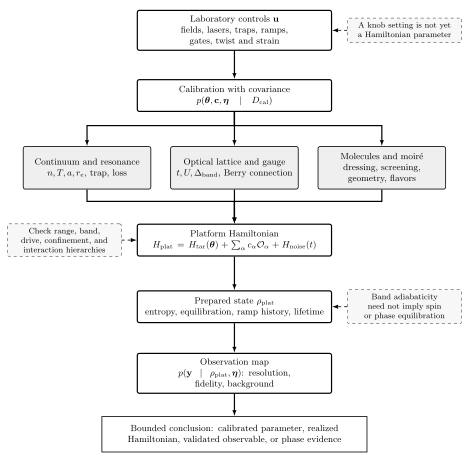
The platform-to-many-body dictionary. Calibration, Hamiltonian matching, state preparation, and observation each add assumptions and uncertainty; none can be inferred solely from the preceding knob setting. Original schematic, not to scale; evidence status is bounded through 10 August 2026.
Nonvisual description of the synthetic-matter structure figure
Section titled “Nonvisual description of the synthetic-matter structure figure”| Figure element or arrow | Relation encoded | Condition or resulting statement |
|---|---|---|
| Laboratory controls | Fields, lasers, traps, ramps, gates, twist, and strain form the control vector . | The dashed side note states that a knob setting is not yet a Hamiltonian parameter. |
| Controls → calibration | Independent calibration produces a joint distribution . | Parameter, discrepancy, and nuisance covariances remain attached to later predictions. |
| Calibration → continuum and resonance branch | The continuum branch determines , , , , trap, and loss parameters. | Resonant universality requires the range, confinement, gradient, and lifetime hierarchy appropriate to the claim. |
| Calibration → optical-lattice and gauge branch | The lattice branch determines , , , and the Berry connection. | Higher bands, nonadiabatic dressing, scalar potentials, and heating remain possible corrections. |
| Calibration → molecular and moiré branch | The molecular and moiré branch determines dressing, screening, geometry, and active flavors. | Internal channels, relaxation, remote bands, strain, and inhomogeneity constrain the reduction. |
| Three platform branches → platform Hamiltonian | Each branch feeds . | The dashed hierarchy condition requires checks of interaction range, band isolation, drive, confinement, and correction scales. |
| Platform Hamiltonian → prepared state | Hamiltonian realization is followed by preparation of with stated entropy, equilibration, ramp history, and lifetime. | The dashed side note warns that band adiabaticity need not imply spin or phase equilibration. |
| Prepared state → observation map | The state is mapped to with resolution, fidelity, and background. | Measurement inversion and covariance are distinct from Hamiltonian calibration. |
| Observation map → bounded conclusion | The completed chain supports only the strongest verified level: a calibrated parameter, realized Hamiltonian, validated observable, or phase evidence. | No later level follows solely from success at an earlier level. |
Failure channels and claim strength
Section titled “Failure channels and claim strength”Different platforms fail in different ways, but the inference structure is common. Trap inhomogeneity can mix phases; finite range can spoil resonant universality; higher bands can invalidate a Hubbard reduction; microwave shielding can alter both loss and interactions; spontaneous emission and Floquet absorption can heat a dressed band; strain and screening can change a moiré Hamiltonian; imaging and contact resistance can change the measured observable. The geometric and dynamical routes to artificial gauge potentials, including their scalar corrections and adiabatic limits, are reviewed by Dalibard et al. 2011, §§II–V.
The second figure is a sequence of claim checks rather than a phase diagram. Inspect the dashed exits: they retain a narrower result—such as a calibrated single-particle band or finite-time correlation—even when a many-body realization or phase conclusion is not warranted.
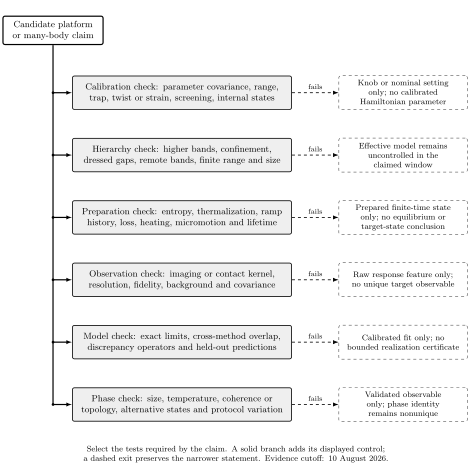
Validity map for synthetic-matter claims. A knob setting, calibrated parameter, realized Hamiltonian, validated observable, and phase inference are successively stronger conclusions. Original schematic, not to scale; mutable platform and phase evidence is assessed through 10 August 2026.
Nonvisual description of the synthetic-matter validity figure
Section titled “Nonvisual description of the synthetic-matter validity figure”A candidate platform or many-body claim branches to the controls required by its stated level. A solid branch adds a control; the paired dashed exit retains the narrower conclusion when that control fails.
| Test selected | Control added by the solid branch | Dashed-exit conclusion when the test fails |
|---|---|---|
| Calibration check | Propagate covariance in interaction range, trap, twist or strain, screening, and internal-state parameters. | Only a knob or nominal setting is known; no calibrated Hamiltonian parameter follows. |
| Hierarchy check | Bound higher bands, confinement, dressed gaps, remote bands, finite range, and finite size. | The effective model remains uncontrolled in the claimed window. |
| Preparation check | Establish entropy, thermalization, ramp history, loss, heating, micromotion, and lifetime. | The result describes a prepared finite-time state, not an equilibrium or target-state conclusion. |
| Observation check | Calibrate the imaging or contact kernel, resolution, fidelity, background, and covariance. | A raw response feature is not a unique target observable. |
| Model check | Test exact limits, cross-method overlap, discrepancy operators, and held-out predictions. | A calibrated fit alone is not a bounded realization certificate. |
| Phase check | Vary size, temperature, coherence or topology diagnostics, alternative states, and protocol. | A validated observable does not uniquely identify the phase. |
The validity relations above use the evidence cutoff 10 August 2026.
Cold-atom and synthetic-matter claim test matrix
Section titled “Cold-atom and synthetic-matter claim test matrix”| Platform or claim | Calibrated Hamiltonian term | Required scale hierarchy | Preparation | Observable and resolution | Loss, heating, discrepancy | Evidence ceiling through 10 August 2026 |
|---|---|---|---|---|---|---|
| Cross-platform realization | with covariance | Retained target scales exceed bounded corrections over declared domain | State, ramp, equilibration, and history fixed | Full response matrix with held-out predictions | Noise, omitted operators, and covariance stress-tested | Model compatibility for stated states, sizes, times, and observables |
| Trapped continuum gas | Kinetic, trap, chemical potential, and matched interaction | , , , , , lifetime | Atom number, entropy, ramps, and holds reproduced | Density or correlations after LDA and point-spread map | Trap gradients, dimensional crossover, loss, heating | Local or trap-averaged equation-of-state statement, not automatic phase identity |
| Feshbach-controlled gas | , , , and confinement-matched coupling | Field covariance small enough; , and loss controlled | Sweep and molecule-association history specified | Spectroscopy, binding energy, loss, or many-body response | Overlapping poles, gradients, optical loss, closed-channel fraction | Calibrated scattering window; pole field alone does not prove unitarity |
| Optical-lattice Hubbard system | Wannier , , trap, and leading extended terms | ; smaller resolved | Loading entropy and spin equilibration tested | Site-resolved density and correlations with parity/fidelity map | Higher bands, , , density-assisted hopping, photon heating | Hubbard realization and observable agreement in benchmarked window |
| Unitary Fermi gas | Zero-range broad-resonance fixed point plus range corrections | , , trap and imbalance small as claimed | Equilibrium and thermometry established | Dimensionless EOS, contact, spectral or superfluid observable with convention | Range, trap, final-state response, analytic continuation | Universal scaling relations; numerical benchmarks retain method uncertainty |
| Dipolar or molecular gas | Contact plus anisotropic dressed interaction and internal channels | Diluteness, confinement, shielding gap, thermalization and lifetime | Polarization, dressing, evaporation, and internal-state purity fixed | Momentum spectrum, coherence, modulation, expansion, or loss | Short-range collision model, LHY boundary, two-/three-body loss | Roton, condensate, droplet, or coherence evidence for stated protocol |
| Synthetic gauge or spin–orbit gas | Berry connection, scalar potential, SOC or Floquet Hamiltonian | Dressed gap exceeds Doppler, interaction, temperature, ramp; drive avoids resonances | Laser phases, detuning, polarization, timing controlled | Band geometry, Wilson-loop or dynamics with micromotion map | Spontaneous emission, nonadiabaticity, Floquet heating, projection | Calibrated gauge dynamics; interacting topological phase requires separate tests |
| Moiré flat-band device | Continuum/downfolded bands plus screened form-factor interaction | , isolation gaps, , temperature, disorder, remote bands quantified | Density, displacement field, twist/strain map, history fixed | Compressibility, spectroscopy, transport, thermodynamics with contacts | Relaxation, screening, flavor polarization, domains, inhomogeneity | Device-specific band or phase evidence; filling alone has no phase content |
| Certified analog simulation | Target, discrepancy operators, preparation and measurement channels | Exact limits and benchmark regime overlap the claimed domain | Calibration data separated from validation data | Held-out observable vector with full covariance | Adversarial faults, solver discrepancy, extrapolation failure | Bounded model-realization certificate, never proof beyond tested domain |
The two artifact-specific tables above are the nonvisual equivalents of the figures and preserve their nodes, arrows, conditions, and failed-test exits. The claim test matrix is a chapter-level comparison of platforms and evidence ceilings; it does not reproduce either figure’s graph topology.
Guide to the pages
Section titled “Guide to the pages”- Ultracold Platforms, Scales, and Traps builds the dimensionless scale table, LDA map, thermometry, loss, heating, and imaging kernel.
- Feshbach Control and Resonance Calibration converts a signed field resonance into scattering length, range, width, confinement, and loss parameters.
- Optical Lattices and Hubbard-Model Realizations derives Wannier and and bounds higher-band, trap, loading, and readout corrections.
- Unitary Fermi-Gas Platforms and Benchmark Evidence separates exact scale relations from numerical thermodynamic, spectral, and superfluid benchmarks.
- Long-Range, Dipolar, and Molecular Quantum Gases develops the anisotropic interaction and stability criterion with shielding, loss, confinement, and coherence limits.
- Synthetic Gauge Fields and Spin–Orbit Coupling derives Berry connections and Raman SOC while bounding projection, micromotion, and heating.
- Moiré Flat-Band Quantum-Matter Platforms compares moiré geometry, bandwidth, topology, screening, flavors, strain, and phase evidence.
- Analog-Simulation Model Realization and Observable Validation turns calibration and discrepancy records into noncircular held-out tests.
Review the chapter
Section titled “Review the chapter”Trap translation. If a harmonic trap has , then a measured shell at radius samples a homogeneous chemical potential only within LDA. Moving the shell changes density, , range parameters, and resolution in local units simultaneously; a trap-averaged curve cannot be labeled by central alone.
Hamiltonian hierarchy. Suppose a Hubbard realization has , a higher-band correction , and an uncertainty . Relative to charge dynamics these are small, but the antiferromagnetic scale is . The correction is of and the uncertainty ; a spin-correlation claim must use the smaller comparison scale.
Evidence limits. The durable conclusion is always tied to a calibration version, parameter and state domain, observable map, and cutoff. A cryogenic neutral-atom Hubbard implementation illustrates how calibration, thermometry, solver control, and observable scope remain coupled Xu et al. 2025, main text, Methods, and source data. The source assessment in this chapter is current through 10 August 2026. The dated Quantum Matter and Emergence Research synthesis carries later platform results, corrections, and disputed phase evidence. A reproducible verification workflow should cover covariance, discrepancy, and held-out validation.
References
Section titled “References”- Bloch, I., Dalibard, J., and Nascimbène, S. (2012). “Quantum simulations with ultracold quantum gases.” Nature Physics 8, 267–276. doi:10.1038/nphys2259.
- Chin, C., Grimm, R., Julienne, P., and Tiesinga, E. (2010). “Feshbach resonances in ultracold gases.” Reviews of Modern Physics 82, 1225–1286. doi:10.1103/RevModPhys.82.1225.
- Dalibard, J., Gerbier, F., Juzeliūnas, G., and Öhberg, P. (2011). “Colloquium: Artificial gauge potentials for neutral atoms.” Reviews of Modern Physics 83, 1523–1543. doi:10.1103/RevModPhys.83.1523.
- Xu, M., Kendrick, L. H., Kale, A., Gang, Y., Feng, C., Zhang, S., Young, A. W., Lebrat, M., and Greiner, M. (2025). “A neutral-atom Hubbard quantum simulator in the cryogenic regime.” Nature 642, 909–915. doi:10.1038/s41586-025-09112-w.
Original QFT.org content:CC BY 4.0, unless an item supplies different terms. Third-party material retains its own terms.