

Quantum Impurities, Polarons, and Kondo Matter
A quantum impurity problem is defined by a small Hilbert space coupled to a continuum, but its low-energy behavior depends on more than the impurity Hamiltonian. Bath density of states, channel symmetry, conserved charges, charge-excitation gaps, the definition of the Kondo scale, and the measured operator all matter. This chapter builds the Anderson-to-Kondo chain with those data explicit, then asks what survives for transport, edge singularities, mobile impurities, Kondo lattices, heavy Fermi liquids, and quantum-critical evidence.
Helpful background. Quantum impurity models and local moments defines the local Hilbert space and bath channels. Dyson equations and self-energies supplies the spectral-function and pole language used for hybridization, transport, and polarons.
Enter impurity and Kondo physics
Section titled “Enter impurity and Kondo physics”The central habit is to preserve the scale at which each description becomes valid. The Anderson model retains virtual impurity charge states; Schrieffer–Wolff matching removes them below their excitation gaps; perturbative Kondo RG stops when the exchange becomes strong; and infrared phase shifts, residual entropy, or non-Fermi-liquid exponents require a separate fixed-point solution. Extending one impurity to a lattice adds coherence and intersite exchange rather than merely repeating the single-site calculation.
| Reader goal | Suggested route | Capability at the end |
|---|---|---|
| Single-impurity core | Local Hilbert space → Anderson model → Schrieffer–Wolff matching → Kondo RG → strong coupling | Derive the exchange, Kondo scale, screened phase shift, and their domains of validity |
| Non-Fermi-liquid impurity physics | Core route → multichannel Kondo → NRG or CT-QMC | Classify screening by spin and channel number and test a solver against fixed-point and sum-rule data |
| Spectroscopy and quenches | Anderson model → strong coupling → quantum-dot transport → orthogonality edge | Translate a local spectrum or phase-shift change into conductance or threshold exponents with the correct measurement kernel |
| Mobile and lattice extensions | Polarons → Kondo lattice and RKKY → heavy Fermi liquid → Kondo-breakdown evidence | Separate a pole from a continuum, a scale comparison from a phase diagram, and a large Fermi surface from a dated criticality claim |
The Anderson-to-Kondo construction
Section titled “The Anderson-to-Kondo construction”For one correlated orbital, the Anderson Hamiltonian is
The bath enters through . A local moment is possible when the empty and doubly occupied charge gaps and are both large compared with temperature and hybridization broadening. Eliminating those virtual charge states gives, for slowly varying and ,
Anderson 1961, §§2–4 establishes the charge-fluctuating model, while Schrieffer and Wolff 1966, pp. 491–492 derives the displayed matching. This is a result at a cutoff below the charge gaps. For a metallic bath with density of states per spin, , and , leading scaling gives and ; Cheng et al. 2017, accepted manuscript, Eqs. (66)–(67), pp. 11–12, PDF states exactly this normalization. Kondo 1964, pp. 37–43 identifies the perturbative logarithm, and Wilson 1975, §§II–V resolves the nonperturbative crossover. The weak-coupling divergence identifies loss of control; it does not derive the screened infrared state, whose one-channel spin- limit has a Kondo phase shift at particle–hole symmetry and Fermi-liquid corrections fixed by irrelevant operators.
The structure figure follows this sequence while separating two microscopic routes: the one-orbital Anderson model produces one active hybridization eigenchannel, whereas genuine screening requires independent conserved baths and channel-resolved matching.
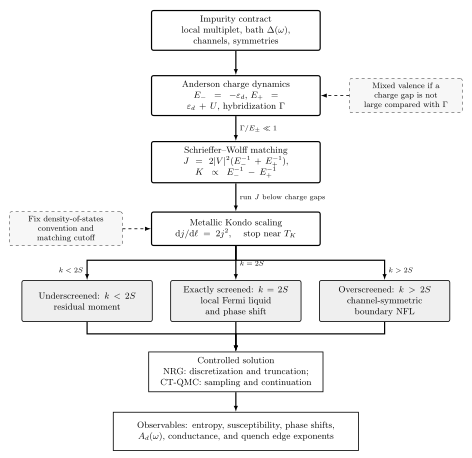
The impurity–Kondo dictionary. The one-orbital Anderson route licenses Schrieffer–Wolff matching only across separated charge gaps and supplies one active channel. A distinct channel-preserving microscopic route must supply for genuine screening. Running exchange, candidate fixed-point physics, controlled solution, and measured spectra remain separate steps. Original schematic, not to scale.
Extensions and inference boundaries
Section titled “Extensions and inference boundaries”A transport maximum is a convolution of the impurity spectrum with lead couplings, Fermi functions, bias drop, and temperature; it is not a direct image of the equilibrium spectral function outside controlled limits. An X-ray edge is instead a quench problem governed by the change of scattering phase shifts. A mobile impurity acquires momentum, recoil, and competing polaron or molecular branches. A Kondo lattice adds the intersite RKKY scale, lattice coherence, and a global Fermi-volume question. Hewson 1993, chs. 4–10 develops the single-impurity-to-heavy-fermion progression, and Coleman 2015, chs. 16–19 makes the constraint, hybridization, and competing-scale structure explicit.
The resulting inference problem is displayed below. The Doniach comparison versus in the same per-spin convention is an organizing estimate, not a proof of a unique phase boundary. Likewise, a Hall crossover, Fermi-surface reconstruction, non-Fermi-liquid scaling, or vanishing coherence scale is individually nonunique. A Kondo-breakdown conclusion requires one parameterization that jointly fits thermodynamics, transport, momentum- or frequency-resolved probes, and their crossover widths while confronting spin-density-wave, Lifshitz, valence, disorder, and multiband alternatives.
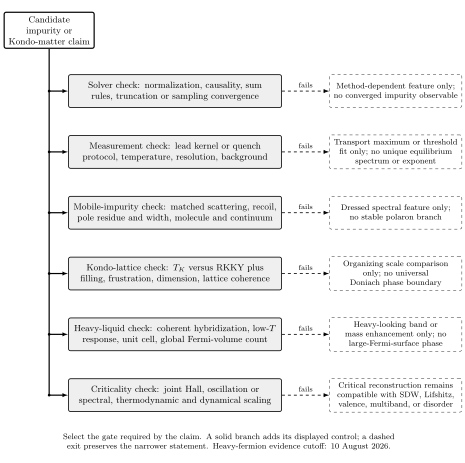
Six independent, claim-selected validity gates for impurity measurements and lattice extensions. Solid branches select the control required by a proposed conclusion; dashed exits state the narrower conclusion retained when that control fails. The gates are alternatives, not a chronological sequence. Original schematic, not to scale; heavy-fermion evidence is bounded through 10 August 2026.
Impurity claim test matrix
Section titled “Impurity claim test matrix”| Claim or regime | Fixed point or defining input | Observable | Necessary control | Decisive failure test or ceiling |
|---|---|---|---|---|
| Local-moment impurity | Declared local multiplet, bath channels, and positive charge gaps | Curie susceptibility and moment-sector probability | below and ; symmetry and channel conservation stated | Mixed-valence charge fluctuations are order one or the bath is not the assumed low-energy continuum |
| Anderson resonance | , , and hybridization function | Impurity spectral function, occupancy, and charge susceptibility | Spectral sum rule, causality, bandwidth, and bath normalization | Claimed feature moves or loses weight under an admissible bath reconstruction |
| Schrieffer–Wolff Kondo model | Projection onto a separated moment multiplet | Matched exchange , potential scattering , and transformed operators | and cutoff below both charge gaps | Mixed valence or an omitted nearby multiplet invalidates the projection |
| Perturbative Kondo scaling | Antiferromagnetic exchange and metallic bath convention | Running and convention-defined | Density of states, cutoff, and observable definition of fixed | Finite size, temperature, pseudogap, field, or superconducting gap stops the flow first |
| Exactly screened strong coupling | Conserved metallic channels with | Phase shift, Friedel count, vanishing residual entropy, and analytic local-Fermi-liquid corrections | Phase branch, displaced-charge and Luttinger hypotheses, irrelevant-operator regime, and contact geometry | Under- or overscreening or a nonmetallic bath changes the fixed point; asymmetry shifts the phase and can permit a linear spectral term |
| Overscreened Kondo | Channel-symmetric exchange | Residual entropy and nonanalytic boundary exponents | Channel anisotropy, field, spin-assisted interchannel exchange, finite size, and crossover scale controlled | A relevant perturbation drives the system to a Fermi liquid before the claimed window |
| NRG result | Logarithmic discretization and iterated truncated chain | Thermodynamics and real-frequency spectra | Discretization, kept-state, symmetry, broadening, sum-rule, and exact-limit convergence | Result drifts beyond tolerance under , shift, truncation, or broadening changes |
| CT-QMC result | Specified imaginary-time impurity action | Matsubara correlators and thermodynamics | Expansion order, sampling, autocorrelation, covariance, tail, stabilization, and sign or phase checks | Analytic continuation is presented as unique or errors fail replica and sum-rule tests |
| Quantum-dot spectroscopy | Interacting region plus lead and bias model | Conductance matrix, temperature and field scaling, and noise | Coupling asymmetry, voltage drop, heating, resolution, and nonequilibrium treatment | A dot level, singlet–doublet crossing, or lead artifact fits the same sweeps |
| Orthogonality or X-ray edge | Sudden local quench and initial/final phase shifts | Overlap exponent and threshold power law | Channel count, phase-shift branch, core-hole lifetime, and finite-temperature rounding | Bound-state or excitonic contribution is omitted or no asymptotic scaling window exists |
| Mobile polaron | Matched impurity–medium scattering and total momentum | Pole energy, residue, width, effective mass, molecule and continuum thresholds | Density/range parameters, recoil, branch preparation, and spectral sum rule | Peak lacks pole scaling, decays into continuum, or molecule and final-state effects remain viable |
| Kondo-lattice competition | Local moments, conduction band, , and intersite exchange | Magnetic ordering, coherence scale, and reconstructed bands | Frustration, filling, dimensionality, and self-consistent lattice dynamics | Doniach scale crossing alone is used as a phase boundary or single-impurity is equated with coherence |
| Heavy Fermi liquid | Coherent hybridization and unbroken translation symmetry | Low- Fermi-liquid response and large Fermi-volume consistency | Constraint fluctuations, unit cell, multiband structure, and Luttinger hypotheses | Hybridization mean field fits a band without thermodynamic coherence or correct global counting |
| Kondo breakdown or local criticality | Critical loss of Kondo coherence in a specified lattice model | Joint crossover scale, Fermi-volume-sensitive response, dynamics, and thermodynamics | Common tuning variable, width extrapolation, disorder and resolution, held-out predictions | Spin-density-wave, Lifshitz, valence, multiband, or disorder model explains the same combined data |
The surrounding prose, relationship-oriented alternative text, and matrix together provide a nonvisual account of both figures. They keep Hamiltonian matching, RG flow, infrared fixed point, solver output, measurement forward model, lattice extension, and date-bounded evidence in separate columns.
Guide to the pages
Section titled “Guide to the pages”- Quantum Impurity Models and Local Moments defines the impurity Hilbert space, bath, channels, symmetries, and scale hierarchy.
- The Anderson Impurity Model and Hybridization derives the hybridization self-energy and locates empty-orbital, local-moment, and mixed-valence regimes.
- From the Anderson Model to Kondo Exchange eliminates virtual charge states and fixes exchange, potential scattering, transformed operators, and matching cutoff.
- Kondo Screening and Impurity RG Flow integrates weak-coupling scaling and defines its convention-dependent stopping scale.
- Strong-Coupling Screening, Phase Shifts, and the Friedel Sum Rule derives the local Fermi-liquid endpoint and its qualifications.
- Multichannel and Overscreened Kondo Fixed Points classifies under-, exact-, and overscreening and the relevant crossover perturbations.
- NRG and CT-QMC Impurity Solvers: Validity and Error separates discretization, truncation, sampling, and continuation errors.
- Quantum-Dot Transport and Impurity Spectroscopy connects equilibrium spectra to conductance only under a declared lead and bias model.
- Orthogonality Catastrophe and the X-Ray Edge derives overlap and threshold exponents from a sudden phase-shift quench.
- Mobile Impurities and Polarons distinguishes attractive and repulsive poles, molecules, and continua with matched scattering data.
- Kondo Lattices, RKKY Competition, and the Doniach Regime compares screening and intersite exchange without turning two scales into a universal phase diagram.
- Heavy Fermi Liquids, Hybridization, and Large Fermi Surfaces develops lattice coherence and the conditions for a large Fermi-volume statement.
- Kondo Breakdown and Local-Criticality Evidence evaluates reconstruction and scaling evidence against itinerant, valence, disorder, and band-structure alternatives.
Review the chapter
Section titled “Review the chapter”Matching. At particle–hole symmetry, . Evaluate and and state what the calculation does not determine.
Solution
Here , so and in the displayed spin-density convention. The result is controlled only when the hybridization and external energies are small compared with . It defines a low-energy Hamiltonian at a matching cutoff; it does not determine the Kondo crossover prefactor, infrared phase shifts, or a lattice coherence scale.
Fixed-point diagnosis. A two-channel spin- device displays an approximate square-root temperature correction over one decade. What additional evidence would be needed to identify overscreening rather than merely fit an exponent?
Solution
Establish channel symmetry; bound channel anisotropy, magnetic field, and their crossover scales; test residual-entropy or boundary-scaling consistency where accessible; and seek crossover collapse across several observables. A fitted exponent over one decade is not unique because a finite window can mimic asymptotic scaling even when a relevant perturbation ultimately restores a Fermi liquid.
Lattice inference. A Hall coefficient changes rapidly near a heavy-fermion critical field. What follows directly from that observation, and what would be needed to argue for Fermi-surface reconstruction or Kondo breakdown?
Solution
The durable direct conclusion is a crossover in a transport observable. A Fermi-surface or Kondo-breakdown claim additionally requires a calibrated multiband forward model, zero-temperature width extrapolation, quantum-oscillation or spectroscopic information where available, thermodynamic and dynamical scaling, and explicit spin-density-wave, Lifshitz, valence, and disorder comparisons. The dated Quantum Matter and Emergence Research synthesis carries changing material evidence. Reproducible scaling and solver checks should test the competing interpretations.
References
Section titled “References”- Anderson, P. W. (1961). “Localized magnetic states in metals.” Physical Review 124, 41–53. doi:10.1103/PhysRev.124.41.
- Cheng, M., Chowdhury, T., Mohammed, A., and Ingersent, K. (2017). “Phase boundaries of power-law Anderson and Kondo models: A poor man’s scaling study.” Physical Review B 96, 045103. doi:10.1103/PhysRevB.96.045103.
- Coleman, P. (2015). Introduction to Many-Body Physics. Cambridge University Press, chs. 16–19. doi:10.1017/CBO9781139020916.
- Hewson, A. C. (1993). The Kondo Problem to Heavy Fermions. Cambridge University Press. doi:10.1017/CBO9780511470752.
- Kondo, J. (1964). “Resistance minimum in dilute magnetic alloys.” Progress of Theoretical Physics 32, 37–49. doi:10.1143/PTP.32.37.
- Schrieffer, J. R., and Wolff, P. A. (1966). “Relation between the Anderson and Kondo Hamiltonians.” Physical Review 149, 491–492. doi:10.1103/PhysRev.149.491.
- Wilson, K. G. (1975). “The renormalization group: Critical phenomena and the Kondo problem.” Reviews of Modern Physics 47, 773–840. doi:10.1103/RevModPhys.47.773.
Original QFT.org content:CC BY 4.0, unless an item supplies different terms. Third-party material retains its own terms.