

Multichannel and Overscreened Kondo Fixed Points
In a -channel Kondo model, each channel carries an independent copy of the spinful bath. Comparing with twice the impurity spin selects three candidate infrared endpoints: incomplete screening for , a local Fermi liquid for , and an overscreened non-Fermi liquid for . The last possibility is much less generic than the counting formula suggests. The channels must be conserved, metallic, and symmetry-equivalent; channel anisotropy, impurity-spin-assisted interchannel exchange, or a local magnetic field eventually drives the celebrated two-channel fixed point back to a Fermi liquid.
Required background. Kondo RG flow supplies exchange scaling and .
Helpful background. Affine currents and WZW models supplies the exact boundary-CFT description.
What counts as a screening channel
Section titled “What counts as a screening channel”Take
where labels bath momentum and labels the channel. With the local bath field,
We take the density of states per spin and per channel, so the dimensionless exchange is . “Channel” means that is conserved by the exchange and that the baths have equivalent low-energy spectra. Spin is not a channel here: spin is precisely the degree of freedom exchanged with .
Two leads do not automatically make a two-channel model. A single dot orbital with amplitudes and couples only to
while the orthogonal combination decouples. The hybridization matrix has rank one. Genuine screening needs protected orbital, charge, valley, or other labels that remain independent at the impurity.
Under-, exact-, and overscreening
Section titled “Under-, exact-, and overscreening”In the large- boundary problem, one spin- from each active channel can participate in screening. Their maximally aligned boundary spin is , which couples antiferromagnetically to .
- If , screening is incomplete and a residual spin remains. Ferromagnetic residual coupling produces singular corrections.
- If , the boundary spins can form a singlet. The stable endpoint is the local Fermi liquid developed on the previous page.
- If , the formal cluster has residual spin . Hopping onto and off the boundary generates an effective coupling that makes this strong-coupling limit unstable. For exactly equivalent channels, the flow instead stops at a finite-coupling overscreened fixed point.
Nozières and Blandin 1980, §§3–4, pp. 197–204 introduced this strong-coupling classification and its instability argument. It is a classification of the SU(2) model above, not a universal rule for arbitrary impurity representations or nonmetallic baths.
Boundary entropy and anomalous powers
Section titled “Boundary entropy and anomalous powers”Define the impurity entropy by subtracting the same bath without the impurity,
At a conformal boundary condition its zero-temperature limit is , where is a boundary degeneracy rather than the dimension of an isolated impurity Hilbert space. Fusion in the spin sector gives, for the integrable representations ,
For exact screening, and , so the residual entropy vanishes. For the two-channel spin- model,
The noninteger does not mean that a literal fraction of a free finite-state object sits at the impurity. It is a universal contribution from an entangled many-body boundary condition. Affleck and Ludwig 1991, “Universal noninteger ground-state degeneracy,” pp. 161–164 derives this boundary degeneracy.
The leading irrelevant boundary operator at an overscreened fixed point has scaling dimension
Its first-order correction to single-electron scattering scales as , where can be or . Thermodynamic corrections enter at second order. The comparison is:
| Infrared endpoint | Electron -matrix correction | Low- thermodynamics | |
|---|---|---|---|
| Underscreened, | residual spin gives | singular logarithmic corrections | residual-moment response with logarithmic corrections |
| Exactly screened spin-, | analytic; at the symmetric unitary point | and finite | |
| Overscreened spin-, | |||
| Overscreened | , |
The coefficient and even the presence of the first correction depend on the operator measured and its symmetries; the exponent is not permission to fit every observable to the same power. Affleck and Ludwig 1991, “Critical theory of overscreened Kondo fixed points,” §§4–6 obtains the operator spectrum and thermodynamics.
Relevant perturbations and the observable window
Section titled “Relevant perturbations and the observable window”At the spin-, two-channel fixed point, channel anisotropy and a local magnetic field couple to operators of dimension . A coupling to an operator of dimension grows under a reduction of energy as . Setting the renormalized coupling to order one therefore gives . For , the exponent is two.
The normalizations must be stated separately. With
the parametric scales are
up to convention-dependent coefficients. The stronger channel wins below ; a field polarizes the boundary below . An off-diagonal exchange such as is likewise relevant: it transfers an electron between channels while acting on the impurity spin, so the channel label is no longer conserved. Sela, Mitchell, and Fritz 2011, Eqs. (1)–(4) shows that these symmetry-breaking fields enter a common Fermi-liquid crossover scale.
Potential scattering and bare one-body bath mixing require a different diagnosis. A channel-symmetric local potential acts in the charge sector and is exactly marginal: it shifts a charge phase without by itself removing the overscreened spin/flavor fixed point. For identical baths, a quadratic term can be diagonalized by rotating the channel basis; it becomes channel-dependent potential scattering rather than the relevant spin-assisted exchange above. One must then recheck that the exchange remains diagonal and equivalent in the rotated basis. Affleck and Ludwig 1993, §§II–IV treats the charge-sector phase shifts, while Mitchell, Logan, and Krishnamurthy 2011, Eqs. (66)–(69) makes the one-body-transfer distinction explicit.
Let be the finite-size level spacing and let include all relevant perturbations. Clean two-channel scaling requires a window
The roles that set this window are:
| Input or perturbation | Scaling role at the spin- two-channel point | Observable consequence |
|---|---|---|
| Conserved, equivalent metallic channels | defining fixed-point assumption | permits the overscreened boundary condition |
| Channel anisotropy | relevant, dimension | ; the stronger channel wins below it |
| Local Zeeman energy | relevant, dimension | ; the boundary polarizes below it |
| Impurity-spin-assisted interchannel exchange | relevant | destroys channel conservation and produces a Fermi-liquid crossover |
| Channel-symmetric potential scattering | exactly marginal | shifts a charge phase without removing overscreened spin/flavor scaling |
| Finite-size spacing | infrared cutoff, not a relevant field | the observable window is ; at exact symmetry the endpoint requires |
For , the ultimate endpoint is a Fermi liquid; for , the system has not reached the overscreened regime. At exact symmetry the non-Fermi-liquid boundary condition survives to only in the thermodynamic or continuum limit . A fractional power over a narrow interval is therefore crossover evidence, not by itself proof of the fixed point. Stronger evidence combines tuning of the relevant field, collapse versus , the predicted entropy or thermodynamics, and a microscopic demonstration of channel conservation.
The fixed-point map makes both decisions explicit: channel count selects a candidate endpoint, while perturbations decide whether the overscreened endpoint survives to the measurement scale.
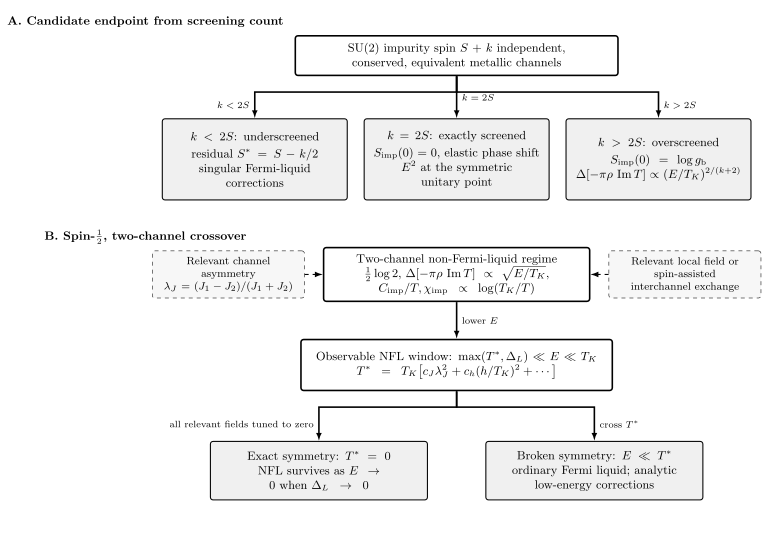
Channel count selects the candidate fixed point only after the microscopic model establishes independent, conserved, equivalent metallic channels. For the two-channel spin- case, fractional entropy and square-root corrections require ; channel anisotropy or a local field produces an ordinary Fermi liquid below . At exact symmetry the non-Fermi-liquid endpoint persists to zero energy only as . Original schematic; scales and flows are not to scale.
The chapter-wide map places this classification inside the full model-to-observable workflow.
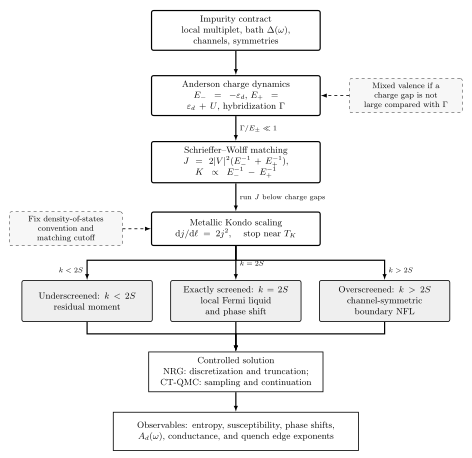
The one-orbital Anderson model generically produces one active hybridization eigenchannel. The overscreened branch requires a different microscopic input that preserves multiple channels; numerical flow must then verify the candidate fixed point. Original workflow schematic, not to scale.
See the impurity claim test matrix for fixed-point and crossover tests.
Common pitfalls
Section titled “Common pitfalls”Counting leads instead of channels. If a unitary rotation leaves only one lead combination coupled, the model is one-channel regardless of how many contacts are drawn.
Calling a crossover a fixed point. NFL powers above can coexist with a Fermi-liquid ground state. State the lower cutoff and demonstrate scaling as the relevant perturbation is tuned.
Treating every particle–hole-breaking or mixing term as relevant. Channel-symmetric potential scattering is marginal, and direct one-body mixing of identical baths can be removed by a channel rotation. Exchange anisotropy and impurity-spin-assisted off-diagonal exchange destabilize two-channel Kondo physics.
Exercises
Section titled “Exercises”Classify three models. Give the screening class for , , and .
Solution
For , and a residual spin remains: underscreened. For , : exactly screened. For , : overscreened if the two channels are exactly conserved and symmetric. Breaking that symmetry ultimately produces a one-channel Fermi liquid.
Evaluate the boundary degeneracy. Use the formula to compute for and . Explain why the answers distinguish exact screening from overscreening.
Solution
For ,
so , as expected for an exactly screened singlet. For ,
so . The noninteger boundary degeneracy diagnoses the overscreened conformal boundary condition, not a free impurity doublet.
Build an observable window. Quote energy scales in kelvin by dividing them by . Take , , , and . With order-one prefactors, estimate the lower edge of the two-channel scaling window.
Solution
The anisotropy and field scales are
For independent relevant fields their squared scaling amplitudes add parametrically, giving of order . The finite-size spacing is larger, so the practical lower edge is about . A two-channel window can exist only for ; precise bounds require the convention-dependent prefactors and observable-specific crossover function.
References
Section titled “References”- Affleck, I., and Ludwig, A. W. W. (1991). “Critical theory of overscreened Kondo fixed points.” Nuclear Physics B 360, 641–696. doi:10.1016/0550-3213(91)90419-X.
- Affleck, I., and Ludwig, A. W. W. (1991). “Universal noninteger ‘ground-state degeneracy’ in critical quantum systems.” Physical Review Letters 67, 161–164. doi:10.1103/PhysRevLett.67.161.
- Affleck, I., and Ludwig, A. W. W. (1993). “Exact conformal-field-theory results on the multichannel Kondo effect: Single-fermion Green’s function, self-energy, and resistivity.” Physical Review B 48, 7297–7321. doi:10.1103/PhysRevB.48.7297.
- Mitchell, A. K., Logan, D. E., and Krishnamurthy, H. R. (2011). “Two-channel Kondo physics in odd impurity chains.” Physical Review B 84, 035119. doi:10.1103/PhysRevB.84.035119.
- Nozières, P., and Blandin, A. (1980). “Kondo effect in real metals.” Journal de Physique 41, 193–211. doi:10.1051/jphys:01980004103019300.
- Sela, E., Mitchell, A. K., and Fritz, L. (2011). “Exact crossover Green function in the two-channel and two-impurity Kondo models.” Physical Review Letters 106, 147202. doi:10.1103/PhysRevLett.106.147202.
Original QFT.org content:CC BY 4.0, unless an item supplies different terms. Third-party material retains its own terms.