

Root Densities, Macrostates, and Model Observables
In the thermodynamic limit, an integrable eigenstate is described locally by particle and hole root densities for every quasiparticle species. These densities are not microscopic particle densities: Bethe scattering changes the density of available rapidity states, and dressing converts bare one-particle data into the response and velocity of a populated macrostate.
Required background. Bethe-integrable gases and spin chains fixes the rapidity, phase, and conventions used here. Thermodynamic Bethe ansatz supplies the entropy variational method.
Helpful background. Generalized Gibbs ensembles and integrable charges supplies the ensemble interpretation of the resulting macrostates.
Root densities from Bethe quantization
Section titled “Root densities from Bethe quantization”For the repulsive Lieb–Liniger convention of the preceding page, define particle, hole, and total state densities per unit length and per unit rapidity:
is the filling function and should not be confused with the spatial particle density. Differentiating the logarithmic Bethe equation gives
The physical line density and energy density are
The distinct symbols and prevent a frequent error. In a string or nested model, each species has , , a bare momentum derivative , and a coupled kernel ; signs may be included in or the kernel convention and must be stated. Takahashi 1999, chs. 1–3 develops these gas and spin-chain thermodynamic conventions in parallel.
The Yang–Yang entropy density for diagonal fermionic-style Bethe occupancy is
The formula counts microscopic Bethe states compatible with the macrostate. It is not automatically the entanglement entropy of a finite interval or the thermodynamic entropy of an incomplete set of string species.
Dressing and effective velocity
Section titled “Dressing and effective velocity”For any bare one-particle function , define dressing by
This plus-sign convention follows from the plus sign in the root-density equation above. A source that defines will display a minus sign instead; mixing the two changes susceptibilities and velocities.
Dressing the bare momentum derivative gives
For bare energy and momentum , the Euler-scale quasiparticle velocity is
The derivatives are taken before dressing. In general is not the same expression because the dressing operator depends on the macrostate and does not commute naively with rapidity differentiation.
The structure figure locates this operation between Bethe quantization and hydrodynamics. Inspect the charge branch: bare eigenvalues identify conserved quantities, while dressed derivatives determine how their excitations propagate through an occupied state.
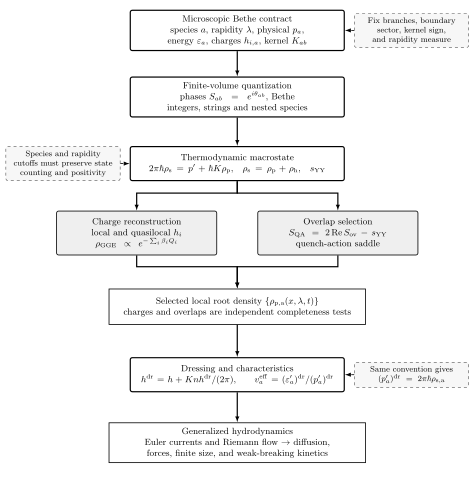
Root-density and dressing dictionary. The kernel sign, measure, quasiparticle species, and filling function are one inseparable convention. Effective velocity is the ratio . Original schematic, not to scale.
Charges and model observables
Section titled “Charges and model observables”If a conserved charge has bare one-particle eigenvalue , its density and Euler current in a homogeneous macrostate are
The charge eigenvalue in these formulas is bare; dressing has already entered the available states and velocity. Static susceptibilities contain dressed charges. For a generalized potential , differentiation of the TBA saddle gives covariances involving with the appropriate state measure.
Local correlation functions are not determined by a root density through a universal algebraic rule. They require model-specific form factors, Hellmann–Feynman derivatives, quantum-transfer-matrix identities, or numerical evaluation. Quasiparticle particle density should therefore not be plotted as if it were an in-situ atomic density.
Yang and Yang 1969, Parts I–II establish the thermodynamic root-density and entropy construction for the one-dimensional Bose gas. Castro-Alvaredo, Doyon, and Yoshimura 2016, §§2–3 use dressed velocities in hydrodynamic expectation values.
The canonical integrable-matter claim test matrix records rapidity species, charges, entropy, dressing, and validation tests. A reproducible verification workflow checks discretization, species truncation, charge reconstruction, and velocity identities.
Exercise
Section titled “Exercise”State density as dressed momentum. Starting from the dressing equation for , show that .
Solution
The dressing equation is
Assume . Since , the right side becomes
by the Bethe density equation. Thus the assumed function solves the same linear integral equation; uniqueness in the regular repulsive regime establishes the identity. In the Tonks–Girardeau limit , , so and dressing becomes the identity.
References
Section titled “References”- Castro-Alvaredo, O. A., Doyon, B., and Yoshimura, T. (2016). “Emergent hydrodynamics in integrable quantum systems out of equilibrium.” Physical Review X 6, 041065. doi:10.1103/PhysRevX.6.041065.
- Takahashi, M. (1999). Thermodynamics of One-Dimensional Solvable Models. Cambridge University Press. doi:10.1017/CBO9780511524332.
- Yang, C. N., and Yang, C. P. (1969). “Thermodynamics of a one-dimensional system of bosons with repulsive delta-function interaction.” Journal of Mathematical Physics 10, 1115–1122. doi:10.1063/1.1664947.
Original QFT.org content:CC BY 4.0, unless an item supplies different terms. Third-party material retains its own terms.