

Relativistic Fields, Spinors, and the Ising Continuum Limit
The previous page produced a surprise: a two-dimensional Ising model written in terms of ordinary commuting spins contains a natural fermionic field. The field is not inserted by hand. It is the point-split product of an order operator and a disorder operator, and its fermionic sign comes from transporting the disorder cut past the order insertion.
This page translates that observation into continuum field theory. We first classify scalar, vector and spinor fields by their rotation laws. Then we explicitly project the square-lattice corner equation onto its two critical modes, obtaining a Majorana equation with to leading scaling order in the conventions below. This limit assumes and in the bulk, away from additional coincident insertions. The same calculation identifies the critical part of the Ising energy with the fermion mass operator and explains the logarithmic specific heat.
Required background. Order, disorder, and the Ising fermion supplies the four corner directions, transported cuts and exact local propagation relation.
Helpful background. Critical propagators and the upper critical dimension supplies the scaling interpretation of a correlation length; two-dimensional disorder lines supplies the underlying mixed-correlator sign proof. The rotation review below is self-contained.
Fields as rotation representations
Section titled “Fields as rotation representations”A continuum field is not defined only by its equation of motion. It is also defined by how it transforms under spacetime symmetries. In Euclidean field theory, the local rotation group is , or more precisely its double cover when spinors are present. A field with components transforms as
where is a finite-dimensional representation carried by the field indices. A scalar has . A vector has . A spinor has a matrix satisfying
This is the first difference between writing down a field and writing down a collection of components. A two-component object is not automatically a spinor; it is a spinor only if rotations act by the spin representation.
A free scalar field is the simplest example. In Euclidean signature one may write
so the classical equation is
After analytic continuation to Lorentzian signature this becomes the Klein–Gordon equation. The field carries no internal rotation index; all angular momentum of a scalar excitation is orbital.
A vector field carries one rotation index:
A tensor field carries several such indices. For example,
These transformation laws are local. They do not yet say which field equations are correct or how many physical polarizations propagate. Those are dynamical questions.
Vector fields and transversality
Section titled “Vector fields and transversality”A massive vector field can be described by the Euclidean Proca action
Varying gives
Expanding ,
so the equation is
Taking a divergence gives
Therefore, for ,
The vector equation plus this constraint is equivalent to a Klein–Gordon equation for the transverse components:
In momentum space, the decomposition is especially transparent:
with transverse projector for nonzero Euclidean momentum ,
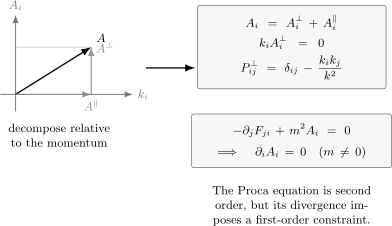
A vector field decomposes into components transverse and longitudinal to the momentum. The massive Proca equation imposes on shell, leaving the spin-one polarizations.
This is a useful warning for later gauge theory. A vector field has a vector index, but not every component of that index represents an independent physical polarization. Gauge redundancy, constraints, and equations of motion all matter. In the Ising problem the analogous lesson is that the four corner labels of the lattice fermion are not four independent particles. They are a convenient lattice package whose long-distance content is a smaller spinor field.
Spinors and half-angle rotations
Section titled “Spinors and half-angle rotations”Spinors are not ordinary tensors. For an active counterclockwise rotation, fix
In the chosen gamma basis, the spin transformation is
Indeed, and direct multiplication gives . Together with , this makes the Dirac equation covariant. The same rotor is derived in the one-plane Spin example.
Thus and . These signs depend on the complete coordinate-and-field convention; checking only a full turn would not detect their reversal. In particular,
A spinor changes sign under a full rotation. Only after a rotation does it return to itself.
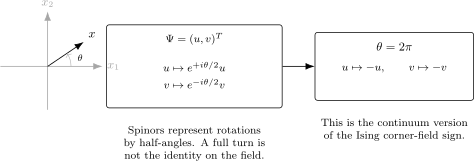
For and , , the upper component acquires and the lower component . Both acquire under a full turn. The coordinate rotation is schematic; its orientation and the component phases use the same convention.
The Euclidean two-dimensional Dirac equation is a first-order equation,
With the gamma matrices stated above and , this is equivalent to
At these equations split into holomorphic and antiholomorphic pieces:
Thus one component depends only on , and the other depends only on . This is the continuum seed of the Ising conformal field theory: the critical fermion separates into left-moving and right-moving Majorana components.
There is no contradiction between the first-order Dirac equation and the second-order Klein–Gordon equation. Squaring the operator gives
With these fixed conventions, this identity is exact. Multiplying by an overall minus sign gives the positive Euclidean operator . Each component obeys the associated second-order equation, while the first-order equation also relates the components.
The Ising corner field as a spinor
Section titled “The Ising corner field as a spinor”Recall the point-split order–disorder composite from the previous page. Put a spin at an original-lattice site and a disorder endpoint at a neighboring dual site , where the four half-lattice vectors have angles
The four corner fields are
Because moving the disorder endpoint once around the spin crosses the branch cut once, the corner field is antiperiodic:
This antiperiodicity is exactly the lattice form of spinorial behavior. A scalar function of a continuous direction would have integer angular harmonics, whereas an antiperiodic function has half-integer harmonics. Here, however, the direction is sampled at only four corners. The corner-label space is therefore four-dimensional, with four independent Fourier characters. A convenient set of representatives is
A complete finite Fourier expansion is
Here is the coefficient called on the previous page; the temporary name keeps it distinct from the continuum components . The angles are lifted continuously, so . Advancing a corner frame multiplies its character by , whereas rotating the field and its argument actively transforms the coefficient by . For example, a lattice quarter-turn gives with the cut transported, and hence . This is the same convention as above.
The critical projection retains . The other two characters have a nonzero lattice kernel at criticality and can be eliminated in a long-wavelength expansion. They are not extra independent continuum particles or the beginning of an unlimited corner-harmonic tower. Inspect the figure’s original sites, dual face centers and the two successive reductions before following the matrix calculation.
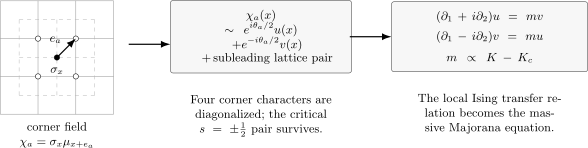
The four Ising corner fields split into a critical pair and a gapped pair. With the lifted angles and active rotation convention stated here, the critical coefficients give up to one common normalization, and the leading mass is . In the figure, labels the corners and is lattice spacing. The geometry is schematic; the continuum step requires and .
Projecting the four-component lattice equation
Section titled “Projecting the four-component lattice equation”Let denote the lattice spacing in this calculation ( in the surrounding text), to distinguish it from the corner index . Define the antiperiodic shift by , including . The exact previous-page relation is
This is a correlator equation away from spectator contacts. With inverse Fourier phase , write it as , where
Use the orthonormal matrix with columns ordered . Then and . At zero momentum and critical coupling,
Write , , and keep first order in and . The critical block is
These coefficients can be checked directly from , and . The derivative term comes from .
Eliminating the heavy block gives the Schur complement . The heavy eigenvalues remain nonzero, and both mixed blocks vanish at . Their correction therefore starts at and cannot alter the displayed first-order coefficients.
Replace by and multiply the two equations, respectively, by and . The phases cancel:
The omitted operator terms have order . In the scaling limit with and physical momentum fixed, and this remainder vanishes. The lattice spacing is now again denoted by .
The continuum components may be normalized as
The common dimensionless factor fixes the chosen two-point amplitude; the homogeneous propagation equation does not determine it. No relative field rephasing is needed with these lifted angles. This completes the promised differential and mass normalization. Polyakov 1987, § 10.3.1, pp. 276–278, Eqs. (10.60)–(10.69) gives the lattice equation and soft-mode argument; the explicit matrix calculation above fixes our spacing and phase dictionary. His same-argument transformation corresponds to the inverse of the active transformation used here.
The Majorana action
Section titled “The Majorana action”The two low modes describe one Lorentzian Majorana field, with two real spinor components, rather than a charged complex Dirac field. In the Euclidean functional integral use independent Grassmann variables and
Varying this action gives the two displayed component equations. Since and is symmetric, integration by parts makes antisymmetric with boundary conditions that remove its surface term. With a fixed Grassmann measure orientation the Gaussian integral is proportional to ; its sign is not specified by taking an arbitrary square root of a determinant. No pointwise condition is imposed. This action describes the local bulk scaling theory; a global partition function also requires the spin structure and sector combination inherited from the lattice boundaries.
Mass, duality, and the two phases
Section titled “Mass, duality, and the two phases”The Kramers–Wannier relation is
At the self-dual point,
Expanding around criticality gives
Therefore the continuum mass changes sign under duality:
With the field phases fixed above, is the ordered side and is the disordered side. Duality exchanges long-range order of the spin and disorder variables in the thermodynamic limit. The free-fermion correlation length is in the continuum normalization. Other Ising channels can have different correlation-length amplitudes, but their critical divergence has the same exponent:
Thus the two-dimensional Ising correlation-length exponent is
This agrees with the exact solution and is much sharper than mean-field theory. The deeper reason is that the critical Ising model is not an interacting scalar theory at long distances; it is a free massless Majorana fermion plus nontrivial spin and disorder fields.
Energy operator and the specific heat
Section titled “Energy operator and the specific heat”The lattice energy is the operator conjugate to the coupling. For the nearest-neighbor square-lattice model,
define the bond energy
The dimensionless free energy satisfies
and
Up to conventional powers of the temperature, this is the specific heat. Translational invariance turns it into an integral of the connected energy–energy correlator:
The lattice bond has a nonzero identity contribution. Its critical part has an expansion , with nonuniversal coefficients; the connected correlator removes . In the action convention above,
Here is the independent opposite-chirality Grassmann field, not the complex conjugate of . Anticommutation gives , so the factor of is consistent with the already fixed phases. The sign of relates this mass derivative to the particular lattice bond convention; it does not affect the connected two-point scaling.
Equivalently, the energy operator is the operator multiplying the fermion mass in the action. Since the Majorana field has scaling dimension , the bilinear has scaling dimension
At criticality,
Therefore the specific heat diverges logarithmically:
The same result appears in momentum space as the one-loop fermion bubble
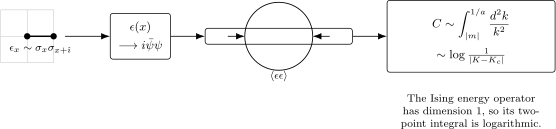
After subtracting its identity contribution and fixing the field amplitude, the critical part of the Ising bond energy is proportional to the fermion mass operator . Its two-point function scales as , so the integrated energy–energy correlator gives the logarithmic specific-heat singularity. The diagram represents the scaling argument; it does not fix its lattice amplitude.
Once the correct scaling field is known, the thermodynamic singularity follows from its connected two-point function. The exact lattice solution fixes the nonuniversal amplitude and regular terms; the continuum argument fixes the logarithm. The equivalent fermion-integral calculation appears in Polyakov 1987, § 10.3.1, p. 278, Eq. (10.70) and the following specific-heat formula. These estimates assume and a sample much larger than ; at criticality in a finite sample the sample size supplies the infrared cutoff.
From lattice transport to critical thermodynamics
Section titled “From lattice transport to critical thermodynamics”A continuum field is classified not only by its equation of motion but also by its rotation representation. Scalars transform trivially, vectors transform by the ordinary rotation matrix, and spinors transform by the double cover. The essential spinor fact is .
The Ising order–disorder composite has precisely this sign. Its four corner components are antiperiodic under a full rotation of the disorder endpoint around the order insertion. Their four independent corner characters may be represented by spins and modulo . In the scaling limit the leading combinations form a real two-component fermion. The local lattice transfer relation becomes the massive two-dimensional Dirac equation
At , the mass vanishes and the two components become holomorphic and antiholomorphic Majorana fields. The energy operator is the fermion mass bilinear , whose scaling dimension is . Hence the specific heat is logarithmically singular:
Common pitfalls
Section titled “Common pitfalls”The four Ising corner fields are not four independent continuum fermions, nor do four samples support an unlimited independent harmonic tower. They form a four-dimensional lattice-label space; the long-distance spin projection gives one Majorana fermion, while derivative descendants account for higher continuum-spin corrections.
The statement is not ordinary anticommutation of microscopic spins. It is monodromy of mixed order–disorder correlation functions. The original Ising variables are still commuting classical spins.
The sign of the continuum mass depends on phase conventions, but its oddness under Kramers–Wannier duality is physical. The two signs encode the ordered and disordered phases.
The Feynman-bubble picture of the specific heat should be understood as a continuum scaling argument. The lattice cutoff and the normalization of determine nonuniversal constants, while the logarithmic divergence is universal.
Exercises
Section titled “Exercises”Exercise 1: Proca transversality
Section titled “Exercise 1: Proca transversality”Derive the transversality condition for a massive vector field from the Proca equation
Then show that the transverse momentum-space projector is
Solution
Taking a divergence of the Proca equation gives
The first term vanishes because is symmetric in , while is antisymmetric:
For , this implies
In momentum space, the longitudinal part of a vector is proportional to . The projector onto this direction is
Therefore the projector onto the orthogonal subspace is
It obeys
so is transverse.
Exercise 2: Half-angle rotation and corner characters
Section titled “Exercise 2: Half-angle rotation and corner characters”Let a two-dimensional spinor transform under rotations by
Use the active convention . Check , then show that a rotation gives a minus sign. Explain why a continuously defined antiperiodic angular field has half-integer harmonics, and why four corner directions contain only four independent characters, labeled by modulo .
Solution
Direct multiplication gives
For ,
Thus
Now suppose a function of the corner angle has an angular harmonic . Under it transforms as
Antiperiodicity requires
Therefore
Thus a continuously defined antiperiodic angular field has half-integer harmonics. On the four corner angles , however,
so and give the same corner character up to an -independent phase. There are only four independent characters. One may choose the representatives
Exercise 3: Euclidean Dirac components
Section titled “Exercise 3: Euclidean Dirac components”Using
show that
is equivalent to
What happens at ?
Solution
Compute
Therefore
The equation gives
These are the desired equations, just written in the opposite order.
At they become
Since
we get
Thus is holomorphic and is antiholomorphic.
Exercise 4: The duality-odd Ising mass
Section titled “Exercise 4: The duality-odd Ising mass”Use the Kramers–Wannier relation
to show that near the self-dual point,
Why does this imply that the Ising fermion mass is duality-odd?
Solution
Set
At criticality,
Expanding to first order,
and similarly
Multiplying and using gives
Therefore
or
The continuum mass is proportional to the relevant perturbation away from criticality:
Since duality reverses , it reverses . Thus the mass term is duality-odd.
Exercise 5: The logarithmic specific heat
Section titled “Exercise 5: The logarithmic specific heat”Assume the energy operator at the critical Ising point has scaling dimension . Show that the integrated energy–energy correlator diverges logarithmically. Then express the answer in terms of the correlation length and the mass .
Solution
At criticality, an operator of scaling dimension has two-point function
For ,
The specific heat is proportional to the integral of this correlator. With a UV cutoff and an IR cutoff ,
up to the normalization of .
The mass gap cuts off correlations at
Since ,
plus nonuniversal regular terms.
References
Section titled “References”- A. M. Polyakov, Gauge Fields and Strings. Contemporary Concepts in Physics, Vol. 3. Harwood Academic Publishers, 1987, § 10.3.1, doi:10.1201/9780203755082.
Further reading
Section titled “Further reading”- P. Di Francesco, P. Mathieu, and D. Sénéchal, Conformal Field Theory. Graduate Texts in Contemporary Physics. Springer, 1997, Chapters 4 and 12.
- B. M. McCoy and T. T. Wu, The Two-Dimensional Ising Model. Harvard University Press, 1973.
- T. D. Schultz, D. C. Mattis, and E. H. Lieb, “Two-Dimensional Ising Model as a Soluble Problem of Many Fermions,” Reviews of Modern Physics 36, 856–871 (1964), doi:10.1103/RevModPhys.36.856.
Original QFT.org content:CC BY 4.0, unless an item supplies different terms. Third-party material retains its own terms.