

Lorentz Group and Complex Coordinates
The previous part of the course developed Green functions, scattering, Euclidean continuation, and thermal field theory mostly for scalar fields. We now return to the symmetry that made those scalar formulas relativistic in the first place: the Lorentz group.
This is the gateway to spin. A scalar field is the simplest possibility because it does not carry a Lorentz index. Fermions, vectors, photons, and gauge fields do. To understand what a spinor field or a vector field is, we first need a clean description of how spacetime itself transforms.
The page has three jobs. First, it fixes the geometry of timelike, lightlike, and spacelike intervals. Second, it explains why rotations and boosts combine into a noncompact group with two spinorial halves. Third, it gives the matrix description of Minkowski vectors, which is the bridge to Weyl spinors on the next pages.
There is a particularly efficient way to do this in four spacetime dimensions. A real Minkowski vector can be encoded as a Hermitian matrix. Its determinant is the Lorentz interval, and the transformation
preserves that determinant. This is the first appearance of the group , which will later act directly on Weyl spinors.
A useful dictionary for this page is:
Causal intervals and the light cone
Section titled “Causal intervals and the light cone”A spacetime point is denoted
and the squared interval between two events is
The sign of this number is invariant under Lorentz transformations. It divides separated events into three qualitatively different classes:
For timelike separation, there exists an inertial frame in which the two events occur at the same spatial point. For spacelike separation, there exists an inertial frame in which they occur at the same time. For lightlike separation, the two events lie on the same light ray.
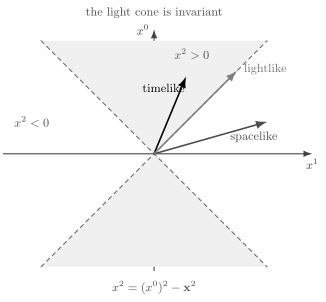
The Lorentz interval classifies separations. The light cone is invariant; timelike vectors lie inside it, and spacelike vectors lie outside it.
This classification is not just geometry. It is the reason local relativistic fields obey a causality condition. For a real scalar field,
where is the Pauli–Jordan commutator function. Lorentz invariance and canonical equal-time commutation relations imply
Thus spacelike-separated measurements cannot influence one another by a commutator signal. This is a sharper statement than saying that particles move slower than light: in QFT the local fields themselves know about the light cone.
For a free scalar field, the cancellation can be seen directly. With and
the mode expansion gives
If is spacelike, a Lorentz transformation brings it to . In that frame,
because the two terms exchange under . The relative minus sign is essential. By contrast, the vacuum expectation value of the anticommutator contains the sum
which is even in and is generally nonzero at spacelike separation. This is the elementary scalar-field glimpse of the spin–statistics connection: integer-spin local fields use commutators, whereas half-integer-spin fields obey graded locality, with spacelike anticommutators vanishing. In either case, local observables commute at spacelike separation. The full connection between spin, positivity, and statistics is a theorem, not a consequence of this one cancellation alone.
The remaining pages of the course use this idea in a more refined form. The possible field types are constrained by how they transform under Lorentz transformations, and the possible particle types are constrained by how one-particle states transform under the Poincaré group.
Lorentz transformations
Section titled “Lorentz transformations”A Lorentz transformation is a real linear transformation preserving the interval:
Writing , this condition becomes
or, in matrix notation,
Taking determinants gives
so
The transformations with are called proper Lorentz transformations. The transformations that also preserve the direction of time, so that future-directed timelike vectors remain future-directed, form the proper orthochronous Lorentz group, denoted
This connected component contains the identity transformation. It is the part generated continuously by rotations and boosts.
A spatial rotation is already familiar:
In the active convention fixed above, a boost in the direction with rapidity is
The velocity parameter is
As a sign check, this matrix maps the rest four-velocity to . If instead denotes coordinates in a frame moving at velocity relative to the original frame, the passive coordinate transformation is the inverse:
Thus the familiar disagreement over the sign of a boost is usually only a disagreement about active versus passive language, or equivalently about whether the parameter is or .
Rapidity is additive: two boosts in the same direction with rapidities and give a boost with rapidity . This is why hyperbolic functions are the natural language of Lorentz boosts.
The Lorentz algebra
Section titled “The Lorentz algebra”Near the identity, write
The condition gives, to first order,
Thus is antisymmetric and has six independent components. Three are spatial rotations and three are boosts.
It is standard to introduce generators for rotations and for boosts. Here is the three-dimensional alternating symbol with . With the quantum-mechanical convention that generators are Hermitian, their commutators are
The minus sign in the last equation is the algebraic trace of the Lorentzian metric. Rotations close among themselves, but boosts do not: the commutator of two nonparallel boosts is a rotation. This is the group-theoretic origin of Thomas precession.
A useful complex recombination is
Then
So the complexified Lorentz algebra splits as two commuting copies of the rotation algebra:
This formula is not just pretty notation. It is the reason finite-dimensional Lorentz representations are labeled by two spins, usually written . Scalars are , the two inequivalent Weyl spinors are and , and four-vectors are equivalent to . The words “left” and “right” will be attached to chiral projectors only after a gamma-matrix basis has been chosen.
A second lesson is equally important for readers coming from ordinary quantum mechanics. These finite-dimensional Lorentz matrices are generally not unitary, because boosts form a noncompact part of the group. The unitary object is the Hilbert-space operator implementing the symmetry on states. The finite-dimensional matrix only tells us how the components of a local field are reshuffled.
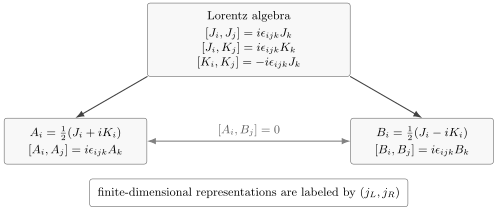
After complexification, the Lorentz algebra separates into two commuting -type algebras generated by and . This is the algebraic origin of the representation labels .
Minkowski vectors as Hermitian matrices
Section titled “Minkowski vectors as Hermitian matrices”Now introduce the Pauli matrices
Given a real four-vector , define the Hermitian matrix
This formula uses the contravariant spatial components of . Later, when we write , the lowered momentum produces the opposite spatial sign. Keeping these two notations separate prevents one of the most common spinor-sign mistakes.
In components,
The map from to is one-to-one because
The key identity is
Thus the Lorentz interval is the determinant of a Hermitian matrix.

A real four-vector can be encoded as . The determinant of is the Lorentz interval .
This matrix form also gives a useful description of the light cone. If is lightlike, then
Equivalently, the Hermitian matrix has rank at most one. This is the first real payoff of the notation: null vectors become degenerate matrices, and degenerate positive Hermitian matrices are naturally written as spinor outer products.
For a future-directed null vector, and is positive semidefinite with rank one. Therefore it can be written as
for some two-component complex column vector . In components, this says a null momentum can be written as a spinor times its Hermitian conjugate. This observation becomes central in the spinor-helicity formalism, but even here it reveals why spinors are geometrically natural in four dimensions.
The SL(2,C) action
Section titled “The SL(2,C) action”Let be a complex matrix with unit determinant:
Define
Because is Hermitian, is also Hermitian:
Therefore corresponds to a new real four-vector . Its determinant is
Hence
Every therefore defines a Lorentz transformation. More precisely, it defines an element of the proper orthochronous Lorentz group . The correspondence is not one-to-one, because
So and define the same Lorentz transformation. The group is the double cover of :
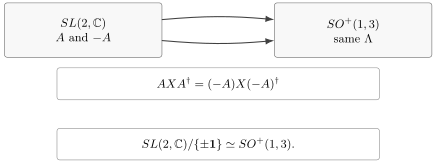
The transformation maps to the proper orthochronous Lorentz group. The two matrices and give the same Lorentz transformation.
This double cover is the precise mathematical statement behind the familiar fact that spinors change sign under a rotation. A vector returns to itself under a full rotation, but a spinor transforms by the corresponding matrix and acquires a minus sign.
The notation also gives a useful dictionary:
| Object | Matrix language | What is preserved |
|---|---|---|
| Minkowski vector | Hermitian matrix | |
| Lorentz transformation | Pair of matrices | |
| Weyl spinor | Two-component column transformed by or | spinorial square roots of vectors |
This table is more useful than it may look. The next few pages repeatedly translate between vector statements, such as , and spinor statements, such as .
Rotations and boosts inside SL(2,C)
Section titled “Rotations and boosts inside SL(2,C)”The subgroup gives ordinary spatial rotations. Let
Then gives
and
So this is a rotation by angle around the axis.
Boosts are generated by Hermitian, rather than unitary, matrices. For a boost along the direction, take
The diagonal entries of transform as
Adding and subtracting gives
Meanwhile and are unchanged. This is exactly the boost written earlier.
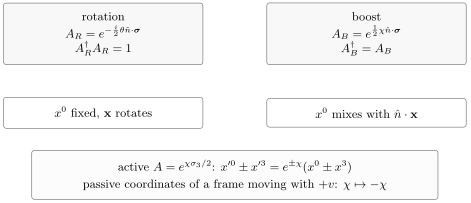
Unitary matrices in give spatial rotations, while Hermitian positive matrices give boosts. In the active convention shown, a boost along scales by ; the corresponding passive frame transformation uses .
The matrix viewpoint makes the difference between rotations and boosts especially transparent. A rotation matrix in changes the direction of while keeping fixed. A boost matrix is not unitary, so it mixes trace and traceless parts of ; that is, it mixes time and space.
Scalar fields and non-scalar fields
Section titled “Scalar fields and non-scalar fields”The Lorentz group acts both on coordinates and on field components. We now use an explicitly passive matrix . The same physical event has coordinates in one frame and in the other. For the frame moving at velocity in the preceding example, . A scalar field has no Lorentz index, so
Equivalently, if both functions are evaluated at the same coordinate label , then
This inverse is a common source of confusion. It does not mean the scalar transforms with a hidden matrix. It only says that the transformed function at the coordinate value is the old function evaluated at the event that maps to .
For a general field multiplet , the passive covariance law is
or, at the same coordinate argument,
The matrix acts only on the field components. If is either lift of , the main examples are
The lift here is fixed by , not merely by naming a spinor matrix. With the chiral gamma basis of lesson 33, this gives the displayed left/right assignment. For the positive-rapidity boost above, the right component therefore carries and the left component . These are the boost signs in Schwartz 2014, § 10.2, p. 164, Eqs. (10.38)–(10.39); his rotation-angle sign is opposite to the angle in our displayed .
The next pages develop these cases in detail. The labels “left” and “right” refer to the chiral convention used for the Dirac spinor; what is invariant is the existence of two inequivalent Weyl representations. The canonical Weyl treatment separates that chirality from particle helicity. The important lesson here is that is not an optional mathematical decoration. It is the natural group acting on the spinorial square roots of null vectors and, through , on ordinary Minkowski vectors.
Example: a null vector as a spinor square
Section titled “Example: a null vector as a spinor square”Consider a future-directed null vector pointing in the direction
with energy :
The associated Hermitian matrix is
Because , this matrix has zero determinant. Since , it is positive semidefinite and can be written as
A convenient choice is
Indeed,
Using
and
we recover
This is the simplest bridge from Lorentz geometry to spinor notation. A null vector is a rank-one Hermitian matrix, and a rank-one Hermitian matrix is an outer product of a spinor with its Hermitian conjugate. The spinor is not unique: and give the same null vector. That harmless phase is the first small hint of why helicity and little-group phases enter the description of massless particles.
Summary
Section titled “Summary”The Lorentz group is the group of real linear transformations preserving the Minkowski interval. The proper orthochronous component is generated continuously by three rotations and three boosts. Its Lie algebra contains the familiar rotation algebra, but boosts do not close among themselves; two boosts generally produce a rotation.
The most useful four-dimensional trick is to package a vector into a Hermitian matrix
The determinant is the invariant interval:
The transformation with preserves this determinant and gives a Lorentz transformation. The matrices and give the same transformation, so double-covers .
This is the structural reason spinors appear in relativistic quantum field theory. Vectors are naturally Hermitian bilinears of spinors, null vectors are spinor outer products, and finite-dimensional Lorentz representations are built from the two commuting spinorial halves of the Lorentz algebra. The field-component matrices used in these representations need not be unitary; the physical Hilbert-space representation is unitary and is obtained only after imposing the equations of motion and going to particle states.
Common pitfalls
Section titled “Common pitfalls”A Lorentz transformation is not any matrix with determinant one. It must preserve the metric: . The condition is necessary but far from sufficient.
The group is not the Lorentz group itself. It is the double cover of the proper orthochronous Lorentz group. Spinors transform under , while ordinary vectors transform under the corresponding Lorentz transformation. The two matrices and produce the same Lorentz transformation but act differently on spinors.
The map uses Hermitian conjugation, not matrix inversion. For unitary , these are related, but a general boost matrix in is not unitary.
Do not confuse with . The sign difference is only index-lowering with the mostly-minus metric, but it becomes important in the Weyl and Dirac equations.
A spacelike interval is not “outside relativity.” It means that the time ordering of the two events is frame-dependent. Precisely because no invariant time ordering exists for spacelike separation, local relativistic QFT requires commutators of local bosonic observables to vanish there.
Do not compare boost formulas before fixing whether the transformation is active or passive. On this page actively sends a rest vector to velocity , while the coordinates of a frame moving at that velocity transform with . Both formulas preserve the same interval.
Exercises
Section titled “Exercises”Exercise 1: determinant of the Hermitian coordinate matrix
Section titled “Exercise 1: determinant of the Hermitian coordinate matrix”Show directly that
satisfies
Solution
Compute the determinant:
The first factor gives
The second gives
Therefore
Exercise 2: a boost from an SL(2,C) matrix
Section titled “Exercise 2: a boost from an SL(2,C) matrix”Let
Use to derive the boost along the direction.
Solution
Since is real diagonal, . The transformed matrix is
Thus
while the off-diagonal entries are unchanged. Therefore
Adding the two equations gives
Subtracting gives
The off-diagonal entries show and .
Exercise 3: the Lorentz-algebra split
Section titled “Exercise 3: the Lorentz-algebra split”Let and obey
Define
Show that the and generate two commuting copies of the rotation algebra.
Solution
First compute
Expanding,
Using
and
we get
Thus
The same calculation gives
Finally,
so
Therefore the complexified Lorentz algebra splits into two commuting algebras.
Exercise 4: a null vector as a spinor square
Section titled “Exercise 4: a null vector as a spinor square”For a future-directed null vector , show that the matrix
has one zero eigenvalue and one eigenvalue .
Solution
Because is null,
Thus at least one eigenvalue of vanishes. The trace is
The sum of the two eigenvalues is , and their product is zero. Since and is positive semidefinite for a future-directed null vector, the eigenvalues are
Equivalently, is a rank-one positive Hermitian matrix and can be written as .
References
Section titled “References”- Schwartz, Matthew D. Quantum Field Theory and the Standard Model. Cambridge University Press, 2014. DOI.
Further reading
Section titled “Further reading”- Sidney Coleman, Lectures on Quantum Field Theory, edited by Bryan Gin-ge Chen et al., World Scientific, 2019, chapters 5 and 18.
- Mark Srednicki, Quantum Field Theory, Cambridge University Press, 2007, sections 2 and 33.
- Steven Weinberg, The Quantum Theory of Fields, Volume I: Foundations, Cambridge University Press, 1995, chapters 2 and 5.
- A. Zee, Quantum Field Theory in a Nutshell, 2nd edition, Princeton University Press, 2010, chapter II.3.
Original QFT.org content:CC BY 4.0, unless an item supplies different terms. Third-party material retains its own terms.