

Spinor Representations and Gamma Matrices
Scalar and vector fields are not the end of Lorentz representation theory. The proper orthochronous Lorentz group has the double cover , whose smallest nontrivial finite-dimensional representations are two-component spinors. These are not ordinary tensors: a rotation acts on them by a minus sign. That minus sign is the representation-theoretic seed of spin one-half.
The previous page distinguished finite-dimensional field representations from the little-group representations carried by one-particle states. We now construct the finite-dimensional representations needed for spin one-half fields. The two elementary objects are the two inequivalent Weyl spinors. A massive relativistic fermion combines both, and a chosen chiral gamma-matrix basis then identifies them with the left- and right-chiral components of a Dirac spinor. The gamma matrices package this pair into a single Dirac spinor and turn the two first-order Weyl equations into the compact Dirac operator .
The reader should watch two separate ideas. A Weyl spinor is a Lorentz-representation object; a gamma matrix is an intertwiner that maps between the two inequivalent Weyl representations. The Dirac equation works because momentum, written as or , is exactly such an intertwiner.
The Lorentz algebra and two spinor representations
Section titled “The Lorentz algebra and two spinor representations”Chiral-basis dictionary
Section titled “Chiral-basis dictionary”This page uses the chiral, or Weyl, gamma-matrix basis. Define
where
Thus
This differs by a spatial sign from the coordinate matrix used on the previous page because uses the lowered index . We suppress dotted and undotted spinor indices in the main text; the matrix products indicate which chirality is mapped to which. The transformation laws below fix the otherwise ambiguous choice of which Weyl matrix is called .
The gamma matrices are
In this chiral basis a Dirac spinor is ordered as
so the projectors and pick the upper and lower two components respectively.
The site convention also defines and writes the spinor Lorentz generator as .
Let be Lorentz generators. In the following formulas is the three-dimensional alternating symbol with . Separate rotations and boosts by
Their commutation relations are
The minus sign in is the algebraic trace of the noncompactness of the Lorentz group. It is also why finite-dimensional Lorentz representations are generally not unitary.
Now complexify the algebra and define
A direct calculation gives
Thus the complexified Lorentz algebra is the direct sum of two commuting complex simple algebras,
Physicists often call these the two factors because the displayed commutators have the form and their finite-dimensional irreducible representations carry the usual spin labels. Strictly speaking, after complexification the algebra on each side is , not the real compact algebra .
The finite-dimensional irreducible representations are labeled by a pair
where the two entries specify which of the two commuting complex factors is active. In the chiral convention used below, is called left-handed and is called right-handed. The representations have dimension
The simplest representations are
Under ordinary spatial rotations, the physical rotation generator is
Therefore the representation contains ordinary spins
Both and contain spin under rotations. They differ not by their rotation spin, but by how boosts act.
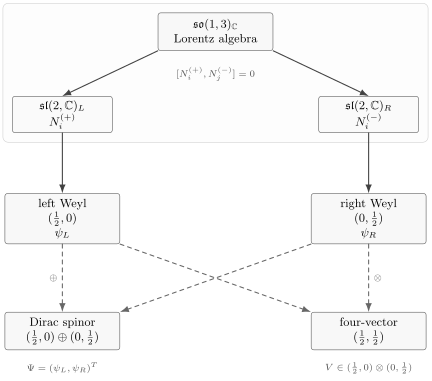
The complexified Lorentz algebra splits into two commuting factors, each with the familiar angular-momentum representation labels. The two Weyl representations are inequivalent under boosts. Their tensor product gives a vector, and their direct sum gives the four-component Dirac spinor used below.
A useful way to remember the difference between the two Weyl representations is this. The matrices
are equivalent for pure rotations, because then is unitary, but they are inequivalent for boosts. Fix by the Hermitian-vector transformation used below. With that choice, the chiral components transform as
The upper component is still and the lower component is ; the subscripts refer to chirality, not to whether the corresponding matrix was named . Some references instead attach the symbol to the other Weyl factor. Stating the Hermitian-vector map and the two transformation laws removes that naming ambiguity.
Four-vectors as two-by-two matrices
Section titled “Four-vectors as two-by-two matrices”The bridge between spinors and vectors is the Pauli matrix identity
For a real four-vector , define the Hermitian matrix
Its determinant is the Minkowski norm:
If , then
preserves the determinant because . Thus every determines a Lorentz transformation by
The two matrices and give the same Lorentz transformation, so is a double cover of the proper orthochronous Lorentz group.
The same construction works for momentum, but here the lowered index matters. With the convention stated above,
The plus-sign matrix is . With the same that defines , the two momentum matrices transform as
Consequently maps into the representation, while maps into the representation. These transformation laws are the precise content behind the arrows in the coupled Weyl equations.
They obey
This single identity is the two-component version of “squaring the Dirac operator.” It is the reason first-order spinor equations can imply the second-order relativistic mass shell.
In index notation, maps a right-handed spinor into a left-handed one, while maps a left-handed spinor into a right-handed one. The compact matrix notation suppresses dotted and undotted spinor indices, but the direction of this map is the reason the massive equations below couple the two chiralities in the order they do.
The sign pattern is worth pausing over. The Hermitian coordinate matrix on the previous page used . Here because the lower-index momentum is in the mostly-minus convention. Many spinor sign errors are just this index-lowering step in disguise.
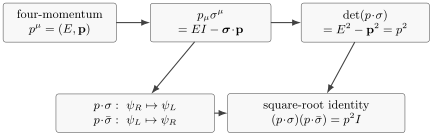
A four-vector can be represented by a Hermitian matrix. The determinant gives the invariant , while multiplication by and maps between the two Weyl spinor representations.
Coupling left and right spinors
Section titled “Coupling left and right spinors”A massive Dirac spin one-half particle is described most economically by combining the two inequivalent Weyl spinors. In the chiral basis these become the left- and right-chiral components of a Dirac spinor. Momentum naturally maps one chirality to the other, and the Dirac mass term ties the two chiralities together.
Let transform as and as . The first-order massive equations are
Written out,
Apply to the first equation:
Use the second equation on the right and the sigma identity on the left:
Similarly,
Thus both Weyl components satisfy the Klein–Gordon mass shell,
The massless limit is especially transparent. If , the equations decouple:
This is not just a simplification of algebra. It means that chirality becomes a separately conserved Lorentz label for a free massless fermion. Interactions may still distinguish or mix chiralities depending on their form, but the free kinetic equation itself no longer needs both pieces.
A massless left-chiral field and a massless right-chiral field are independent Lorentz representations. A massive spinor ties them together.
This is the conceptual reason the Dirac spinor is a direct sum,
It is not irreducible under the proper Lorentz group, but it is the natural object for a massive parity-symmetric spin one-half theory.
Gamma matrices and the Clifford algebra
Section titled “Gamma matrices and the Clifford algebra”The gamma matrices package the two equations above into one matrix equation. In the chiral basis,
Then
The equation
is exactly the pair
The gamma matrices satisfy the Clifford algebra
To verify it, multiply the block matrices:
Therefore
The Pauli matrices give
and similarly for the lower block. Hence the Clifford algebra follows.
Now square the Dirac operator:
The antisymmetric commutator part drops out because is symmetric. Therefore
This is the precise sense in which the Dirac operator is a Lorentz-covariant square root of the Klein–Gordon operator.
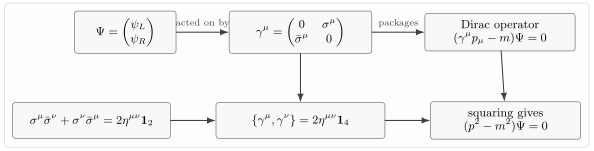
In the chiral basis, is off-diagonal and maps left-chiral spinors to right-chiral spinors and back. The Clifford algebra is equivalent to the basic identities of the Pauli matrices.
Lorentz generators on Dirac spinors
Section titled “Lorentz generators on Dirac spinors”Gamma matrices also give a compact representation of the Lorentz algebra. Define
With the site definition , the generator used here is . This is the matrix that appears in the finite spinor transformation .
Using only the Clifford algebra, one finds
This is the defining statement that the transform as the components of a Lorentz vector under similarity transformations in spinor space. The phrase “gamma matrices transform as a vector” is a shorthand for this commutator identity. The matrices themselves are fixed matrices; what transforms is the spinor basis and therefore the bilinear object in which the gamma matrix appears.
For a finite Lorentz transformation,
with in the vector representation. Then
This identity makes the Dirac equation Lorentz covariant. If
then the transformed spinor
obeys
In block form, the generators split into the two Weyl pieces:
where
With fixed by , the finite matrix has the corresponding block form
Rotations act with the usual Pauli spin matrices on both chiralities, while boosts act with opposite signs. This is the matrix version of the representation-theoretic statement
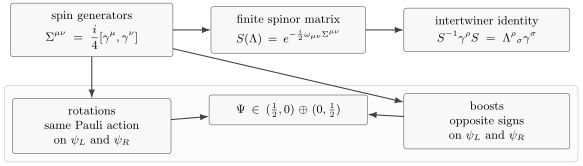
The commutators generate Lorentz transformations on Dirac spinors. Their defining property is that conjugating by reproduces the vector transformation of the index .
Chirality, gamma five, and parity
Section titled “Chirality, gamma five, and parity”The matrix
has three central properties:
The first property says that has eigenvalues . The second says that flips chirality. The third says that chirality is preserved by proper Lorentz transformations.
The projectors
satisfy
In our chiral basis,
Parity is different from a proper Lorentz transformation. It sends , hence it interchanges the two inequivalent Weyl representations:
This is why a single Weyl spinor cannot by itself furnish a parity-invariant Dirac theory. A Dirac spinor contains both chiralities, so parity can act within the same field multiplet.
The Dirac adjoint will become important in the next pages. It is defined by
With this definition, is a Lorentz scalar and is a Lorentz vector. These bilinears are the building blocks of spinor Lagrangians and QED interactions.
Building Clifford algebras by tensor products
Section titled “Building Clifford algebras by tensor products”The four-dimensional gamma matrices are not mysterious isolated objects. They are one instance of a general Clifford-algebra construction.
In two Euclidean dimensions, the Pauli matrices themselves may be used as gamma matrices:
In four Euclidean dimensions, a convenient construction is
The factors of make the old generators anticommute with the new ones. For example,
The general even-dimensional pattern is
These matrices act on a space of dimension . Thus a spinor in even Euclidean dimension has complex components before any further reality or chirality conditions are imposed.
In Lorentzian signature, one obtains gamma matrices satisfying
by assigning the appropriate signs, often by inserting factors of into the Euclidean matrices. The representation is not unique. In the even dimensions constructed here, all irreducible complex representations are equivalent up to similarity transformations; odd-dimensional complex Clifford algebras have two irreducible choices distinguished by the sign of the highest-grade gamma product.
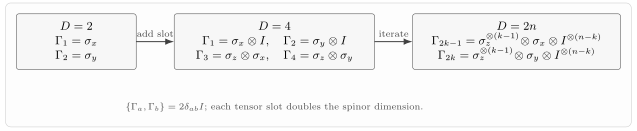
The Clifford algebra in even dimension can be built recursively from Pauli matrices. Each new tensor slot adds two anticommuting generators and doubles the dimension of the spinor space.
Summary
Section titled “Summary”The Lorentz algebra becomes transparent after complexification: it splits into two commuting factors whose finite-dimensional representations carry the familiar angular-momentum labels. This produces two inequivalent two-component spinor representations, and . They look the same under rotations but transform differently under boosts.
The Pauli matrices connect spinors to vectors. A four-vector can be encoded as a Hermitian matrix, and its determinant is the Minkowski norm. This is the practical meaning of the relation between and the Lorentz group.
A massive spin one-half particle uses both chiralities. The equations
square to the mass shell . The gamma matrices combine these equations into
and the Clifford algebra guarantees that this first-order operator is a Lorentz-covariant square root of the Klein–Gordon operator.
Common pitfalls
Section titled “Common pitfalls”Chirality is not spin projection. A left-handed spinor is not “spin down,” and a right-handed spinor is not “spin up.” Both transform as spin under spatial rotations; chirality becomes helicity only in the massless positive-energy particle limit.
The symbol is not universal. Do not memorize versus without checking the Hermitian-vector map and the placement of dotted and undotted indices. Here fixes the choice, and the coupled equations with and provide the consistency check.
Finite-dimensional boost matrices are not unitary. The Hilbert-space operator is unitary, but the finite-dimensional component matrix acting on spinor indices need not be.
Gamma matrices are not dynamical vectors. They are fixed matrices. Their vector character means the similarity identity .
Matrix formulas depend on the gamma basis. Do not mix chiral-basis and Dirac-basis formulas without translating , , and the spinor components. The physics is basis-independent, but the block matrices are not.
Spinor indices do not use the spacetime metric. Dotted and undotted spinor indices have their own antisymmetric tensors; the spacetime metric acts on vector indices.
Two common Lorentz-generator symbols differ by a factor of two. In the site convention, , while the generator used in is .
A massive solution cannot have only one chirality. The massless Weyl equations decouple, but the massive Dirac equation couples and . Setting one chirality to zero is then inconsistent unless .
Exercises
Section titled “Exercises”Exercise 1: sigma matrices and the mass shell
Section titled “Exercise 1: sigma matrices and the mass shell”Using
show that
Solution
By convention,
Therefore
The cross terms cancel because is a scalar:
Now
The antisymmetric term vanishes because is symmetric while is antisymmetric. Hence
Thus
Exercise 2: elementary Clifford-algebra checks
Section titled “Exercise 2: elementary Clifford-algebra checks”With
verify explicitly that , , and .
Solution
Since ,
Therefore
For a spatial index ,
Then
because .
Finally,
Adding gives zero:
Together with the Pauli algebra, these identities imply the full Clifford algebra .
Exercise 3: projectors from gamma five
Section titled “Exercise 3: projectors from gamma five”Show that the projectors
are genuine projection operators and that .
Solution
Since ,
Similarly,
Also,
and
Using ,
But , so
Thus flips chirality.
Exercise 4: boost weights in a first-order equation
Section titled “Exercise 4: boost weights in a first-order equation”Using the chiral-basis dictionary above, let a boost along the -axis act on the two Weyl components as
and on light-cone momenta as
For momentum along the -axis, show that the equations
are covariant if and .
Solution
For the component of a spinor, has eigenvalue . Therefore
The left-hand side of the first equation transforms as
The right-hand side transforms as
So the first equation is covariant. The second equation transforms as
and
So the second equation is covariant as well. The opposite boost weights of left and right spinors are exactly what make the first-order equations Lorentz covariant.
Further reading
Section titled “Further reading”- Coleman, Sidney. Lectures on Quantum Field Theory. World Scientific, 2019, chapters 18–20.
- Srednicki, Mark. Quantum Field Theory. Cambridge University Press, 2007, sections 33–36 and 47.
- Weinberg, Steven. The Quantum Theory of Fields, Volume I: Foundations. Cambridge University Press, 1995, sections 5.4–5.6.
- Zee, A. Quantum Field Theory in a Nutshell. 2nd ed., Princeton University Press, 2010, chapter II.3.
Original QFT.org content:CC BY 4.0, unless an item supplies different terms. Third-party material retains its own terms.