

Modular Response, Relative Entropy, and Emergent-Gravity Claims
Relative entropy and modular response connect quantum information to semiclassical gravity with remarkable precision—but only through a declared holographic dictionary, operator algebra, region, state family, and perturbative order. The equality of boundary and bulk relative entropy established by Jafferis, Lewkowycz, Maldacena, and Suh 2016 is the central controlled example. This chapter develops the strongest relations from modular reconstruction to canonical energy and QNEC while making every gravitational inference and nonconverse explicit.
Helpful background. Relative Entropy for QFT States, First Law of Entanglement and Quadratic Corrections, and Quantum Fisher Information in QFT supply the information-theoretic objects. QNEC on Curved Backgrounds supplies the theorem domains. FLM Corrections and Holographic Use of Imported Generalized Entropy and QES supplies the semiclassical entropy expansion.
Enter this chapter
Section titled “Enter this chapter”Two routes share the same checkpoints.
- Modular route. Fix the algebra and reference state, match boundary and bulk relative entropy, use modular flow for wedge reconstruction, then study shape response, information geometry, crossed products, and Berry transport.
- Gravity-inference route. Import the boundary first law and holographic entropy dictionary, derive the all-ball integral identity, invert it at linear order, match second-order relative entropy to canonical energy, and stop before nonlinear claims unless the additional interaction data are present.
Every route must state whether an equality is exact in QFT, leading in , perturbative in a state amplitude, conditional on a code subspace, or conjectural.
Chapter map
Section titled “Chapter map”- Boundary Relative Entropy and Bulk Modular Data derives the area cancellation and leading JLMS relative-entropy equality.
- Modular Flow Reconstruction and Bulk Modular Evolution represents wedge operators using modular frequencies and a controlled correlator inverse.
- Entanglement First Law and Conditional Linearized Field-Equation Inference derives the all-ball integral identity and states the inversion hypotheses.
- Canonical Energy and Second-Order Relative Entropy matches the information Hessian to the renormalized gravitational symplectic form.
- Shape Deformations and Displacement Response connects modular shape variation to the extremal-surface Jacobi equation.
- Quantum Fisher Information and Bulk Symplectic Forms distinguishes the symmetric information metric from the antisymmetric bulk form and identifies the modular complex structure.
- Crossed-Product Gravitational Algebras and Generalized-Entropy Terms explains Type-III, Type-II, area-mode, and trace choices.
- Modular Berry Transport and Bulk Connections develops zero-mode gauge freedom, curvature, and the symmetric-example bulk map.
- Holographic ANEC, QNEC, and Focusing Arguments preserves theorem domains while applying energy inequalities to extremal surfaces and causality.
- Beyond Linear Order: Conditional Emergent-Equation Claims identifies the higher correlators, entropy corrections, locality, and closure data missing from first-law arguments.
- Emergent-Gravity Claims: Assumptions, Nonconverses, and Status compares the durable implications and records the literature boundary through 10 August 2026.
The central implication chain
Section titled “The central implication chain”For a boundary ball and nearby state,
is an exact information identity. The gravitational step adds
A covariant phase-space identity then expresses the difference as a weighted integral of the linearized bulk equation. Equality for all balls and an injective transform yield the local linearized equation. RT, the stress-tensor map, locality, gauge control, and inversion are inputs; none follows from the first law alone.
At second order,
with normalization conventions understood. Positivity constrains the canonical energy of the matched perturbation. Cubic interactions are new data and are not fixed by this quadratic form.
Objects that must remain distinct
Section titled “Objects that must remain distinct”| Object | Domain | Strongest routine conclusion | Unsupported promotion |
|---|---|---|---|
| Entanglement first law | any smooth faithful state family | equality of first variations | Einstein dynamics without a dictionary |
| JLMS relation | matched code-subspace algebras and perturbative order | boundary/bulk modular and relative-entropy match | exact all-state finite-N identity |
| Canonical energy | linearized physical perturbations with surface terms | quadratic stability constraint | nonlinear global stability |
| Crossed-product entropy | declared algebra, weight, area mode, and regime | generalized-entropy realization in the model | unique algebra of every gravitational region |
| QNEC | theorem’s QFT, state, geometry, and renormalization domain | local null-energy/entropy inequality | general quantum focusing conjecture |
| Modular Berry curvature | smooth modular family and zero-mode group | covariant transport; bulk match in symmetric examples | unique geometry from one holonomy |
Checks before using an implication
Section titled “Checks before using an implication”- Are boundary and bulk algebras, including centers, actually matched?
- Is the expansion order in state amplitude separate from the order in or ?
- Does the extremal or quantum extremal surface remain on one branch?
- Are gauge transformations trivial at all relevant boundaries, or do they carry charges?
- Are symplectic, entropy, and stress-tensor counterterms in the same scheme?
- Is the family of regions or states rich enough for the claimed inversion?
- Has the reverse implication been proved, or merely assumed?
These questions turn a slogan about emergence into a reproducible statement.
Scientific boundaries
Section titled “Scientific boundaries”Quantum Information in QFT owns the definitions and general theorems of relative entropy, modular theory, information metrics, and energy inequalities. QFT in Curved Spacetime owns semiclassical equations, generalized entropy, focusing, and QFC status. This chapter owns the holographic matching and the chiefly linearized gravitational inferences.
Current algebraic proposals continue to develop. The dated summary page records primary results through 10 August 2026; it does not convert a recent preprint into consensus or an exact nonperturbative definition.
Review the chapter
Section titled “Review the chapter”- Why does the area term cancel from relative entropy but remain in the modular-operator relation?
- Why are all boundary balls needed to infer a local linearized equation?
- How does modular evolution turn an antisymmetric symplectic form into a positive information metric?
- Which choices determine a crossed-product entropy?
- Why can QNEC be proved while the general quantum focusing statement remains conjectural?
- Give two bulk actions with identical quadratic data but different interactions; which “emergence” claim fails?
A complete answer identifies state subtraction for question 1, transform injectivity for question 2, canonical energy for question 3, algebra/weight/area/trace data for question 4, distinct domains and logical directions for question 5, and the insufficiency of first- and second-order information for question 6.
Where to go next
Section titled “Where to go next”Entanglement Wedges and Holographic Quantum Error Correction develops recovery maps, complementary reconstruction, centers, and finite-N errors. Holographic Complexity Proposals and Diagnostics treats inequivalent geometric conjectures whose status is weaker than the relative-entropy identities here.
Chapter-scale structure and validity checks
Section titled “Chapter-scale structure and validity checks”The chapter-scale structure map locates this page’s result inside the full reasoning chain. Follow the solid arrows through the declared inputs and checks; the dashed final arrow marks the point where an additional inference would be required.

Information identities constrain gravity only after the dictionary, code sector, semiclassical expansion, and boundary terms are fixed. The diagram is an original schematic, is not to scale, and uses the dashed final arrow to mark the claim boundary.
The companion validity map turns three common overclaims into explicit failure tests. Read each row from its declared object to the diagnostic, then compare the licensed conclusion with the dashed “not” endpoint.
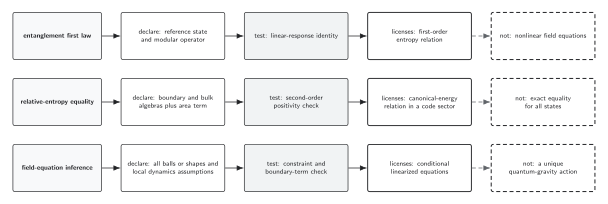
Information identities constrain gravity only after the dictionary, code sector, semiclassical expansion, and boundary terms are fixed. Each row pairs a diagnostic with the strongest supported conclusion and an explicitly unsupported promotion. The diagram is an original schematic and is not to scale.
Claim-domain comparison
Section titled “Claim-domain comparison”The table below gives a screen-reader-friendly comparison of three representative claims. It keeps the required declaration, approximation status, evidence timing, counterevidence, falsifier, failure condition, and licensed conclusion in one reading order.
| Claim object | State, ensemble, and conventions | Approximation, status, and evidence timing | Uncertainty and counterevidence | Falsifier | Failure condition | Licensed conclusion |
|---|---|---|---|---|---|---|
| entanglement first law | Declare reference state and modular operator; use the volume conventions unless the page states a local replacement. | Model-specific calculation or conditional result. Control chain: boundary relative entropy → modular flow and first law → bulk canonical energy → positivity and shape checks → conditional gravity inference. Sources are cited on the destination page; literature checked through 10 August 2026. | Track omitted corrections, alternate branches, and competing definitions. A failed “linear-response identity” check is counterevidence to the promoted claim. | linear-response identity | nonlinear field equations | first-order entropy relation |
| relative-entropy equality | Declare boundary and bulk algebras plus area term; use the volume conventions unless the page states a local replacement. | Model-specific calculation or conditional result. Control chain: boundary relative entropy → modular flow and first law → bulk canonical energy → positivity and shape checks → conditional gravity inference. Sources are cited on the destination page; literature checked through 10 August 2026. | Track omitted corrections, alternate branches, and competing definitions. A failed “second-order positivity check” check is counterevidence to the promoted claim. | second-order positivity check | exact equality for all states | canonical-energy relation in a code sector |
| field-equation inference | Declare all balls or shapes and local dynamics assumptions; use the volume conventions unless the page states a local replacement. | Model-specific calculation or conditional result. Control chain: boundary relative entropy → modular flow and first law → bulk canonical energy → positivity and shape checks → conditional gravity inference. Sources are cited on the destination page; literature checked through 10 August 2026. | Track omitted corrections, alternate branches, and competing definitions. A failed “constraint and boundary-term check” check is counterevidence to the promoted claim. | constraint and boundary-term check | a unique quantum-gravity action | conditional linearized equations |
Download the structured table data (JSON).
References
Section titled “References”- Faulkner, Thomas, Monica Guica, Thomas Hartman, Robert C. Myers, and Mark Van Raamsdonk. “Gravitation from Entanglement in Holographic CFTs.” Journal of High Energy Physics 2014, 051 (2014). DOI; arXiv:1312.7856.
- Jafferis, Daniel L., Aitor Lewkowycz, Juan Maldacena, and S. Josephine Suh. “Relative Entropy Equals Bulk Relative Entropy.” Journal of High Energy Physics 2016, 004 (2016). DOI; arXiv:1512.06431.
- Lashkari, Nima, and Mark Van Raamsdonk. “Canonical Energy Is Quantum Fisher Information.” Journal of High Energy Physics 2016, 153 (2016). DOI; arXiv:1508.00897.
Original QFT.org content:CC BY 4.0, unless an item supplies different terms. Third-party material retains its own terms.