

Quantum-Gravity Phenomenology and Comparative Status
Quantum-gravity phenomenology begins with measured quantities, not with the name of a favored microscopic program. A defensible test connects a mechanism to an operator, a source and propagation model, a detector response, a likelihood with nuisance parameters, and a conclusion whose scope is no broader than the tested assumptions. The operator-first discipline follows the effective-field-theory separation between low-energy quantum corrections and ultraviolet completion Donoghue 1994. This chapter develops that chain across laboratory, astrophysical, and cosmological probes. Its evidence cutoff is 10 August 2026. None of the empirical sources reviewed in this chapter through that cutoff reports a confirmed detection of quantum gravity or an observation that uniquely selects an ultraviolet completion.
Helpful background. Effective Field Theory as a Controlled Expansion supplies power counting; Low-Energy Constraints on UV Completion explains what infrared consistency can and cannot determine. The comparative limits are sharpened in Dated Status, Counterexamples, and Falsifiers, Semiclassical Recovery, Decoherence, Obstructions, and Status, and Falsifiers, Negative Results, and Counterexamples.
Enter through the observable
Section titled “Enter through the observable”Every proposal should answer the same sequence of questions:
- What calibrated datum is recorded?
- Which EFT coefficient, state modification, or mediator property changes its probability distribution?
- What source, propagation, and detector models carry that change to the data?
- Which conventional effects can imitate it?
- What likelihood, prior, selection function, and uncertainty model support the inference?
- What observation would falsify the proposed mechanism?
The possible outcomes form a strict hierarchy. A sensitivity forecast says an apparatus could constrain a parameter under stated assumptions. An exclusion rejects a parameter region within a model. An anomaly is a residual not yet absorbed by the accepted model and its systematics. A mediator witness rules out a specified class of classical communication models. A detection requires a statistically and systematically controlled signal, independent checks, and a uniquely adequate physical interpretation. Moving upward requires new evidence; persuasive language cannot promote a result.
Chapter guide
Section titled “Chapter guide”- Quantum-Gravity Observables and Test Taxonomy builds the common inference chain and claim hierarchy.
- Lorentz-Invariance and Modified-Dispersion Tests treats propagation, birefringence, thresholds, preferred frames, and radiative stability.
- Equivalence-Principle and Universality Tests separates weak, Einstein, strong, and quantum formulations.
- Interferometry, Decoherence, and Entanglement Proposals analyzes phase tests and mediator witnesses under explicit locality assumptions.
- Gravitational-Wave Propagation and Polarization Tests maps modified wave equations into network likelihoods.
- Black-Hole Ringdown, Shadows, and Compact-Object Probes compares near-horizon corrections with environmental and modeling degeneracies.
- Cosmological Background and Primordial-Spectrum Probes treats initial states, higher-derivative templates, relics, and stochastic backgrounds.
- High-Energy, Cosmic-Ray, and Multimessenger Constraints develops threshold and time-of-flight constraints with source and composition uncertainty.
- Cross-Program Evidence and Falsifier Matrix prevents shared EFT assumptions and datasets from being counted as independent support.
- Open Problems, Research Handoffs, and Update Ledger defines how mutable bounds and disputed claims leave a stable teaching page for dated research records.
A worked routing example
Section titled “A worked routing example”Suppose photons of different energies arrive at different times from a transient. The datum is an energy-tagged arrival-time distribution. A candidate mechanism is a dimension-five photon operator producing a correction proportional to . The source model includes intrinsic energy-dependent emission; propagation includes redshift; the detector model includes timing and energy calibration. A joint likelihood must marginalize source lags and selection effects. Even a strong bound then constrains that operator in that preferred-frame, species, and helicity model. It does not test every string, loop, discrete, or asymptotic-safety construction.
The same discipline applies elsewhere. A null equivalence-principle test bounds composition-dependent couplings, not quantum gravity in general. A ringdown consistent with Kerr constrains the injected deformation and waveform family, not all horizon-scale microphysics. A primordial tensor limit constrains a cosmological template after reheating and foreground marginalization, not the existence of gravitons.
Review the chapter
Section titled “Review the chapter”A satisfactory phenomenology argument should let another reader reconstruct the forward model and identify the strongest surviving claim after an adversarial control. Ask:
- Is the measured quantity distinguished from an inferred theoretical parameter?
- Are source, propagation, detector, calibration, and selection effects explicit?
- Are conventional alternatives fitted, not merely mentioned?
- Is the result identified as forecast, exclusion, anomaly, witness, or detection?
- Is the theory conclusion restricted to the actual operator, state, or mediator assumptions?
- Are mutable numerical bounds dated and handed to a maintained research record?
The exit capability is practical: given any proposed quantum-gravity test, write its forward model, likelihood, nuisance structure, falsifier, and claim ceiling before comparing programs.
Chapter-scale structure and validity checks
Section titled “Chapter-scale structure and validity checks”The chapter-scale structure map locates this page’s result inside the full reasoning chain. Follow the solid arrows through the declared inputs and checks; the dashed final arrow marks the point where an additional inference would be required.

Quantum-gravity phenomenology begins with a mechanism and likelihood; sensitivity, bounds, anomalies, and detections have sharply different meanings. The diagram is an original schematic, is not to scale, and uses the dashed final arrow to mark the claim boundary.
The companion validity map turns three common overclaims into explicit failure tests. Read each row from its declared object to the diagnostic, then compare the licensed conclusion with the dashed “not” endpoint.
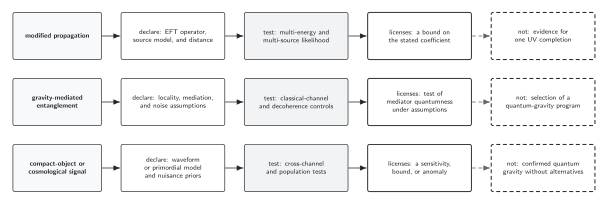
Quantum-gravity phenomenology begins with a mechanism and likelihood; sensitivity, bounds, anomalies, and detections have sharply different meanings. Each row pairs a diagnostic with the strongest supported conclusion and an explicitly unsupported promotion. The diagram is an original schematic and is not to scale.
Claim-domain comparison
Section titled “Claim-domain comparison”The table below gives a screen-reader-friendly comparison of three representative claims. It keeps the required declaration, approximation status, evidence timing, counterevidence, falsifier, failure condition, and licensed conclusion in one reading order.
| Claim object | State, ensemble, and conventions | Approximation, status, and evidence timing | Uncertainty and counterevidence | Falsifier | Failure condition | Licensed conclusion |
|---|---|---|---|---|---|---|
| modified propagation | Declare EFT operator, source model, and distance; use the volume conventions unless the page states a local replacement. | Model-specific calculation or conditional result. Control chain: mechanism and detector observable → data and nuisance model → likelihood and systematics → competing explanations → bound, anomaly, or detection. Sources are cited on the destination page; literature checked through 10 August 2026. | Track omitted corrections, alternate branches, and competing definitions. A failed “multi-energy and multi-source likelihood” check is counterevidence to the promoted claim. | multi-energy and multi-source likelihood | evidence for one UV completion | a bound on the stated coefficient |
| gravity-mediated entanglement | Declare locality, mediation, and noise assumptions; use the volume conventions unless the page states a local replacement. | Model-specific calculation or conditional result. Control chain: mechanism and detector observable → data and nuisance model → likelihood and systematics → competing explanations → bound, anomaly, or detection. Sources are cited on the destination page; literature checked through 10 August 2026. | Track omitted corrections, alternate branches, and competing definitions. A failed “classical-channel and decoherence controls” check is counterevidence to the promoted claim. | classical-channel and decoherence controls | selection of a quantum-gravity program | test of mediator quantumness under assumptions |
| compact-object or cosmological signal | Declare waveform or primordial model and nuisance priors; use the volume conventions unless the page states a local replacement. | Model-specific calculation or conditional result. Control chain: mechanism and detector observable → data and nuisance model → likelihood and systematics → competing explanations → bound, anomaly, or detection. Sources are cited on the destination page; literature checked through 10 August 2026. | Track omitted corrections, alternate branches, and competing definitions. A failed “cross-channel and population tests” check is counterevidence to the promoted claim. | cross-channel and population tests | confirmed quantum gravity without alternatives | a sensitivity, bound, or anomaly |
Download the structured table data (JSON).
References
Section titled “References”Original QFT.org content:CC BY 4.0, unless an item supplies different terms. Third-party material retains its own terms.