

Black-Hole Microstates and Stringy Entropy
A black-hole entropy is one number, but a microscopic explanation is a chain of distinct claims. String theory gives controlled state-counting results for important supersymmetric black holes, precision macroscopic tests, explicit horizonless solutions, and nontrivial response matches. This chapter keeps those achievements connected without treating evidence for a protected index, a classical geometry, or one dynamical channel as automatic evidence for a typical non-BPS state.
Start here if these ideas are new. BPS Bounds, Shortening, and Multiplet Recombination explains why some supersymmetric quantities survive continuous changes of coupling. The Witten Index, Vacuum Counting, and Its Failure Modes explains why a signed trace is not generally an absolute state count.
Helpful for the precision sections. Localization Loci, Zero Modes, and One-Loop Determinants supplies the field-theory template for localization; Noether-Charge Entropy and Higher-Curvature Terms supplies the macroscopic correction; and BTZ Black Holes and Modular CFT Thermodynamics supplies the AdS₃ comparison.
Evidence cutoff for current localization, microstate-geometry, and non-BPS assessments: 29 August 2026. Later work can change the inventory of examples; it cannot be imported into the conclusions below without rechecking the same charge, ensemble, regime, and observable.
What a microscopic entropy claim must specify
Section titled “What a microscopic entropy claim must specify”Fix the charges and any angular momenta or other quantum numbers used to define the count. Let denote the finite-dimensional sector of normalizable BPS bound states after the compactification and exterior-hair convention have been fixed. For a non-BPS count one would instead specify a microcanonical window . In the schematic BPS sector, two elementary quantities already answer different questions:
The degeneracy counts every state with positive weight. The simple index is a signed trace: paired bosonic and fermionic states cancel, so , and equality requires an additional no-cancellation argument. In an actual black-hole problem, fermion zero modes can force one to use a helicity supertrace or a refined trace rather than this schematic index. The trace, insertions, charge normalization, contour, chamber, and treatment of hair and multicenter states are therefore part of the result—not bookkeeping added afterward. Wall crossing illustrates the point sharply: a multicenter contribution can appear or disappear when asymptotic moduli cross a stability wall, even though the charges are unchanged Dabholkar, Murthy, and Zagier 2012.
Four further distinctions organize the chapter:
- A microscopic count is an index, a degeneracy, or the asymptotic growth of one of them in a declared charge sector.
- A macroscopic entropy comes from a gravitational saddle: the two-derivative area law, a higher-derivative Wald entropy, or the finite part of a fixed-charge AdS₂ path integral. Matching it to a microscopic quantity requires the same ensemble and subtraction conventions.
- A dynamical test compares an observable such as an absorption cross section, emission rate, or correlator. It is evidence about that channel and kinematic regime.
- A microstate geometry is first a classical solution. Calling it one quantum state requires a quantization or CFT map; calling a family typical additionally requires a measure and a concentration statement.
“Protected” describes the transported observable, not every state individually. “Typical” is probabilistic: it means typical with respect to a named measure on a named state space and for a named class of observables.
The D1–D5–momentum benchmark
Section titled “The D1–D5–momentum benchmark”For a concrete convention, take type IIB string theory on : D1-branes wrap , D5-branes wrap , and is left-moving momentum along . After the decoupling limit, the interacting D1–D5 CFT has, at leading large-charge order, effective central charge Callan and Maldacena 1996
When is the excitation above the Ramond ground and , so that ordinary Cardy asymptotics applies, the leading growth is
At strong coupling and in the corresponding two-derivative black-hole regime, the five-dimensional area law gives the same leading term,
Higher-derivative terms replace the area law by the appropriate Wald entropy, and loops add further quantum corrections. Every arrow in the leading comparison has a hypothesis. The weak-coupling calculation needs a specified BPS sector and large-charge limit; transport across coupling applies to the protected trace, while a separate cancellation analysis is needed if its growth is identified with an absolute degeneracy; and the gravitational comparison needs the same normalized charges, ensemble, and asymptotic order. In the original construction, Strominger and Vafa 1996, §§1–4 established agreement of the leading large-charge logarithm in a specified five-dimensional -BPS sector. It was not an exact finite-charge identity, a theorem that every index equals an absolute degeneracy, or a count of generic non-BPS black holes.
Choose a path through the chapter
Section titled “Choose a path through the chapter”The pages form four branches that meet again at the evidence-limits page. The numbering below preserves the canonical reading order without implying that every branch is a prerequisite for every other one.
Counting and protection
Section titled “Counting and protection”- Microscopic Black-Hole Entropy: Claim and Ensemble Contract fixes charges, ensemble, chamber, protection, coupling, and asymptotic order.
- BPS Indices, Absolute Degeneracies, and Wall Crossing explains cancellations and separates single- from multicenter sectors.
- D-Brane Bound States and the Strominger–Vafa Count derives the leading D-brane asymptotics.
- D1-D5 CFT and AdS3 Microstate Data identifies protected CFT data across moduli and maps the controlled sector to AdS₃ and BTZ.
Macroscopic precision
Section titled “Macroscopic precision”- Attractor Mechanism and Charge-Only Entropy derives horizon data and states the regularity, basin, and single-center conditions.
- Higher-Derivative and Quantum Entropy Corrections separates Wald terms, nonzero-mode determinants, zero modes, and ensemble transforms.
- Supersymmetric Localization Tests of the Quantum Entropy Function studies when a specified fixed-charge AdS₂ path integral reduces to a finite-dimensional integral and which inputs remain conditional.
Geometries and dynamics
Section titled “Geometries and dynamics”- Microstate Geometries and Fuzzball Proposals assesses smooth capped families, scaling throats, superstrata, quantization, and special non-BPS extensions.
- Absorption, Emission, and Dynamical Tests compares low-energy D-brane and CFT response with black-hole greybody factors in matched channels.
Synthesis
Section titled “Synthesis”- Typicality, Non-BPS Extensions, and Evidence Limits asks what is still needed before protected, geometric, and channel-specific evidence reaches generic black holes.
Four evidence streams and their ceilings
Section titled “Four evidence streams and their ceilings”The evidence is branching, not a ladder in which one calculation automatically upgrades all the others.
Counting and protection. Index asymptotics can be exceptionally robust. To infer an absolute degeneracy, one must also control cancellations, wall crossing, hair, multicenters, and the inverse transform to the desired ensemble.
Macroscopic precision. A regular single-center attractor can fix near-horizon fields, possibly leaving controlled flat directions, and produce charge-dependent Wald entropy Ferrara, Kallosh, and Strominger 1995, Sen 2005. It does not protect the microscopic trace, exclude multicenters, or guarantee a regular global flow. Higher-derivative terms, one-loop determinants, zero-mode measures, ensemble transforms, and nonperturbative saddles are separate correction layers.
The quantum entropy function (Sen 2009) defines a fixed-charge AdS₂ path integral for the horizon sector; supersymmetric localization (Dabholkar, Gomes, and Murthy 2011) is a proposed method for evaluating it, not a synonym for the definition. A localization answer still depends on the off-shell supercharge, boundary conditions, contour, measure, determinants, zero modes, and allowed saddles. Sen 2026 shows that a full localization derivation still faces unresolved closure of normalizable modes under supersymmetry, ultraviolet-cutoff sensitivity in order-one terms, and additional flat directions, while a restricted zero-mode calculation remains useful.
Dynamics. Near-extremal D1–D5 absorption and emission matches test normalized response, not just a density of states. Their classic form applies in a dilute-gas, low-frequency regime and selected channels Maldacena and Strominger 1997, §§1–4. Such a match does not by itself identify individual typical-state radiation, resolve finite-charge line structure, or cover generic non-BPS holes.
Geometry. Smooth capped solutions establish that the target charge sector contains regular horizonless classical configurations. A CFT map Lunin and Mathur 2002, or a phase-space quantization of the regular moduli space Rychkov 2006, can strengthen the statement to quantum states or coherent-state families. It remains a separate question whether the controlled family is entropy-sized and, with a specified measure, represents typical observables. Reviews of the program and technical critiques agree on many examples but disagree about how far they license black-hole-interior claims Bena et al. 2022, Raju and Shrivastava 2019.
Typical non-BPS physics is the synthesis problem. One needs a state space and measure, an entropy-sized set, stability for the stated time scale, strong-coupling control, and concentration or ETH-like behavior for a specified observable class. Recent D1–D5 work also emphasizes that the dominant phase of the microcanonical ensemble can depend on energy and compactification scales Aharony, Frumkin, and Mehl 2026. “Typical” without those declarations is not yet a falsifiable claim.
Evidence map and failure tests
Section titled “Evidence map and failure tests”The structure map begins with one claim contract and then separates four independent evidence streams. Solid arrows mean “this test bears on the bounded sector claim”; they do not mean that a geometry follows from an index or that a response function follows from an entropy count. The final dashed arrow marks the additional premises needed to reach typical non-BPS physics.
On a narrow screen, swipe or use the Left and Right arrow keys to pan across the figure. Home and End move to its edges. A full-size link is also available.

Counting, macroscopic precision, dynamics, and geometry provide complementary rather than serial evidence. Agreement in one declared charge sector supports a bounded synthesis; promotion to typical non-BPS states requires new statistical and dynamical premises. Original schematic, not to scale.
Independent evidence streams for black-hole microstate claims — print equivalent
Fixed claim contract. Declare charges, trace or observable, ensemble, chamber, and regime before comparing evidence.
Complementary streams
Counting and protection: index, degeneracy, cancellations, and wall crossing. Macroscopic precision: area or Wald entropy, the quantum entropy function, corrections, and localization. Normalized dynamics: operator, channel, frequency window, and response. Geometry and state map: regularity, CFT map or quantization, and measure.
Bounded synthesis and blocked promotion
Solid relations support agreement only for the same declared sector and observable map. The dashed promotion to typical non-BPS physics additionally requires an entropy-sized state set, a named measure, concentration, stability, and strong-coupling control.
Structured structure-map data (JSON)
The companion map applies the same discipline to three common overclaims. Each row states the declaration and diagnostic needed before the solid-arrow conclusion is licensed; its dashed endpoint names a stronger conclusion that still does not follow.
On a narrow screen, swipe or use the Left and Right arrow keys to pan across the figure. Home and End move to its edges. A full-size link is also available.
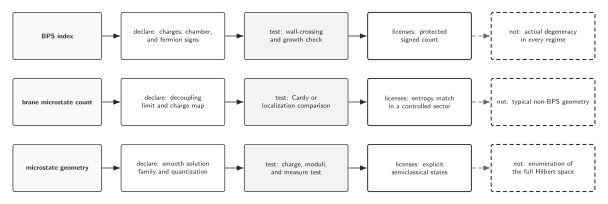
The strongest conclusion in each row is bounded by the declared trace or observable, charges, chamber, regime, and control test. Dashed endpoints are blocked inferences, not expected next steps. Original schematic, not to scale.
Validity boundaries for black-hole microstate claims — print equivalent
Protected trace
After declaring charges, trace or refinement, chamber, zero modes, and hair, test single-center growth and boson–fermion cancellations. This licenses protected indexed asymptotics, not an absolute degeneracy without no-cancellation input.
Entropy match
After declaring compactification, charge map, ensemble, sector, and correction order, compare the same charges, asymptotic regime, transforms, and corrections. This licenses agreement in the specified sector and order, not an exact finite-charge or generic non-BPS count.
Smooth solution family
After declaring charges, asymptotics, regularity, state map or quantization, and measure, test CTCs, singularities, gaps, fluctuations, and phase-space growth. This licenses regular classical solutions—and quantum states only if mapped or quantized—not a complete or typical entropy-sized ensemble.
Structured validity-map data (JSON)
Claim-domain comparison
Section titled “Claim-domain comparison”The complete comparison below uses the same evidence cutoff in every row. On a narrow screen it reflows into one card per claim; on a wider screen its seven-column form is horizontally scrollable so that the distinctions remain directly comparable.
| Claim and observable | State, ensemble, and regime | Status, uncertainty, and evidence date | Current limitation or counterevidence; falsifying result | Licensed conclusion | Not licensed | Update source |
|---|---|---|---|---|---|---|
| Protected BPS index: specified trace, insertion, or refinement | Fixed normalized charges; named chamber and boundary conditions; fermion zero modes and exterior hair treated explicitly. | Protected quantity in suitable supersymmetric sectors. Uncertainty: its relation to an absolute degeneracy is model- and chamber-dependent. Reviewed 29 August 2026. | Current limitation or counterevidence. Multicenter wall-crossing terms and leading boson–fermion cancellations can make the index differ from an absolute degeneracy. Falsifying result. Along a deformation that preserves the supercharge, trace insertion, boundary conditions, chamber, and discrete gapped or Fredholm domain, a change in Ω(Q) or in its large-Q asymptotics would falsify the claimed protection. A disagreement between index and degeneracy growth instead falsifies only the promotion from the protected trace to an absolute count. | A protected signed or refined count, including its asymptotic growth in the declared sector. | The absolute degeneracy in every chamber or at every coupling. | BPS indices, degeneracies, and wall crossing |
| Microscopic BPS count: degeneracy or Fourier coefficient | Specified compactification, BPS sector, charge map, fixed-charge ensemble, coupling path, and large-charge scaling. | Controlled leading asymptotic in canonical D-brane and CFT examples. Uncertainty: finite-charge remainders, hair subtraction, and no-cancellation extrapolations are model-dependent. Reviewed 29 August 2026. | Current limitation or counterevidence. Cardy growth is asymptotic, and protection of an index does not by itself protect an absolute degeneracy. Falsifying result. After matched charge normalization, hair subtraction, and inverse transform, failure of the count to reproduce the predicted leading charge scaling in its declared Cardy regime would falsify the microscopic match. | Leading microscopic entropy agreement in the stated supersymmetric sector and asymptotic regime. | An exact finite-charge identity or a count of generic non-BPS states. | D-brane bound states and the Strominger–Vafa count |
| Macroscopic entropy: Wald terms, logarithms, and the quantum entropy function | Regular single-center near-horizon saddle; fixed charges and AdS₂ boundary conditions; matched higher-derivative action, massless spectrum, zero modes, and contour. | Wald and entropy-function results are controlled under their hypotheses. Uncertainty: full localization remains conditional on measure, closure, regulator, contour, and saddle assumptions. Reviewed 29 August 2026. | Current limitation or counterevidence. Normalizable-mode closure and regulator sensitivity of order-one terms remain unresolved in the full localization argument. Falsifying result. A correction coefficient that disagrees with the same-ensemble microscopic result beyond the combined uncertainty, or changes under equally admissible regulator or contour choices without a selection principle, would falsify the claimed precision match. | Macroscopic entropy and specified corrections for the declared horizon sector; in controlled examples, a precision microscopic match. | Automatic evaluation of the full string path integral or protection of the microscopic trace. | Localization tests of the quantum entropy function |
| Dynamical response: absorption, emission, or a normalized correlator | Named near-extremal ensemble, operator and channel, frequency window, normalization, and dilute-gas or other kinematic limit. | Strong channel-specific agreement in controlled D1–D5 regimes. Uncertainty: extension to other observables, frequencies, and states is model-dependent. Reviewed 29 August 2026. | Current limitation or counterevidence. Existing matches emphasize selected channels and dilute-gas or low-frequency windows, where universal infrared behavior can hide microscopic differences. Falsifying result. Disagreement in fully normalized spectral dependence or selection rules within the declared channel and window, beyond stated errors, would falsify that response match. | Agreement of the stated ensemble response in the stated energy and frequency window. | State-by-state typical emission, all-frequency Hawking radiation, or Hilbert-space completeness. | Absorption, emission, and dynamical tests |
| Microstate geometry: regular horizonless classical solution or quantized family | Fixed charges, asymptotics, moduli, boundary conditions, regularity and no-CTC tests; a CFT map or symplectic quantization when a quantum-state claim is made. | Large explicit supersymmetric families and special non-BPS constructions exist. Uncertainty: their quantum-state map, entropy-sized completeness, and typicality remain limited or open. Reviewed 29 August 2026. | Current limitation or counterevidence. Controlled families are special, and established phase-space counts do not generally supply a complete entropy-sized ensemble. Falsifying result. A singularity or closed timelike curve would falsify regularity; uncontrollable quantum fluctuations would falsify semiclassical control; failure of the proposed state map would falsify the quantum-state identification; and parametrically undersized phase-space growth would falsify a completeness claim. | Regular classical configurations in the target sector; quantum states or coherent families only where a map or quantization is supplied. | A complete basis or a typical entropy-sized ensemble of black-hole states. | Microstate geometries and fuzzball proposals |
| Typical non-BPS physics: distribution of observables over states | Declared non-BPS state space and measure, compactification and coupling regime, observable class, energy window, and stability time scale. | Research program with model-specific evidence. Uncertainty: no general entropy-sized, strongly coupled typicality result is established. Reviewed 29 August 2026. | Current limitation or counterevidence. Known evidence is model- and observable-dependent, while phase structure, strong-coupling transport, stability, and the relevant measure can change the typicality question. Falsifying result. Absence of an entropy-sized stable state set or failure of the declared observables to concentrate under the named measure would falsify the proposed typical-state claim. | Only the model- and observable-specific non-BPS evidence that passes those tests. | A generic claim that typical black-hole states are known or admit smooth semiclassical geometries. | Typicality, non-BPS extensions, and evidence limits |
Download the structured table data (JSON).
Exercises
Section titled “Exercises”1. A protected index need not be an absolute count
Section titled “1. A protected index need not be an absolute count”A BPS sector contains 12 bosonic and 8 fermionic states. Compute its absolute degeneracy and simple index. Then suppose boson–fermion pairs, with , recombine into long multiplets and leave the BPS sector. What changes? Why is this different from a wall-crossing jump?
Solution
Initially,
Removing paired bosonic and fermionic states gives but . The absolute BPS count changes while the signed trace does not. At a wall of marginal stability, by contrast, a multicenter bound state can enter or leave the spectrum; its net indexed contribution need not vanish, so the index itself can jump between chambers. Protection is always stated within the domain in which the trace and boundary conditions are fixed.
2. Recover the D1–D5–momentum exponent
Section titled “2. Recover the D1–D5–momentum exponent”Starting from , use the chiral Cardy formula to obtain the leading microscopic entropy. List three hypotheses needed before comparing it with a black-hole area.
Solution
Substitution gives
The comparison needs, at minimum: (i) the same normalized D1, D5, and momentum charges on both sides; (ii) a BPS and large-charge regime in which the chosen Cardy asymptotics apply; and (iii) a protected trace that can be transported from weak to strong coupling. A separate cancellation or recombination analysis is needed before identifying that trace’s growth with an absolute degeneracy. A precise claim also fixes the ensemble and the subtraction of exterior hair.
3. A two-charge attractor and a one-charge runaway
Section titled “3. A two-charge attractor and a one-charge runaway”Consider the toy effective potential
Find its finite critical point when , evaluate the minimum, and explain what happens when .
Solution
The critical-point equation is
so and
The second derivative is positive there, so this is a finite attractor. If , then runs toward zero as and has no finite critical point. The exercise diagnoses near-horizon regularity in a toy model; it does not establish a microscopic degeneracy, exclude multicenters, or prove that a global flow reaches the critical point.
4. Audit a localization formula
Section titled “4. Audit a localization formula”Suppose a calculation presents
as an “exact black-hole degeneracy.” Name the data that must be checked before accepting that interpretation.
Solution
One must identify the fixed-charge AdS₂ boundary condition and boundary Wilson line, the localized supercharge and off-shell field content, the integration contour , the measure , the nonzero-mode determinant, zero-mode treatment, renormalization prescription, and any instanton or orbifold saddles. One must also state whether the result is a horizon-sector degeneracy or index, and how hair and multicenters are restored or removed. Finally, the normalizable modes must form an admissible supersymmetric domain and the ultraviolet regulator must control the requested correction order. Without those items, a finite-dimensional integral is a conditional localization formula, not automatically the exact full string-theory degeneracy.
5. Classify mixed evidence
Section titled “5. Classify mixed evidence”A smooth solution family at charge scale grows as , while the corresponding black-hole entropy grows as . In one low-frequency scalar channel, its ensemble-averaged absorption rate matches the black-hole greybody factor. What has been established, and what remains open?
Solution
The construction establishes explicit classical configurations in the target charge sector, provided regularity and boundary-condition tests pass. The response calculation supplies a nontrivial dynamical match for the named scalar, ensemble, and low-frequency window. But is parametrically smaller than , so the family is not yet entropy-sized. The two results do not establish Hilbert-space completeness, typical state-by-state radiation, other channels or frequencies, stability at long times, or generic non-BPS behavior. Those conclusions require a quantum-state map, a measure, strong-coupling control, and concentration tests for additional observables.
Where to go next
Section titled “Where to go next”For topology sums, replica or Euclidean wormholes, baby universes, ensembles, and factorization, continue to Wormholes, Gravitational Path Integrals, and Ensembles. For the information problem, continue to Black-Hole Information, Islands, and Interiors. For AdS₂ boundary conditions and the lower-dimensional quantum-entropy setting, return to AdS2, JT Gravity, SYK, and Random Matrices.
References
Section titled “References”- Aharony, Ofer, Ronny Frumkin, and Jonathan Mehl. “The Phase Diagram of the D1-D5 CFT and Localized Black Holes.” Physical Review D 113, 126024 (2026). DOI. Open PDF.
- Bena, Iosif, Emil J. Martinec, Samir D. Mathur, and Nicholas P. Warner. “Fuzzballs and Microstate Geometries: Black-Hole Structure in String Theory.” arXiv:2204.13113 [hep-th] (2022). arXiv.
- Callan, Curtis G., Jr., and Juan M. Maldacena. “D-Brane Approach to Black Hole Quantum Mechanics.” Nuclear Physics B 472, 591–610 (1996). DOI. Open PDF.
- Dabholkar, Atish, João Gomes, and Sameer Murthy. “Quantum Black Holes, Localization, and the Topological String.” Journal of High Energy Physics 2011, 6 (2011): 019. DOI. Open PDF.
- Dabholkar, Atish, Sameer Murthy, and Don Zagier. “Quantum Black Holes, Wall Crossing, and Mock Modular Forms.” arXiv:1208.4074 [hep-th] (2012). arXiv.
- Ferrara, Sergio, Renata Kallosh, and Andrew Strominger. “ Extremal Black Holes.” Physical Review D 52, R5412–R5416 (1995). DOI. Open PDF.
- Lunin, Oleg, and Samir D. Mathur. “AdS/CFT Duality and the Black Hole Information Paradox.” Nuclear Physics B 623, 342–394 (2002). DOI. Open PDF.
- Maldacena, Juan M., and Andrew Strominger. “Black Hole Greybody Factors and D-Brane Spectroscopy.” Physical Review D 55, 861–870 (1997). DOI. Open PDF.
- Raju, Suvrat, and Pushkal Shrivastava. “A Critique of the Fuzzball Program.” Physical Review D 99, 066009 (2019). DOI. Open PDF.
- Rychkov, Vyacheslav S. “D1-D5 Black Hole Microstate Counting from Supergravity.” Journal of High Energy Physics 2006, 1 (2006): 063. DOI. Open PDF.
- Sen, Ashoke. “Black Hole Entropy Function and the Attractor Mechanism in Higher Derivative Gravity.” Journal of High Energy Physics 2005, 9 (2005): 038. DOI. Open PDF.
- Sen, Ashoke. “Quantum Entropy Function from AdS2/CFT1 Correspondence.” International Journal of Modern Physics A 24, 4225–4244 (2009). DOI. Open PDF.
- Sen, Ashoke. “Revisiting Localization for BPS Black Hole Entropy.” Journal of High Energy Physics 2026, 8 (2026): 174. DOI. Open PDF.
- Strominger, Andrew, and Cumrun Vafa. “Microscopic Origin of the Bekenstein–Hawking Entropy.” Physics Letters B 379, 99–104 (1996). DOI. Open PDF.
Original QFT.org content:CC BY 4.0, unless an item supplies different terms. Third-party material retains its own terms.