

AdS Geometry, Boundary Problems, and the Dictionary
An AdS/CFT observable is not specified by naming a bulk field and a boundary operator. One must also choose the AdS patch and causal domain, boundary conformal structure, admissible falloffs, quantization branch, global and topological sector, state or contour, source normalization, and approximation regime. This chapter develops those choices as one coherent boundary problem. Its result is a dictionary record that later calculations can use without silently changing the theory being computed, following the source-based formulation of Witten 1998, §§2–3 and the broader synthesis of Aharony et al. 2000, §§2–3.
Helpful background. Timelike boundaries and self-adjoint extensions explain why AdS evolution needs boundary data. Large-N CFT data and large-N bulk scaling distinguish a useful semiclassical limit from the dictionary itself. Dictionary completeness and global data supplies the claim discipline used here.
A dictionary begins with a boundary problem
Section titled “A dictionary begins with a boundary problem”For a bulk calculation in asymptotically locally AdS, the minimum reproducible record is
| Layer | Data that must be fixed | Failure if omitted |
|---|---|---|
| geometry | Lorentzian or Euclidean signature, dimension, radius , patch, conformal boundary, causal domain | coordinate horizons are mistaken for singularities or a patch result is promoted to a global one |
| field | action normalization, mass and spin, gauge redundancy, boundary falloffs | the operator dimension, polarization count, or two-point coefficient is wrong |
| boundary problem | standard, alternate, mixed, reflective, or open boundary data; allowed flux | evolution is nonunique or nonunitary |
| state | global vacuum, Euclidean preparation, density matrix, contour, and prescription | the same formal solution is assigned incompatible operator orderings |
| global sector | gauge-group global form, charge lattice, bundles, line and defect spectrum | theories with identical local Lie-algebra data are conflated |
| approximation | large , coupling, gap, curvature, loop order, and order of limits | a saddle result is reported as an exact duality statement |
The local formulas in this chapter use the site-wide Lorentzian signature and curvature convention. Euclidean pages or sections say so explicitly and use a positive-definite metric. For a scalar, the recurring near-boundary convention is
In standard quantization, is the source and the renormalized response is proportional to , up to local terms. Alternate and mixed choices are stated afresh where used. This convention is a starting point, not a substitute for checking normalizability, logarithms, counterterms, and symplectic flux.
Two ways through the chapter
Section titled “Two ways through the chapter”Geometry-first route. Begin by fixing AdS curvature and its conformal boundary, compare global, Poincaré, and AdS-Rindler coverage, impose a flux-conserving boundary condition, and then generalize to asymptotically locally AdS data. Only after that introduce fields, sources, and states.
Dictionary-first route. Begin with a concrete top-down parameter map. Then specify the field/operator branch, GKPW source convention, conserved-current and stress-tensor normalizations, global form, extended objects, and state prescription. Finish by translating all choices into a single normalization and global-data check.
A reader is ready for either route if they can distinguish a coordinate boundary from a conformal boundary, explain why a timelike boundary requires data, and identify which coefficient in a near-boundary expansion is held fixed. If any of these tasks is unclear, use the helpful-background links above before treating later formulas as definitions.
The sixteen pages
Section titled “The sixteen pages”The pages are ordered by dependency, but focused readers may enter later once the stated prerequisites are in place.
- Anti-de Sitter Geometry and the Conformal Boundary derives the constant-curvature geometry, compactification, causal travel time, and action.
- Global, Poincaré, and AdS-Rindler Patches determines coordinate coverage, patch horizons, boundary domains, and mode generators.
- Timelike-Boundary Causality and Boundary-Value Problems states the flux and self-adjointness conditions for admissible evolution.
- Asymptotically Locally AdS Boundary Data separates boundary sources, constrained coefficients, and state-dependent responses without assuming an exactly AdS interior.
- Radius, Couplings, and the Parameter Map distinguishes large-, weak-curvature, string-loop, Planck, and compactification scales in a concrete dual pair.
- Bulk Fields and Boundary Operators derives the scalar mass–dimension relation and the admissible quantization branches.
- Spinning Fields, Forms, and Mixed-Symmetry Operators extends the map while enforcing gauge constraints and boundary representation theory.
- The GKPW Generating-Functional Dictionary identifies the boundary source, renormalized saddle, and functional derivatives that produce connected correlators.
- Currents, Stress Tensor, and Bulk Gauge and Metric Fields derives Ward identities and normalization scaling from bulk gauge and gravitational constraints.
- Boundary Global Symmetry, Bulk Gauge Symmetry, and Global Form separates local current algebra from charge lattices, bundles, and line-operator data.
- Extended Operators, Defects, and Brane Charges explains when a boundary line, surface, or defect is represented by a worldline, worldsheet, field, or brane.
- States, Geometries, and Radial Quantization relates cylinder energy to global-AdS energy and distinguishes particles, coherent states, and geometry candidates.
- Euclidean Preparation and Lorentzian State Dictionaries fixes caps, gluing data, analytic continuation, contours, and operator ordering.
- Heavy States, Coherent States, and Semiclassical Geometries gives fluctuation and coarse-graining criteria for a state-to-geometry interpretation.
- Boundary Conditions, Alternate Quantization, and Deformations derives the BF-window choices and their multi-trace deformation interface.
- Dictionary Normalization and Global-Data Audit closes the chapter with scalar, current, and stress-tensor benchmarks and an invariant translation procedure.
What the chapter establishes
Section titled “What the chapter establishes”The chapter establishes conditional maps. Given a specified bulk theory, boundary problem, state, and regime, it identifies the boundary source and representation, computes normalized responses, and exposes global information that local correlators cannot recover. The asymptotically locally AdS source/response split is the renormalized construction of de Haro, Solodukhin, and Skenderis 2001, §§2–5. These maps do not prove that an arbitrary CFT has a gravitational dual, that a large- saddle is an exact equality at finite , or that a heavy state has a unique classical interior.
Three checks recur throughout:
- flux: the chosen falloffs make the renormalized symplectic flux through the timelike boundary vanish, unless an explicitly enlarged open system carries it;
- Ward identity: source variations respect gauge and diffeomorphism constraints, including anomalies and contact terms;
- invariant translation: dimensions, poles, conserved charges, and separated-point tensor structures agree after every convention change.
These checks are complementary. Flux does not fix an operator normalization; a correct two-point coefficient does not determine global form; local dictionary data do not determine a nonperturbative duality.
Review the chapter
Section titled “Review the chapter”Use the following prompts as answer criteria rather than as a score.
- Boundary problem. Given and two coefficients , state the allowed quantizations, which coefficient is the source, and the flux condition. A complete answer names the BF window and treats logarithmic endpoints separately.
- Patch. Explain why an AdS-Rindler observer has access to one boundary diamond although the bulk curvature is smooth at the wedge horizon. A complete answer distinguishes coordinate coverage, Killing time, and global mode completeness.
- Normalization. Starting from a bulk kinetic coefficient, predict how the dual two-point coefficient scales with and the coupling. A complete answer checks dimensions and one Ward identity before comparing conventions.
- State. Compare a Euclidean-prepared coherent state and a thermal density matrix with the same mean energy. A complete answer identifies contour data and at least one correlator or fluctuation that distinguishes them.
- Global data. Explain why matching current correlators cannot distinguish all gauge-group global forms. A complete answer names line operators, bundles, or a charge lattice as additional data.
With a complete dictionary record, continue to holographic renormalization for counterterms and finite one-point functions, Witten diagrams for perturbative correlators, thermal and real-time holography for Lorentzian contours and response, or bulk reconstruction for locality questions. Generic conformal representation theory remains in Conformal Field Theory and Bootstrap; self-adjoint extensions and fixed-background boundary QFT remain in QFT in Curved Spacetime; theorem-first equivalence and reconstruction questions belong to Mathematical QFT.
Chapter-scale structure and validity checks
Section titled “Chapter-scale structure and validity checks”The chapter-scale structure map locates this page’s result inside the full reasoning chain. Follow the solid arrows through the declared inputs and checks; the dashed final arrow marks the point where an additional inference would be required.

An AdS/CFT entry is defined by geometry, boundary conditions, global sector, quantization branch, and normalization—not by a mass-dimension formula alone. The diagram is an original schematic, is not to scale, and uses the dashed final arrow to mark the claim boundary.
The companion validity map turns three common overclaims into explicit failure tests. Read each row from its declared object to the diagnostic, then compare the licensed conclusion with the dashed “not” endpoint.
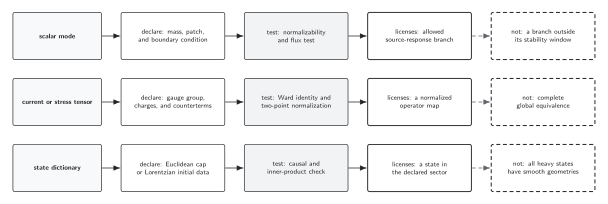
An AdS/CFT entry is defined by geometry, boundary conditions, global sector, quantization branch, and normalization—not by a mass-dimension formula alone. Each row pairs a diagnostic with the strongest supported conclusion and an explicitly unsupported promotion. The diagram is an original schematic and is not to scale.
Claim-domain comparison
Section titled “Claim-domain comparison”The table below gives a screen-reader-friendly comparison of three representative claims. It keeps the required declaration, approximation status, evidence timing, counterevidence, falsifier, failure condition, and licensed conclusion in one reading order.
| Claim object | State, ensemble, and conventions | Approximation, status, and evidence timing | Uncertainty and counterevidence | Falsifier | Failure condition | Licensed conclusion |
|---|---|---|---|---|---|---|
| scalar mode | Declare mass, patch, and boundary condition; use the volume conventions unless the page states a local replacement. | Model-specific calculation or conditional result. Control chain: AdS patch and conformal boundary → boundary and global conditions → asymptotic field modes → renormalized source and response → operator dictionary. Sources are cited on the destination page; literature checked through 10 August 2026. | Track omitted corrections, alternate branches, and competing definitions. A failed “normalizability and flux test” check is counterevidence to the promoted claim. | normalizability and flux test | a branch outside its stability window | allowed source-response branch |
| current or stress tensor | Declare gauge group, charges, and counterterms; use the volume conventions unless the page states a local replacement. | Model-specific calculation or conditional result. Control chain: AdS patch and conformal boundary → boundary and global conditions → asymptotic field modes → renormalized source and response → operator dictionary. Sources are cited on the destination page; literature checked through 10 August 2026. | Track omitted corrections, alternate branches, and competing definitions. A failed “Ward identity and two-point normalization” check is counterevidence to the promoted claim. | Ward identity and two-point normalization | complete global equivalence | a normalized operator map |
| state dictionary | Declare Euclidean cap or Lorentzian initial data; use the volume conventions unless the page states a local replacement. | Dictionary entry or correspondence claim. Control chain: AdS patch and conformal boundary → boundary and global conditions → asymptotic field modes → renormalized source and response → operator dictionary. Sources are cited on the destination page; literature checked through 10 August 2026. | Track omitted corrections, alternate branches, and competing definitions. A failed “causal and inner-product check” check is counterevidence to the promoted claim. | causal and inner-product check | all heavy states have smooth geometries | a state in the declared sector |
Download the structured table data (JSON).
References
Section titled “References”- Aharony, Ofer, Steven S. Gubser, Juan Maldacena, Hirosi Ooguri, and Yaron Oz. “Large N Field Theories, String Theory and Gravity.” Physics Reports 323 (2000): 183–386. arXiv. DOI.
- de Haro, Sebastian, Sergey N. Solodukhin, and Kostas Skenderis. “Holographic Reconstruction of Spacetime and Renormalization in the AdS/CFT Correspondence.” Communications in Mathematical Physics 217 (2001): 595–622. arXiv. DOI.
- Witten, Edward. “Anti-de Sitter Space and Holography.” Advances in Theoretical and Mathematical Physics 2 (1998): 253–291. arXiv. DOI.
Original QFT.org content:CC BY 4.0, unless an item supplies different terms. Third-party material retains its own terms.