

Attractor Mechanism and Charge-Only Entropy
The attractor mechanism is a radial boundary-value problem. Fix a four-dimensional ungauged supergravity theory, a quantized charge vector , and a static, spherically symmetric, extremal branch. Scalar profiles that begin at different asymptotic values can approach the same charge-selected horizon point—provided those initial data lie in a regular basin. The resulting leading single-center entropy is independent of the continuous asymptotic moduli, but it is not independent of the theory, charge orbit, branch, or approximation.
Required background. BPS Indices, Absolute Degeneracies, and Wall Crossing supplies chamber dependence; BPS Particles and Central Charges supplies the BPS bound and central-charge interpretation.
Helpful background. Charge Lattices, Duality Frames, and Local Systems fixes symplectic charge conventions; Black-Hole Thermodynamics at the QFT Interface supplies the entropy interpretation.
This page first derives the radial flow in four-dimensional language, then solves an exact supersymmetric dilaton black hole. A one-charge limit and a two-center wall provide independent failure tests. All entropies below are two-derivative, single-center results unless stated otherwise.
From asymptotic moduli to a horizon fixed point
Section titled “From asymptotic moduli to a horizon fixed point”Use the site’s metric convention and isotropic radius . With inward coordinate , spatial infinity is and a regular extremal horizon is approached as . Write
Here are vector-multiplet scalars with positive special-Kähler metric . Hypermultiplet scalars do not enter the two-derivative black-hole potential in this ungauged setting and are not claimed to be fixed. After eliminating the gauge fields in favor of their conserved charges and dropping an overall factor and a boundary term, the radial integrand is
where a dot means . The remaining Einstein equation is the zero-energy constraint
This constraint is essential: extremizing a scalar function without it does not establish an extremal black-hole geometry. The reduction and constraint are derived in Denef 2000, § 3.2, eqs. (3.10)–(3.12), Open PDF and Ferrara, Gibbons, and Kallosh 1997, § 2, eqs. (10)–(12), Open PDF.
Fix the local-supergravity symplectic convention
The sign of the magnetic term is a convention; charges and periods must be transformed together if another convention is used. Special geometry gives the first equality below. On a patch where , differentiating gives the second:
Consequently, on the same patch, the radial integrand can be completed into squares:
For increasing inward, the BPS equations are therefore
They are first-order equations for spatial profiles, not dissipative time evolution. Suppose a regular BPS flow approaches a finite point with nonsingular scalar metric and . Near its horizon, . If the norm of approached a nonzero value, the scalar equation would instead give for some ; integrating inward would produce a logarithmic drift and prevent from reaching a finite limit. Therefore , and the identity implies
The implication is one-way: a non-BPS extremal attractor may extremize without satisfying . The BPS flow equations and their endpoint interpretation appear in Denef 2000, §§ 3.2–3.4, eqs. (3.13)–(3.19), Open PDF; the original four-dimensional fixed-point construction is in Ferrara, Kallosh, and Strominger 1995, §§ 3–5, Open PDF.
At a regular endpoint,
The limiting two-sphere radius is therefore , so
We set for the worked example.
An exact supersymmetric dilaton attractor
Section titled “An exact supersymmetric dilaton attractor”Consider the axion-free sector of four-dimensional supergravity used by Ferrara and Kallosh. Let and be the electric and magnetic charges in their harmonic-function normalization. For the compatible BPS sign branch,
and the black-hole potential is
Both the BPS condition and the second-order attractor equation give
At this point,
Thus the finite critical point is a strict minimum in the dilaton direction when . If , the whole potential becomes
which makes uniqueness and convexity manifest.
The algebraic minimum is backed by an exact radial solution:
For any finite on this BPS branch, both harmonic functions are positive for . They give a nonsingular exterior and
The asymptotic mass still remembers the boundary datum,
whereas the leading horizon entropy does not:
The action normalization, exact harmonic functions, horizon limit, and entropy are given in Ferrara and Kallosh 1996, introduction eqs. (3)–(6) and § 4, eqs. (57)–(68), Open PDF. The exact solution verifies more than : it supplies the exterior interpolation and identifies the regular basin in this truncation.
Charge invariants and their domain
Section titled “Charge invariants and their domain”The product is the scalar-independent horizon combination in the displayed two-charge sector. In a fuller four-dimensional dyon problem, electric and magnetic lattice vectors and form the duality invariant
After the matter moduli are placed on the same regular large-charge BPS attractor branch, with and , the axion–dilaton and the leading entropy are
Under , one has and . This large-charge scaling is what can make the horizon curvature small in charge units; it does not by itself control every compactification modulus or string loop. Here and use the dimensionless lattice-charge normalization of Banerjee, Jatkar, and Sen 2009, § 2, eq. (2.5), Open PDF; their macroscopic Wald-entropy calculation gives the leading result in § 5, eqs. (5.14)–(5.15).
The qualifications , , an allowed charge orbit, and a regular global flow are part of the result. The expression is not an instruction to assign a black-hole entropy to every lattice vector.
Basins, branches, and flat directions
Section titled “Basins, branches, and flat directions”A basin of attraction is the set of asymptotic scalar values whose inward flow stays in the physical moduli space and reaches the same regular critical point. A candidate endpoint must pass several tests:
- The scalar point is finite and lies where the effective theory and scalar metric are regular.
- The critical value is finite and positive, giving a nonzero horizon area.
- The Hessian is positive in directions normal to the critical set. A zero Hessian eigenvalue by itself only calls for a higher-order stability test: a positive quartic term may stabilize an isolated point. A direction is genuinely flat only when the critical points form a submanifold and is constant along it.
- The complete radial solution from the chosen asymptotic data is nonsingular and remains on the intended single-center branch.
For a regular two-derivative BPS vector-multiplet attractor,
so there are no vector-multiplet flat directions in that class when the metric is positive. Spectator hypermultiplets can remain arbitrary, and extended or non-BPS theories can have genuine critical submanifolds. Charge-only entropy then means that is constant along those flat directions, not that every scalar has been fixed. The BPS Hessian is derived in Ferrara, Gibbons, and Kallosh 1997, § 4, eqs. (65)–(67), Open PDF; the need to test higher orders along non-BPS zero modes is illustrated in Tripathy and Trivedi 2006, § 2, Open PDF.
If the same charge supports several regular isolated critical points with different , the entropy is branch-labeled, , rather than an unqualified function . Continuous asymptotic moduli do not change within one basin, but they can select which branch is reached.
Failure test: the one-charge runaway
Section titled “Failure test: the one-charge runaway”Set in the same supersymmetric truncation. Then
at every finite . The would-be endpoint is the infinite-distance limit , where . The exact solution makes the failure geometric: is constant, so
This is a singular, zero-area two-derivative limit, not a regular black hole whose entropy has been successfully computed as zero. Likewise, parallel charge vectors give and drive the axion–dilaton saddle to the boundary. In both cases a formal charge expression exposes the failure; it does not repair it.
The figure compares the exact normalized potentials. Inspect the finite minimum in the two-charge panel and the missing endpoint in the one-charge panel; the arrows summarize inward radial behavior and do not represent time evolution.
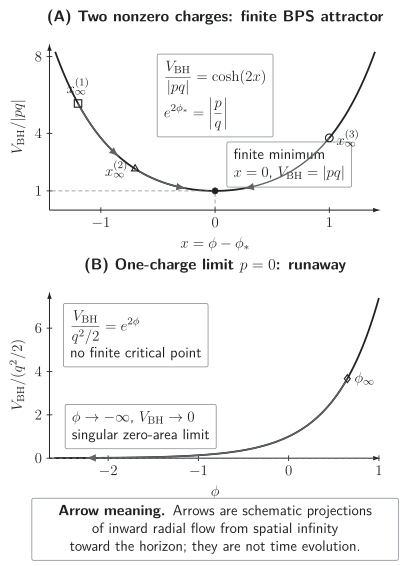
In the canonical supersymmetric normalization, two nonzero charges give the exact curve with a finite minimum. Setting leaves the monotone curve and a singular zero-area limit at . Curves are quantitative for the one-scalar potentials; arrows are schematic projections of inward radial flow, not time trajectories.
Single centers and multicenter chambers
Section titled “Single centers and multicenter chambers”Charge-only single-center horizon data do not make the full BPS spectrum charge-only. Let , let , and set . Denef’s multicenter integrability equation is
For two centers it gives
with every central charge evaluated at infinity. With this charge ordering, the classical existence side satisfies
At a marginal-stability wall the phases align with positive real overlap. Approaching from the allowed side sends ; across the wall the algebraic separation is negative and that two-center bound state is absent. This sign test is necessary, not a general proof that the full solution is globally regular. The total charge and a surviving single-center attractor can remain unchanged while the multicenter contribution to the index jumps. The equations and wall limit are derived in Denef 2000, § 6.1, eqs. (6.4)–(6.7), and § 7.2, eqs. (7.23)–(7.24), Open PDF.
This is why a single-center horizon entropy and the chamber-dependent indexed count are different observables. The wall-crossing prerequisite develops the microscopic side of that distinction.
Conditions behind the charge-only result
Section titled “Conditions behind the charge-only result”| Item | Fixed statement | What is not included |
|---|---|---|
| Observable | Horizon vector scalars and leading single-center entropy | ADM mass, a full exterior profile, or the total indexed spectrum |
| Geometry | Four-dimensional, static, spherical, asymptotically flat, extremal single center | Rotation, gauging, nonextremality, or an arbitrary multicenter geometry |
| Inputs | The supergravity action, charge normalization, charge vector, branch, and asymptotic basin | A theory-independent formula for every lattice vector |
| Regularity | Finite physical endpoint, , stable normal Hessian, and nonsingular global flow | Mere stationarity of |
| Approximation | Two-derivative classical supergravity with small curvature and controlled coupling | Higher-derivative, string-loop, and quantum corrections |
| Evidence and uncertainty | Analytic EFT derivation, checked against an exact BPS solution | No statistical error; omitted terms are systematic truncation uncertainty |
Higher-derivative gravity changes the entropy functional. Under the appropriate regular near-horizon assumptions, Sen’s entropy function is extremized over the near-horizon data and its stationary value equals the Wald entropy. A near-horizon extremum still does not prove a global interpolation to the chosen asymptotics Sen 2005, §§ 2–3, especially eqs. (2.14), (2.17)–(2.18), and (3.1)–(3.5), Open PDF. The next page treats these corrections.
Common pitfalls
Section titled “Common pitfalls”Calling radial flow time evolution. The independent variable is inverse radius. The potential picture is useful, but it does not describe frictional relaxation in physical time.
Attracting every scalar. The displayed potential fixes coupled vector-multiplet directions. Hypermultiplet spectators, or true flat directions in other attractor classes, can remain unfixed while the entropy stays charge-only.
Equating a stationary point with a black hole. A finite critical point must also have positive area, stable physical directions, and a nonsingular exterior flow from the chosen basin.
Using for every extremal solution. It is the BPS condition. Non-BPS attractors can satisfy with .
Dropping normalization data. Rescaling charges changes the numerical coefficient in and . The exact harmonic functions above bind the convention used in the worked result.
Identifying one horizon with the total index. Multicenter states can appear or disappear across walls even when the same single-center critical point persists.
Treating the area law as exact. The result is a two-derivative statement. Higher-derivative and quantum terms require a different entropy functional and their own control regime.
Exercises
Section titled “Exercises”1. Complete the BPS squares
Section titled “1. Complete the BPS squares”Starting from , expand the two squares in the radial action and recover the total derivative.
Solution
The warp-factor square contributes the cross term . The scalar square contributes
Their sum is . Subtracting that derivative leaves the original radial integrand and gives the first-order equations when both squares vanish.
2. Solve and check the dilaton minimum
Section titled “2. Solve and check the dilaton minimum”Take and . Find , , the raw coordinate second derivative , its canonically normalized counterpart, the horizon area, and the leading entropy in units.
Solution
The attractor equation gives
Then and the raw coordinate component is . The scalar metric is , so is canonically normalized and . Hence
3. Verify the basin directly
Section titled “3. Verify the basin directly”Use the exact harmonic functions to show that every finite in the displayed BPS branch reaches the same horizon value when . Which exterior quantity still changes?
Solution
Both constants and are positive, and the pole coefficients and are positive. Thus for every . Near their pole terms dominate, so and , independently of . The ADM mass and the full scalar profile still depend on .
4. Diagnose the runaway
Section titled “4. Diagnose the runaway”Set . Show both from the potential and from the harmonic functions that the regularity assumptions fail.
Solution
The derivative is strictly positive at finite , so no finite critical point exists. In the exact solution, is constant while , giving and . The scalar runs to infinite distance and the horizon area vanishes. The correct conclusion is “no regular two-derivative attractor,” not “a regular black hole of entropy zero.”
5. Add a flat spectator
Section titled “5. Add a flat spectator”Let be independent of , with scalar metric . Find both the raw coordinate Hessian entries and the metric-normalized eigenvalues at the critical set, then explain why the entropy can remain charge-only.
Solution
The critical set has and arbitrary . The coordinate Hessian in has entries . Raising one index with gives metric-normalized eigenvalues and . The normal mode is stable and the tangent mode is genuinely flat. Because is constant along , the horizon area and entropy are fixed even though one scalar is not.
6. Cross a two-center wall
Section titled “6. Cross a two-center wall”Keep and fixed while varying so that from the existence side. What happens to , the total charge, and a separate single-center entropy?
Solution
The denominator approaches zero with the sign required for , so . Across the wall the formal separation is negative and that two-center bound state is absent. The total charge is unchanged. If it has its own regular single-center attractor, that horizon entropy can persist even though the multicenter contribution to the index jumps.
What the attractor mechanism establishes
Section titled “What the attractor mechanism establishes”For a declared theory, charge normalization, regular branch, basin, and two-derivative control regime, the attractor flow can erase continuous asymptotic-modulus dependence from coupled horizon data and the leading single-center entropy. The exact dilaton solution realizes that statement and the one-charge limit shows its boundary. Flat directions, multiple branches, and multicenter walls explain why the strongest conclusion is narrower than “entropy depends only on charges.”
Continue to Higher-Derivative and Quantum Entropy Corrections for corrected macroscopic and microscopic comparisons, Supersymmetric Localization and Quantum Entropy-Function Tests for exact near-horizon tests, and Microstate Geometries and Fuzzball Proposals for state-to-geometry questions.
The chapter overview contains the structure diagram and validity and failure diagram. They are embedded there once so that their shared chapter-level context is not repeated on every article.
For the chapter-wide comparison of assumptions, counterevidence, falsifiers, and claim ceilings, see the claim-domain table.
References
Section titled “References”- Banerjee, Nabamita, Dileep P. Jatkar, and Ashoke Sen. “Asymptotic Expansion of the Dyon Degeneracy.” Journal of High Energy Physics 2009, no. 05, 121 (2009). DOI. Open PDF.
- Denef, Frederik. “Supergravity Flows and D-Brane Stability.” Journal of High Energy Physics 2000, no. 08, 050 (2000). DOI. Open PDF.
- Ferrara, Sergio, Gary W. Gibbons, and Renata Kallosh. “Black Holes and Critical Points in Moduli Space.” Nuclear Physics B 500, 75–93 (1997). DOI. Open PDF.
- Ferrara, Sergio, and Renata Kallosh. “Supersymmetry and Attractors.” Physical Review D 54, 1514–1524 (1996). DOI. Open PDF.
- Ferrara, Sergio, Renata Kallosh, and Andrew Strominger. “ Extremal Black Holes.” Physical Review D 52, R5412–R5416 (1995). DOI. Open PDF.
- Sen, Ashoke. “Black Hole Entropy Function and the Attractor Mechanism in Higher Derivative Gravity.” Journal of High Energy Physics 2005, no. 09, 038 (2005). DOI. Open PDF.
- Tripathy, Prasanta K., and Sandip P. Trivedi. “Non-Supersymmetric Attractors in String Theory.” Journal of High Energy Physics 2006, no. 03, 022 (2006). DOI. Open PDF.
Original QFT.org content:CC BY 4.0, unless an item supplies different terms. Third-party material retains its own terms.