

Canonical, Loop, Spin-Foam, and Group-Field Quantum Gravity
Canonical quantum gravity begins from constrained general relativity, while loop, spin-foam, and group-field approaches make different choices for kinematics and dynamics. This chapter keeps physical Hilbert space, geometric spectra, covariant amplitudes, condensate reductions, continuum recovery, and operational predictions separate.
Helpful background. Physical Gauge Hilbert Spaces and Constraint Enforcement supplies constrained quantization; Constraints, Dirac Brackets, and Symplectic Reduction supplies classical reduction; Fixed-Background, Semiclassical, Gravitational-EFT, and Quantum-Gravity Regimes supplies target regimes; Observable and Regime Matrix for Quantum Gravity supplies comparison criteria; Quantum-Gravity Consistency Claims and Comparison Contract supplies status discipline.
Evidence cutoff for the program-level assessment: 25 July 2026.
Enter this chapter
Section titled “Enter this chapter”Canonical-first readers should follow constraints, Wheeler–DeWitt quantization, connection variables, loop kinematics, and Hamiltonian dynamics. Covariant readers can enter through the EPRL and GFT pages after learning the shared boundary kinematics. Every path should finish with continuum recovery, relational observables, and the dated assessment.
- Canonical Constraints, Dirac Observables, and Constraint Algebras derives ADM constraints and their structure-function algebra.
- Wheeler–DeWitt Quantization and the Problem of Time separates a formal constraint equation from its physical inner product and clock.
- Ashtekar–Barbero Variables and Connection Dynamics constructs connection variables and exposes reality and Immirzi choices.
- Loop-Quantum-Gravity Kinematics and Spin Networks represents the holonomy–flux algebra on gauge-invariant graphs.
- Kinematical Area and Volume Operators and Spectra computes discrete spectra and states their physical ceiling.
- Hamiltonian Constraints and Quantum Dynamics examines regulated graph-changing constraints and anomaly tests.
- Spin-Foam and EPRL Amplitudes: Covariant-Dynamics Proposals derives a four-simplex amplitude and its two Regge phases.
- Group-Field-Theory Fields, Feynman Diagrams, and States generates spin-foam complexes from a many-body field theory.
- Group-Field Condensates and Cosmological Reduction derives a relational Friedmann-type equation within a condensate truncation.
- Semiclassical States, Continuum Limits, and Classical Recovery defines refinement at fixed physical geometry with an error budget.
- Matter Coupling, Relational Observables, and Operational Predictions couples a scalar clock and constructs relational volume.
- Canonical and Loop Programs: Evidence, Obstructions, and Current Status compares achievements and missing physical handoffs at the cutoff.
One program, several non-equivalent layers
Section titled “One program, several non-equivalent layers”The central dependency is
Skipping an arrow changes the claim. The LOST theorem constrains a kinematical representation under specified assumptions; area discreteness is a property of operators there. An EPRL vertex supplies a candidate covariant amplitude with Regge asymptotics. A GFT action generates complexes, and a condensate supplies a reduced collective state. None substitutes automatically for a physical inner product and regulator-independent observable.
| Evidence | Directly supports | Does not yet establish |
|---|---|---|
| closed classical constraint algebra | correct gauge benchmark | anomaly-free quantum algebra |
| spin-network basis | background-independent kinematics | physical spacetime states |
| Regge vertex asymptotic | one nondegenerate semiclassical saddle | continuum Einstein path integral |
| condensate Friedmann equation | collective dynamics in a truncation | generic homogeneous universe |
| refinement convergence | continuum value for tested observable | all observables or universality |
For program-level accounts of the spin-foam and group-field-theory constructions and their open continuum problems, see Perez 2013, Oriti 2017, and the current Hilbert-space comparison in Gielen 2025.
Review the chapter
Section titled “Review the chapter”- Constraint benchmark. Derive . A complete answer identifies the metric-dependent structure function and required surface terms.
- Time and inner product. Solve a parametrized model. A complete answer gives group averaging, a clock-conditioned evolution, and a multiple-choice failure mode.
- Connection variables. Derive and . A complete answer fixes density weights and explains real versus self-dual reality conditions.
- Kinematics versus physics. Compute an area eigenvalue. A complete answer states graph, spins, , operator prescription, and why the result is not a Dirac observable.
- Dynamics test. Act with a regulated Hamiltonian and evaluate its commutator. A complete answer tracks graph changes, domain, regulator, and the expected diffeomorphism action.
- Covariant test. Recover both Regge phases of an EPRL vertex. A complete answer includes nondegeneracy, scaling, orientation, and refinement limitations.
- GFT test. Derive a simplicial Feynman amplitude or condensate volume equation. A complete answer identifies the kernel, interaction, truncation, and connected-correlation error.
- Recovery test. Hold physical geometry fixed while refining. A complete answer combines discretization, quantum width, constraint, and truncation errors.
- Operational test. Change the matter clock. A complete answer compares relational observables in the physical inner product rather than kinematical spectra.
For reduced cosmological applications, continue to Quantum Cosmology and Singularity-Resolution Programs. For other non-holographic quantum-gravity frameworks, continue to Asymptotic Safety, Causal, and Discrete Quantum-Gravity Programs. For cross-program observational comparison, continue to Quantum-Gravity Phenomenology and Comparative Status.
Chapter-scale structure and validity checks
Section titled “Chapter-scale structure and validity checks”The chapter-scale structure map locates this page’s result inside the full reasoning chain. Follow the solid arrows through the declared inputs and checks; the dashed final arrow marks the point where an additional inference would be required.

Kinematical discreteness, constraint solutions, spin-foam amplitudes, continuum limits, and classical recovery are separate achievements. The diagram is an original schematic, is not to scale, and uses the dashed final arrow to mark the claim boundary.
The companion validity map turns three common overclaims into explicit failure tests. Read each row from its declared object to the diagnostic, then compare the licensed conclusion with the dashed “not” endpoint.
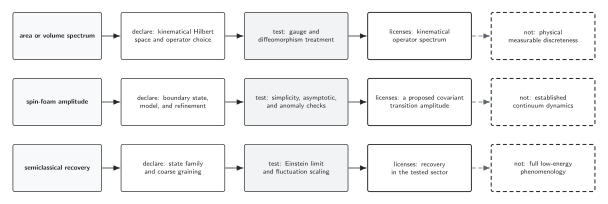
Kinematical discreteness, constraint solutions, spin-foam amplitudes, continuum limits, and classical recovery are separate achievements. Each row pairs a diagnostic with the strongest supported conclusion and an explicitly unsupported promotion. The diagram is an original schematic and is not to scale.
Claim-domain comparison
Section titled “Claim-domain comparison”The table below gives a screen-reader-friendly comparison of three representative claims. It keeps the required declaration, approximation status, evidence timing, counterevidence, falsifier, failure condition, and licensed conclusion in one reading order.
| Claim object | State, ensemble, and conventions | Approximation, status, and evidence timing | Uncertainty and counterevidence | Falsifier | Failure condition | Licensed conclusion |
|---|---|---|---|---|---|---|
| area or volume spectrum | Declare kinematical Hilbert space and operator choice; use the volume conventions unless the page states a local replacement. | Model-specific calculation or conditional result. Control chain: constrained phase space → connections and spin networks → Hamiltonian, foam, or group-field dynamics → continuum and semiclassical tests → physical-observable claim. Sources are cited on the destination page; literature checked through 10 August 2026. | Track omitted corrections, alternate branches, and competing definitions. A failed “gauge and diffeomorphism treatment” check is counterevidence to the promoted claim. | gauge and diffeomorphism treatment | physical measurable discreteness | kinematical operator spectrum |
| spin-foam amplitude | Declare boundary state, model, and refinement; use the volume conventions unless the page states a local replacement. | Model-specific calculation or conditional result. Control chain: constrained phase space → connections and spin networks → Hamiltonian, foam, or group-field dynamics → continuum and semiclassical tests → physical-observable claim. Sources are cited on the destination page; literature checked through 10 August 2026. | Track omitted corrections, alternate branches, and competing definitions. A failed “simplicity, asymptotic, and anomaly checks” check is counterevidence to the promoted claim. | simplicity, asymptotic, and anomaly checks | established continuum dynamics | a proposed covariant transition amplitude |
| semiclassical recovery | Declare state family and coarse graining; use the volume conventions unless the page states a local replacement. | Model-specific calculation or conditional result. Control chain: constrained phase space → connections and spin networks → Hamiltonian, foam, or group-field dynamics → continuum and semiclassical tests → physical-observable claim. Sources are cited on the destination page; literature checked through 10 August 2026. | Track omitted corrections, alternate branches, and competing definitions. A failed “Einstein limit and fluctuation scaling” check is counterevidence to the promoted claim. | Einstein limit and fluctuation scaling | full low-energy phenomenology | recovery in the tested sector |
Download the structured table data (JSON).
References
Section titled “References”- Gielen, Steffen. “Hilbert Space Formalisms for Group Field Theory.” Classical and Quantum Gravity 42, 083001 (2025). DOI. Open PDF.
- Oriti, Daniele. “The Universe as a Quantum Gravity Condensate.” Comptes Rendus Physique 18, 235–245 (2017). DOI. Open PDF.
- Perez, Alejandro. “The Spin-Foam Approach to Quantum Gravity.” Living Reviews in Relativity 16, 3 (2013). DOI. Open PDF.
Original QFT.org content:CC BY 4.0, unless an item supplies different terms. Third-party material retains its own terms.