

Holographic Matter, Transport, and Model Building
Holographic matter models turn boundary sources and ensembles into charged black branes, flavor sectors, broken phases, spectra, and transport. Their value lies in controlled calculations and sharply stated mechanisms. Every conclusion in this chapter therefore names the bulk action, current normalization, source and horizon conditions, Kubo limit, density and translation-breaking parameters, top-down or bottom-up status, calibration set, and inference ceiling.
Helpful background. Sources, Linear Response, and Kubo Formulae supplies response conventions. Charged and Anomalous Hydrodynamics supplies charged-fluid modes. Strange-Metal Transport and Planckian Claims supplies the many-body evidence boundary. AdS Black Branes and Holographic Thermodynamics supplies the thermal saddle.
Specify the observable and the model
Section titled “Specify the observable and the model”An observable-first route begins by choosing charge density, a fermion spectral function, conductivity, viscosity, an anomalous coefficient, or a hydrodynamic constitutive relation. Record its source, response, contact subtraction, Fourier convention, order of limits, fluctuation channel, and causal horizon condition before solving.
A model-first route begins by recording:
- the complete bulk fields, interactions, and boundary conditions;
- the ensemble, charge and current normalizations, and dimensionless control parameters;
- whether the construction is top-down, a consistent truncation, a probe limit, or bottom-up;
- the large-, strong-coupling, derivative, and radial validity windows;
- calibration data, held-out observables, uncertainties, and competing models.
The two routes meet only when the selected model actually defines the selected observable. A regular horizon does not supply missing operator normalizations, and a fitted response curve does not establish a microscopic dictionary.
Choose a route
Section titled “Choose a route”| Goal | Route through the numbered guide | Required stopping test |
|---|---|---|
| Build a finite-density phase | 1–3 | Are ensemble, scalar quantization, source-free condition, and free-energy comparison fixed? |
| Compute fermion response | 1, 4–7 | Are the spinor normalization, infalling condition, matching window, and completion checks explicit? |
| Compute charge or heat transport | 8–10 | Are contact terms, Kubo limit order, momentum relaxation, and source–response data fixed? |
| Derive hydrodynamic coefficients | 8, 11–13 | Are the invariant channel, hydrodynamic frame, anomaly convention, and derivative range controlled? |
| Compare with matter or plasma data | 6, 14–15 | Were calibration and held-out evidence separated, with structural uncertainty and alternative models retained? |
Chapter guide
Section titled “Chapter guide”- Chemical Potential and Charged Black Branes derives the finite-density dictionary, horizon gauge, radial charge, thermodynamics, and ensemble dependence.
- Probe Branes, Flavor, and Mesonic Sectors adds open-string flavor in a declared probe limit and tests where backreaction invalidates it.
- Holographic Superconductors and Symmetry Breaking follows a source-free charged instability to a preferred hairy phase and its optical response.
- Holographic Fermions and Spectral Functions converts infalling spinor data into a renormalized retarded matrix and tracks Fermi poles.
- Holographic Models of Non-Fermi Liquids and Locally Critical Metals matches an throat to the outer geometry and bounds the resulting self-energy claim.
- Holographic Models of Quantum Critical Matter and Strange Metals compares inequivalent mechanisms that can reproduce the same scaling law.
- Hyperscaling-Violating and Lifshitz Geometries derives entropy scaling and null-energy constraints while requiring ultraviolet and infrared completion.
- Kubo Formulae and Horizon Response identifies the radially conserved low-frequency channels in which boundary response reduces to horizon data.
- Holographic Diffusion, Conductivity, and Momentum Relaxation separates incoherent transport from momentum drag and derives a thermoelectric dc matrix.
- Holographic Translation Breaking: Explicit and Spontaneous distinguishes source lattices, source-free density waves, sliding modes, and weak pinning.
- Holographic Viscosity and Higher-Derivative Hydrodynamics computes the effective graviton coupling and tests viscosity corrections against causality and truncation.
- Fluid-Gravity Correspondence promotes black-brane parameters and obtains hydrodynamic conservation and constitutive data from radial equations.
- Holographic Anomalous and Magnetohydrodynamic Transport follows Chern–Simons inflow into convention-dependent currents and distinguishes external from dynamical magnetic fields.
- QCD-Like Holography and Phenomenological Limits separates top-down mechanism demonstrations from calibrated bottom-up plasma models.
- Calibration, Uncertainty, and Cross-Model Inference uses held-out predictions, discrepancy, and adversarial refits to distinguish preference from non-identifiability.
One calculation hierarchy, four claim levels
Section titled “One calculation hierarchy, four claim levels”The chapter’s common structure is
Each step supports a different claim level.
| Claim level | Adequate evidence | Additional evidence needed for the next level |
|---|---|---|
| Mechanism | a regular solution and checked response in one model | robustness across parameters and allowed deformations |
| Universality class | shared invariant scaling and mode structure across models | quantitative predictions beyond calibration |
| Phenomenological fit | held-out agreement with propagated uncertainty | microscopic quantum numbers and independent probes |
| Microscopic identification | a controlled dictionary or convergent body of discriminating evidence | not supplied by fit quality alone |
The Einstein–Maxwell–scalar model demonstrates charged spontaneous order Hartnoll, Herzog, and Horowitz 2008. The membrane argument explains why selected dc coefficients are governed by horizon data Iqbal and Liu 2009. Neither result says that arbitrary strange metals or plasmas possess a unique gravitational dual. Cross-model conclusions require withheld observables and explicit discrepancy, not repeated calibration to the same data.
Review the chapter
Section titled “Review the chapter”Finite density. Derive the radial electric flux and explain why is compatible with nonzero chemical potential. A complete answer states the gauge coupling, ensemble, and boundary potential difference.
Broken phase. Starting from a charged scalar zero mode, explain what establishes spontaneous order. The answer must impose a vanishing source, continue the nonlinear branch, compare the correct thermodynamic potential, and compute an independent response.
Fermion matching. Derive the infrared self-energy. The answer must specify spinor quantization, infalling data, the inner–outer overlap, and the frequency window where analytic terms are subleading.
Horizon transport. Derive one dc coefficient from a conserved radial momentum. The answer must state the Kubo limit order and show explicitly why mixing or finite frequency defeats conservation.
Momentum relaxation. Send the axion strength to zero at finite density. The answer must recover the divergent momentum contribution while retaining a finite incoherent channel.
Symmetry diagnosis. Compare a Q-lattice with a source-free stripe. The answer must use the leading boundary coefficient and Ward identity, not the appearance of the bulk profile.
Higher derivatives. Explain why a value below is not by itself inconsistent or trustworthy. The answer must recompute entropy, test causality and positivity, and estimate the omitted derivative order.
Model comparison. Design a calibration and held-out test for two QCD-like or strange-metal models. The answer must use common units and observables, include structural uncertainty, and permit non-identifiability as an outcome.
Continue from here
Section titled “Continue from here”Proceed to Bulk Reconstruction and Gravitational Dressing to ask how boundary data represent local bulk operators. Return to Lorentzian, Nonequilibrium, and Chaotic Holography for contour and time-window foundations, to Thermal and Nonequilibrium QFT for the general transport theory, or to Many-Body QFT and Quantum Matter for microscopic phases and material evidence.
Evidence cutoff: 25 July 2026. Current-sensitive model comparisons and phenomenological statements in this chapter are fixed to this date.
Chapter-scale structure and validity checks
Section titled “Chapter-scale structure and validity checks”The chapter-scale structure map locates this page’s result inside the full reasoning chain. Follow the solid arrows through the declared inputs and checks; the dashed final arrow marks the point where an additional inference would be required.

A holographic matter model can demonstrate a mechanism or universality class without identifying the microscopic theory of a material or plasma. The diagram is an original schematic, is not to scale, and uses the dashed final arrow to mark the claim boundary.
The companion validity map turns three common overclaims into explicit failure tests. Read each row from its declared object to the diagnostic, then compare the licensed conclusion with the dashed “not” endpoint.
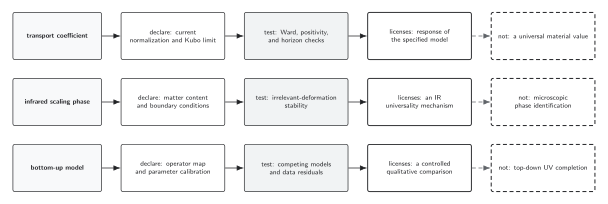
A holographic matter model can demonstrate a mechanism or universality class without identifying the microscopic theory of a material or plasma. Each row pairs a diagnostic with the strongest supported conclusion and an explicitly unsupported promotion. The diagram is an original schematic and is not to scale.
Claim-domain comparison
Section titled “Claim-domain comparison”The table below gives a screen-reader-friendly comparison of three representative claims. It keeps the required declaration, approximation status, evidence timing, counterevidence, falsifier, failure condition, and licensed conclusion in one reading order.
| Claim object | State, ensemble, and conventions | Approximation, status, and evidence timing | Uncertainty and counterevidence | Falsifier | Failure condition | Licensed conclusion |
|---|---|---|---|---|---|---|
| transport coefficient | Declare current normalization and Kubo limit; use the volume conventions unless the page states a local replacement. | Model-specific calculation or conditional result. Control chain: bulk matter action and state → charged or scaling background → horizon and boundary response → transport and robustness tests → bounded mechanism claim. Sources are cited on the destination page; literature checked through 10 August 2026. | Track omitted corrections, alternate branches, and competing definitions. A failed “Ward, positivity, and horizon checks” check is counterevidence to the promoted claim. | Ward, positivity, and horizon checks | a universal material value | response of the specified model |
| infrared scaling phase | Declare matter content and boundary conditions; use the volume conventions unless the page states a local replacement. | Model-specific calculation or conditional result. Control chain: bulk matter action and state → charged or scaling background → horizon and boundary response → transport and robustness tests → bounded mechanism claim. Sources are cited on the destination page; literature checked through 10 August 2026. | Track omitted corrections, alternate branches, and competing definitions. A failed “irrelevant-deformation stability” check is counterevidence to the promoted claim. | irrelevant-deformation stability | microscopic phase identification | an IR universality mechanism |
| bottom-up model | Declare operator map and parameter calibration; use the volume conventions unless the page states a local replacement. | Model-specific calculation or conditional result. Control chain: bulk matter action and state → charged or scaling background → horizon and boundary response → transport and robustness tests → bounded mechanism claim. Sources are cited on the destination page; literature checked through 10 August 2026. | Track omitted corrections, alternate branches, and competing definitions. A failed “competing models and data residuals” check is counterevidence to the promoted claim. | competing models and data residuals | top-down UV completion | a controlled qualitative comparison |
Download the structured table data (JSON).
References
Section titled “References”- Hartnoll, Sean A., Christopher P. Herzog, and Gary T. Horowitz. “Building a Holographic Superconductor.” Physical Review Letters 101, 031601 (2008). DOI.
- Iqbal, Nabil, and Hong Liu. “Universality of the Hydrodynamic Limit in AdS/CFT and the Membrane Paradigm.” Physical Review D 79, 025023 (2009). DOI.
Original QFT.org content:CC BY 4.0, unless an item supplies different terms. Third-party material retains its own terms.