

String, Brane, and Top-Down Constructions
This chapter explains when a string- or brane-derived spacetime supports a controlled holographic calculation. The central discipline is to keep four questions separate: whether the ten- or eleven-dimensional background is consistent, whether a nongravitational sector decouples, whether a lower-dimensional field set is a consistent truncation, and whether the desired observable lies in a regime where string, loop, and Kaluza–Klein corrections are small.
Helpful background. Local Supersymmetry and Supergravity as Low-Energy EFT supplies the gravitational field-theory setting, and BPS Bounds, Shortening, and Multiplet Recombination supplies protected sectors. Radius, Couplings, and the Parameter Map and Boundary Conditions, Alternate Quantization, and Deformations provide the AdS dictionary data used below.
Enter this chapter
Section titled “Enter this chapter”Readers should already be comfortable with large- counting and the basic AdS/CFT source–operator dictionary. The chapter develops the additional string-theoretic data needed to turn that formal dictionary into a top-down construction, beginning from the perturbative framework developed systematically by Polchinski 1998. It uses the global convention; individual pages state only assumptions that are local to their calculation.
Follow the pages in order:
- String Theory as a Holographic Construction Interface separates the ingredients actually used in a construction from stronger claims about string theory.
- Worldsheet Sigma Models and Spacetime Consistency derives the leading relation between two-dimensional Weyl invariance and spacetime field equations.
- String Spectra, Scales, and Low-Energy Limits compares oscillator, momentum, winding, compactification, and interaction scales.
- Decoupling Limits and the Original AdS/CFT Proposal formulates the D3-brane low-energy limit and the conjectural identification it motivates.
- D-Branes, Open-Closed Duality, and Gauge Sectors develops Chan–Paton gauge fields, brane tension, and the open/closed channel relation.
- Near-Horizon Brane Geometries and Top-Down Dictionaries turns harmonic functions, flux, and isometries into field-theory data.
- Flux Quantization, Compact Factors, and Kaluza–Klein Towers shows why the compact factor is physical rather than disposable notation.
- Consistent Truncations and Lower-Dimensional Effective Actions distinguishes an exact upliftable subsector from an ordinary low-energy approximation.
- D3-Branes and AdS5/CFT4: Parameter-Controlled Regimes and Evidence assembles the best-developed example and classifies its tests by regime.
- M2, M5, and Higher-Dimensional Brane Examples compares eleven-dimensional near-horizon systems and their characteristic scaling.
- D1-D5 Systems and AdS3 Top-Down Data tracks charges, moduli, compact factors, and protected versus unprotected sectors.
- Stringy and Quantum Corrections Beyond Supergravity organizes effects, string loops, Kaluza–Klein modes, and nonperturbative sectors.
- Top-Down, Bottom-Up, and UV-Completion Claim Contracts states exactly what each construction class can establish.
Preparation and working method
Section titled “Preparation and working method”Before using a bulk action, identify the parent background, quantized charges, compact spectrum, and decoupling limit. Then write the dimensionless expansion parameters appropriate to the observable: typically , an effective string-loop parameter, , and any inverse- parameter. A classical solution is only the beginning of this analysis.
The examples emphasize type-IIB D3-branes, but the method transfers to M2-, M5-, and D1-D5 systems. Supersymmetry protects selected quantities and often stabilizes backgrounds; it does not make all finite-coupling observables exact. The standard large- review documents both these common structures and the system-specific regimes Aharony et al. 2000.
Synthesis: one construction, four tests
Section titled “Synthesis: one construction, four tests”A defensible top-down claim should survive four independent tests.
- Spacetime consistency: the worldsheet or spacetime theory satisfies its anomaly, flux, and field-equation constraints in the stated expansion.
- Decoupling: excitations assigned to the nongravitational sector do not exchange finite energy with asymptotic bulk modes in the limit being taken.
- Spectral completeness: compactification and string towers are either retained or shown parametrically irrelevant for the observable.
- Approximation control: curvature, loop, finite-, and truncation errors are separately bounded; smallness of one does not imply smallness of the others.
The D3 example passes these tests in a particularly transparent overlap of limits, as formulated in the original correspondence Maldacena 1999. Other systems may establish fewer of them or only for protected data, and should be described accordingly.
Review the chapter
Section titled “Review the chapter”A satisfactory review answer should be able to:
- derive the leading metric beta-function condition and explain why it is only an expansion;
- compare , , and and identify when no lower-dimensional truncation exists;
- state the D3 decoupling limit without confusing it with the later large-, large- supergravity limit;
- reconstruct and explain what flux quantization contributes;
- distinguish consistency of a nonlinear truncation from accuracy of a low-energy effective action; and
- assign a claim ceiling to a bottom-up model even when it fits a measured observable.
An answer is incomplete if it invokes “large ” without also specifying the coupling, curvature, loop, compactification, and order-of-limits conditions relevant to the calculation.
Continue to Nonperturbative String- and M-Theory Definition Proposals to ask whether matrix models, string field theory, or an exact boundary theory define more than a controlled perturbative corner. Return to Large-N and Holographic Evidence for the large- expansion itself, or to The AdS/CFT Dictionary for detailed observable maps.
Chapter-scale structure and validity checks
Section titled “Chapter-scale structure and validity checks”The chapter-scale structure map locates this page’s result inside the full reasoning chain. Follow the solid arrows through the declared inputs and checks; the dashed final arrow marks the point where an additional inference would be required.

Top-down control requires separate checks of decoupling, flux quantization, Kaluza-Klein scales, truncation, string corrections, and loops. The diagram is an original schematic, is not to scale, and uses the dashed final arrow to mark the claim boundary.
The companion validity map turns three common overclaims into explicit failure tests. Read each row from its declared object to the diagnostic, then compare the licensed conclusion with the dashed “not” endpoint.
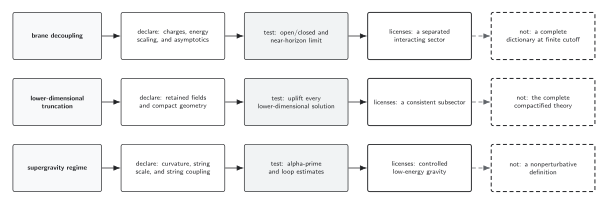
Top-down control requires separate checks of decoupling, flux quantization, Kaluza-Klein scales, truncation, string corrections, and loops. Each row pairs a diagnostic with the strongest supported conclusion and an explicitly unsupported promotion. The diagram is an original schematic and is not to scale.
Claim-domain comparison
Section titled “Claim-domain comparison”The table below gives a screen-reader-friendly comparison of three representative claims. It keeps the required declaration, approximation status, evidence timing, counterevidence, falsifier, failure condition, and licensed conclusion in one reading order.
| Claim object | State, ensemble, and conventions | Approximation, status, and evidence timing | Uncertainty and counterevidence | Falsifier | Failure condition | Licensed conclusion |
|---|---|---|---|---|---|---|
| brane decoupling | Declare charges, energy scaling, and asymptotics; use the volume conventions unless the page states a local replacement. | Model-specific calculation or conditional result. Control chain: worldsheet and brane data → decoupling or near-horizon limit → flux and compact factors → truncation and corrections → top-down dictionary. Sources are cited on the destination page; literature checked through 10 August 2026. | Track omitted corrections, alternate branches, and competing definitions. A failed “open/closed and near-horizon limit” check is counterevidence to the promoted claim. | open/closed and near-horizon limit | a complete dictionary at finite cutoff | a separated interacting sector |
| lower-dimensional truncation | Declare retained fields and compact geometry; use the volume conventions unless the page states a local replacement. | Model-specific calculation or conditional result. Control chain: worldsheet and brane data → decoupling or near-horizon limit → flux and compact factors → truncation and corrections → top-down dictionary. Sources are cited on the destination page; literature checked through 10 August 2026. | Track omitted corrections, alternate branches, and competing definitions. A failed “uplift every lower-dimensional solution” check is counterevidence to the promoted claim. | uplift every lower-dimensional solution | the complete compactified theory | a consistent subsector |
| supergravity regime | Declare curvature, string scale, and string coupling; use the volume conventions unless the page states a local replacement. | Model-specific calculation or conditional result. Control chain: worldsheet and brane data → decoupling or near-horizon limit → flux and compact factors → truncation and corrections → top-down dictionary. Sources are cited on the destination page; literature checked through 10 August 2026. | Track omitted corrections, alternate branches, and competing definitions. A failed “alpha-prime and loop estimates” check is counterevidence to the promoted claim. | alpha-prime and loop estimates | a nonperturbative definition | controlled low-energy gravity |
Download the structured table data (JSON).
References
Section titled “References”- Aharony, O., Gubser, S. S., Maldacena, J. M., Ooguri, H., and Oz, Y. (2000), “Large Field Theories, String Theory and Gravity,” Physics Reports 323, 183–386. doi:10.1016/S0370-1573(99)00083-6.
- Maldacena, J. M. (1999), “The Large Limit of Superconformal Field Theories and Supergravity,” International Journal of Theoretical Physics 38, 1113–1133. arXiv:hep-th/9711200.
- Polchinski, J. (1998), String Theory, Vols. 1–2, Cambridge University Press. Cambridge University Press.
Original QFT.org content:CC BY 4.0, unless an item supplies different terms. Third-party material retains its own terms.