

Large N and Semiclassical Bulk Criteria
Large supplies several independent organizing principles, not a one-step derivation of gravity. This chapter separates factorization, double-line topology, stress-tensor normalization, spectral sparsity, the higher-spin gap, Mellin boundedness, bulk cutoff estimates, and exponentially small finite- effects. The goal is to infer the strongest bulk regime supported by the supplied boundary data—and to stop when a missing condition or counterexample blocks the inference.
Helpful background. Large-N Limits, Normalizations, and Orders of Limits and Large-N Factorization and Master-Field Claims supply the QFT methods. Large-N CFT Data and Vector Models supplies spectral examples. Holographic Duality: Claims, Dictionaries, and Regimes fixes the claim language needed before interpreting those results gravitationally.
From boundary scaling to a controlled bulk regime
Section titled “From boundary scaling to a controlled bulk regime”Two entry routes lead through the chapter.
From a gauge or matrix theory. Begin by normalizing single-trace operators, derive connected-correlator scaling, separate single- and multi-trace sectors, and verify double-line genus counting. Only then ask whether , the coupling, and the spectrum support weakly coupled gravity rather than merely a string-like topological expansion.
From CFT data. Begin with , the light single-trace spectrum, and the spin-resolved gap. Add connected OPE scaling and Mellin behavior, state an energy window, and estimate loop, derivative, and nonperturbative errors. This route can diagnose a candidate semiclassical sector without assuming a microscopic matrix presentation.
Both routes must keep fixed the observable, operator normalization, state, coupling scaling, and order of limits. The target may be a weak bulk field sector, a local AdS EFT below a cutoff, or an Einstein regime; these are different conclusions.
Check your preparation
Section titled “Check your preparation”You are ready to begin if you can normalize a single-trace two-point function to order one, distinguish a connected correlator from its disconnected contractions, and explain why at fixed coupling is different from a simultaneous strong-coupling limit.
- If index counting or master fields are unfamiliar, use the first two helpful-background links and enter at pages 1–3.
- If your input is a spectrum and OPE coefficients rather than a Lagrangian, use the CFT-data link and enter at pages 4–7.
- If “a gravity dual” is currently an unqualified phrase, use the claims-and-regimes link before comparing criteria.
Preparation is capability-specific: knowing double-line counting does not replace understanding a higher-spin gap, and Mellin fluency does not fix the finite- order of limits.
Choose a route
Section titled “Choose a route”| Starting data or goal | Route through the numbered guide | Required stopping test |
|---|---|---|
| Matrix or adjoint gauge theory | 1–12 | Do strong coupling and a spin-resolved gap actually emerge? |
| Vector model | 1–2, then 4–7 and 12 | Do light higher-spin currents obstruct an Einstein conclusion? |
| Numerical or bootstrap CFT data | 4–10, then 12 | Are normalization, spectral thresholds, and errors controlled? |
| Candidate local AdS EFT | 5–10, then 11–12 | Are Mellin growth, finite-gap terms, and exponential sectors bounded? |
| Diagnose an overclaim | 7, 9–12 | Which necessary condition failed, and what weaker conclusion survives? |
The routes are not alternative definitions. They expose which inputs are available and where the argument must pause.
Chapter guide
Section titled “Chapter guide”- Large-N Factorization and Classical Bulk Scaling derives connected three- and four-point scaling after explicit two-point normalization, then uses a vector-model counterexample to limit the gravitational conclusion.
- Single-Trace, Multi-Trace, and Collective-Field Organization diagonalizes single/double-trace mixing and distinguishes a boundary operator-basis change from a matched bulk field redefinition.
- From Genus Counting to a Holographic String Regime turns double-line topology into powers of and explains why vector and tensor expansions need different bulk interpretations.
- Central Charge, Newton Coupling, and the Planck Scale maps the stress-tensor coefficient to only after conventions and species effects are fixed.
- Weakly Coupled Bulk Fields from Connected Correlators extracts cubic scaling from a three-point function and checks it against exchange and contact terms at four points.
- Sparse Spectra, Large Gaps, and Semiclassical Bulk Criteria partitions light single-trace, multi-trace, and heavy sectors and tests the partition against a low higher-spin state.
- Higher-Spin Gaps and Einstein-Regime Obstructions contrasts matrix and vector large- limits and shows why a fixed gap does not become parametrically large merely because does.
- Bulk Interaction Scaling and Effective Cutoffs combines contact power counting, loops, species, and heavy thresholds into an observable-dependent cutoff estimate.
- Approximate Bulk Locality from Spectral and Mellin Data reads low-degree Mellin polynomials as contact interactions and defeats finite-data locality claims with an exponentially growing Regge deformation.
- Corrections, Nonuniform Limits, and Failure Modes compares large with late time and tests energy- and entropy-scaled limits in which nominal corrections become order one.
- Nonperturbative Exponential Effects and Finite-N Sectors separates genus terms from brane, saddle, finite-rank, and level-discreteness effects invisible to every algebraic order.
- Necessary, Sufficient, and Heuristic Bulk Criteria evaluates generalized free, vector, matrix, and top-down examples on one counterexample-indexed implication map.
How the criteria fit together
Section titled “How the criteria fit together”Two notions called “normalized trace” occur in the large- literature. With , the expectation-normalized trace has an order-one mean and variance of order . The bulk-matched fluctuation is instead
with its connected two-point function fixed to order one. The following connected-correlator formula uses this second convention. Equivalently, if a convention assigns a centered raw fluctuation a connected two-point function of order , divide that centered fluctuation by and then fix the remaining -independent coefficient.
For these unit-two-point single-trace fluctuation candidates in a matrix-like family, factorization gives
This scaling suggests weak bulk vertices, while double-line diagrams organize closed-string handles. Neither result fixes a geometric length scale. A stress-tensor normalization can supply a Planck hierarchy,
but only inside an established dictionary and convention. A sparse light single-trace spectrum limits the number of elementary fields below the cutoff; a parametrically large gap supports an Einstein rather than higher-spin regime. Mellin poles and polynomial boundedness then test whether the correlators admit a local derivative expansion. This perturbative reconstruction program is developed in Heemskerk et al. 2009, abstract and § 2.4, pp. 7–8, PDF, while causality makes the higher-spin threshold consequential rather than cosmetic Camanho et al. 2016, § 5.4, pp. 41–42, PDF.
The inference can be summarized as
The plus signs mean that each item contributes independent information. The arrow is conditional and finite-precision. It does not establish a unique nonperturbative completion. Vector models demonstrate why factorization and large central charge do not imply Einstein gravity Klebanov and Polyakov 2002, §§ 1–2, pp. 1–4, PDF; exponentially distinct completions demonstrate why all-orders genus agreement does not settle finite .
Build a semiclassical-bulk argument
Section titled “Build a semiclassical-bulk argument”For any proposed example, record the following in a compact scientific table or calculation:
- Boundary definition: theory, global form, state or ensemble, normalized operators, and correlators.
- Large- data: the scaling of , connected -point functions, and any genus parameter.
- Spectrum: the light single-trace list, multi-trace threshold, spin-resolved heavy gap, and how each quantity scales.
- Bulk interpretation: candidate fields, , or another heavy scale, and interaction normalization.
- Domain: energy, impact parameter or Mellin region, time interval, and which quantities are held fixed.
- Errors: loop, finite-coupling, finite-gap, species, secular, and exponential finite- terms.
- Adversarial case: a theory or synthetic datum satisfying some inputs while failing the target conclusion.
- Bounded conclusion: the weakest missing condition and the strongest statement still justified.
This format makes comparisons reproducible. It also prevents positive signals from being counted twice—for example, treating , , and loop suppression as three independent observations when the latter two were inferred from the first through the same dictionary.
Review the chapter
Section titled “Review the chapter”Normalization and interactions. Normalize an adjoint single-trace operator and derive the -scaling of its connected three- and four-point functions. A successful answer states the unnormalized color count, the normalization factor, and why the result supports weak vertices but not locality.
Topology. Compare a planar vacuum diagram with a one-handle correction. The answer must derive the Euler-characteristic power and explain why the same formula is not automatically valid for vector or tensor models.
Planck and string hierarchies. Given , a coupling-dependent higher-spin gap, and light species, estimate the loop and derivative parameters at energy . A complete answer keeps the convention-dependent coefficient separate and states the species-corrected cutoff.
Counterexample. A family factorizes and has , but retains conserved currents of arbitrarily high spin. The correct conclusion identifies a possible weak higher-spin bulk and explicitly rejects an Einstein regime.
Mellin locality. Fit a degree-two crossing-symmetric polynomial after subtracting light exchanges. The answer identifies the corresponding derivative orders, estimates the next gap-suppressed term, and names polynomial boundedness as information not fixed by the fit.
Order of limits. Compare a thermal correlator at fixed time as with its finite- late-time behavior. A satisfactory answer distinguishes a smooth saddle from level discreteness and estimates the Heisenberg-scale crossover without assigning a universal recurrence time.
Sufficiency. Remove one hypothesis from the combined criterion. A successful answer supplies an explicit counterexample when known; otherwise it marks the implication unresolved instead of asserting a theorem.
Chapter-scale structure and validity checks
Section titled “Chapter-scale structure and validity checks”The chapter-scale structure map contains nine independent tests. Each card starts from a declared evidence input, names the diagnostic to perform, and ends with a limited conclusion. Only results established for the same theory, state, operator basis, coupling regime, sector, kinematics, and precision target may be combined. The dashed arrow marks that conditional synthesis; the barred connector marks a conclusion the evidence does not establish.

Normalized factorization, topological organization and—where claimed—a suitable dynamical saddle, Planck normalization, operator organization, spectral sparsity, a higher-spin gap, locality tests, and controlled corrections answer different questions. They combine only in one declared regime; large N alone does not imply Einstein gravity. This original schematic is not to scale. Its dashed arrow is conditional, while the barred connector blocks promotion to a universal sufficiency theorem or unique nonperturbative completion.
The companion validity map turns three common overclaims into explicit failure tests. Read each row from its declared object to the diagnostic, then compare the licensed conclusion with the dashed “not” endpoint.
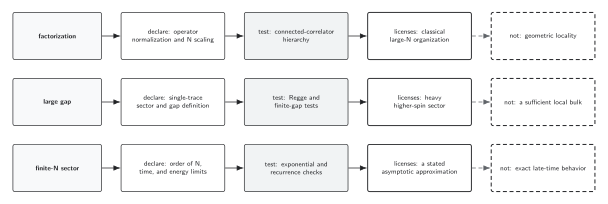
Factorization, sparsity, a higher-spin gap, and controlled corrections are independent criteria; large N alone does not imply Einstein gravity. Each row pairs a diagnostic with the strongest supported conclusion and an explicitly unsupported promotion. The diagram is an original schematic and is not to scale.
Claim-domain comparison
Section titled “Claim-domain comparison”The table below gives a screen-reader-friendly comparison of the nine independent criteria and their combined use. It keeps the required declaration, logical status, evidence timing, control parameter, counterexample, claim boundary, and licensed conclusion in one reading order.
| Claim object and observable | State, sector, regime, and conventions | Logical status, evidence timing, and where developed | Control parameter and correction scale | Counterexample or falsifier | Does not license | Licensed conclusion |
|---|---|---|---|---|---|---|
| Normalized factorization and interaction sums | Use centered, unit-two-point operators and declare the state, large-N family, coupling scaling, insertion number, species set, and kinematics. | The cumulant hierarchy is structural in the stated matrix expansion; matching it to bulk vertices is conditional. The factorization and weak-bulk-fields articles develop the inference. Sources rechecked 27 August 2026. | Connected n-point functions scale as N to the power 2 minus n at fixed insertions. A comparable one-sum species enhancement scales as M over N squared. | An unsuppressed normalized cumulant or M of order N squared comparable exchanges defeats the claimed weak finite-field hierarchy. | Spectral sparsity, geometric locality, or an Einstein bulk. | A nearly Gaussian sector and weak-vertex counting for the isolated operators whose cumulative sums remain small. |
| Topological organization | Fix the matrix, vector, or tensor family, trace normalization, orientability class, boundaries, and the coupling held fixed. | Double-line Euler counting is structural for the declared adjoint expansion. Volume VII derives it; the genus-counting article develops its holographic interpretation. Sources rechecked 27 August 2026. | In the orientable adjoint case, each additional closed-string handle costs 1 over N squared; boundaries and crosscaps carry their own powers. | Vector or melonic tensor counting, nonorientable sectors, or a changed large-N scaling invalidate an unmodified closed-string genus assignment. | A weakly curved geometry, a large higher-spin gap, or a dominant saddle merely from topology. | A string-like perturbative organization in the declared matrix regime. |
| Planck normalization | Declare the normalization of the stress-tensor two-point function, the boundary-to-bulk dictionary, bulk dimension, AdS radius, and light-species content. | The relation between C_T and L to the power d minus 1 over G is dictionary- and convention-dependent. The central-charge article develops the map. Sources rechecked 27 August 2026. | Track the convention coefficient, inverse C_T corrections, and the species-corrected gravitational loop or cutoff parameter. | A missing dictionary, inconsistent stress-tensor normalization, or parametrically growing light-species count defeats the proposed Planck hierarchy. | The string scale, locality, spectral sparsity, or a unique gravitational action. | A candidate hierarchy between the AdS and Planck scales in the stated dictionary. |
| Dynamical saddle control | Specify the state or ensemble, coupling-scaled spectrum, candidate saddle, boundary conditions, stability channel, and competing saddles. | The existence and dominance of a useful strong-coupling or semiclassical saddle are model-dependent dynamical statements. The genus and final-criteria articles separate them from topology. Sources rechecked 27 August 2026. | Bound curvature or finite-coupling corrections, negative modes, saddle-action differences, and the regime in which one saddle dominates. | A fixed small string-scale gap, an instability, or a competing saddle of comparable weight defeats weak-curvature or single-saddle control. | A semiclassical saddle from genus counting alone, or global dominance outside the declared state and ensemble. | A controlled semiclassical saddle regime for the tested state and coupling window. |
| Operator organization | Specify a regulated candidate basis, its Gram metric and dilatation matrix, quantum numbers, level spacings, and any collective variables. | The generalized eigenproblem is exact linear algebra; its particle interpretation is perturbative and basis-dependent. The operator-organization article develops the analysis. Sources rechecked 27 August 2026. | Compare each whitened off-diagonal element with its level splitting; 1 over N mixing becomes order one when the splitting is also order 1 over N. | A dense near-degenerate multiplet, finite-rank identity, or unrediagonalized nonlinear admixture defeats a naive trace-equals-particle label. | A unique off-shell field basis, an exact particle number, or locality. | Approximate one- and multiparticle eigenoperators in a spectrally isolated sector. |
| Spectral sparsity | Declare the light single-trace list, density and degeneracies, multi-trace threshold, coupling, state, and proposed cutoff. | Sparsity is a separate spectral criterion, not a consequence of large N or factorization. The sparse-spectrum article develops the partition. Sources rechecked 27 August 2026. | Bound the number and cumulative OPE weight of fields retained below the cutoff, including their dependence on N and coupling. | A parametrically dense light spectrum or an uncontrolled number of comparable species defeats a finite-field truncation. | A higher-spin gap, polynomial boundedness, or locality merely from a small scalar list. | A finite light-field content below the declared cutoff. |
| Higher-spin separation | Declare the spin-resolved single-trace spectrum, the J greater than 2 gap, its N and coupling scaling, and the stress-tensor sector. | A parametrically large higher-spin gap is a conditional eligibility test for an Einstein-like regime. The obstruction article develops the counterexamples. Sources rechecked 27 August 2026. | Track inverse-gap and finite-coupling corrections and test whether the spin-above-two threshold grows in AdS units. | A conserved or parametrically light tower of higher-spin currents, as in vector-model examples, blocks the Einstein promotion. | Locality, a finite scalar spectrum, or a complete bulk theory by itself. | Eligibility for an Einstein-like low-energy regime, subject to the other criteria. |
| Locality and effective cutoff | Fix the external operators, subtracted light exchanges, Mellin or Regge region, energy window, impact-parameter regime, and heavy threshold. | Mellin, Regge, derivative, and perturbative-unitarity behavior provide conditional EFT-locality diagnostics. The cutoff and locality articles develop them. Sources rechecked 27 August 2026. | Control energy over the heavy scale, loop powers, Regge growth, perturbative unitarity, and finite-gap derivative remainders. | An exponentially growing Mellin deformation or early unitarity failure can preserve low-order data while destroying a local derivative window. | A UV completion, unique Lagrangian, exact locality, or a nonperturbative dictionary. | A perturbative local AdS derivative expansion below a stated observable-dependent cutoff. |
| Finite precision and validity domain | Declare the observable algebra or code subspace, state or ensemble, energy, time interval, entropy scale, species count, and order of limits. | The error estimate is asymptotic or model-specific. The corrections and nonperturbative-sectors articles develop the bounds. Sources rechecked 27 August 2026. | Track algebraic 1 over N terms, inverse-gap terms, species factors, secular growth, and exponentially small sectors. | Late-time level discreteness, energy growing with N, a black-hole-scale state, or a noncommuting limit can make nominal errors order one. | Exact global reconstruction, exact late-time behavior, or all finite-rank sectors. | A bounded approximation for a declared observable sector and precision target. |
| Combined semiclassical-bulk criterion | Combine evidence only within the same theory, operator basis, state, coupling regime, kinematic window, and requested precision. | This is an evidence synthesis rather than a universal sufficiency theorem. The final-criteria article develops the comparison. Sources rechecked 27 August 2026. | The error is set by the weakest branch: loops, gap, derivatives, species, secular terms, or nonperturbative effects. | Satisfying different branches in incompatible regimes, or deleting any necessary branch without a replacement, defeats the combined inference. | A unique nonperturbative completion or a theorem that every qualifying CFT has Einstein gravity. | A conditional perturbative local AdS sector in the shared regime and precision window. |
Download the structured table data (JSON).
Continue from here
Section titled “Continue from here”Proceed to The AdS/CFT Dictionary when the large-, coupling, and spectral regime has been fixed and you are ready to map sources, fields, states, and correlators. For the QFT derivation of the large- methods themselves, return to Nonperturbative Dynamics. For spectral and OPE constraints, continue in Conformal Field Theory and Bootstrap. Return to the volume overview to select a string, information-theoretic, black-hole, non-AdS, or comparative route.
Evidence cutoff: 27 August 2026. The chapter’s implication map reflects the cited structural results and known counterexample classes through this date. It does not claim a universal sufficiency theorem, a unique nonperturbative completion, or a released computational result.
References
Section titled “References”- Camanho, Xian O.; Edelstein, José D.; Maldacena, Juan; and Zhiboedov, Alexander. “Causality Constraints on Corrections to the Graviton Three-Point Coupling.” Journal of High Energy Physics 2016, 020 (2016). doi:10.1007/JHEP02(2016)020.
- Heemskerk, Idse; Penedones, João; Polchinski, Joseph; and Sully, James. “Holography from Conformal Field Theory.” Journal of High Energy Physics 2009, 079 (2009). doi:10.1088/1126-6708/2009/10/079.
- Klebanov, Igor R., and Polyakov, Alexander M. “AdS Dual of the Critical Vector Model.” Physics Letters B 550, 213–219 (2002). doi:10.1016/S0370-2693(02)02980-5.
Original QFT.org content:CC BY 4.0, unless an item supplies different terms. Third-party material retains its own terms.