

AdS Scattering, Mellin Methods, and Bulk Locality
This chapter translates CFT correlator data into qualified statements about AdS interactions, high-energy behavior, flat-space scattering, and approximate bulk locality. Five claims remain distinct: Mellin pole interpretation, Regge boundedness, a parametrically large higher-spin gap, existence of a normalized scattering limit, and accuracy of a local bulk EFT. None follows from any one of the others alone.
Enter this chapter
Section titled “Enter this chapter”Helpful background. Mellin-space CFT correlators supplies the boundary representation. CFT Regge boundedness and flat-space Regge limits supply distinct growth tests. Exchange Witten diagrams supplies the AdS correlator being interpreted.
Proceed in this order:
- Imported Mellin Representations and Bulk-Normalization Conventions separates universal measure poles from dynamics.
- Mellin Amplitudes and Penedones-Type Flat-Space Limits states the large-radius scaling transform.
- Mellin Contact Polynomials and Exchange Poles reads derivative order and particle exchange with contact freedom retained.
- Bulk-EFT Information in Double-Trace Data and Large-Spin Anomalous Dimensions interprets binding data and mixing limits.
- Bulk Causality from Lorentzian Inversion and Dispersive Sum Rules imports analyticity only with its Regge and subtraction assumptions.
- Regge Limits, Eikonal Scattering, and Causality relates phase shifts, time delay, and new high-spin states.
- Bulk-Point Singularities and Locality Diagnostics treats Lorentzian singularities as diagnostics rather than theorems.
- AdS Wavepackets and Boundary Extraction of Flat-Space Scattering isolates a single central collision.
- Finite-Gap Corrections and Locality Error Budgets quantifies the derivative range of a bulk EFT.
- Bulk-EFT Checks from OPE, Unitarity, and Causality Data combines independent consistency tests.
- CFT Criteria for Approximate Bulk Locality returns an observable-specific assessment rather than a binary verdict.
- CFT-to-Bulk Reconstruction: Uniqueness and Ambiguities states what finite correlator data cannot fix.
Preparation and inference order
Section titled “Preparation and inference order”First record the Mellin integration variables, Gamma measure, constraint among them, and normalization of external operators, following Mack 2009. Next identify dynamical poles and polynomial freedom. Only then test the Regge sheet, the higher-spin gap , and the relevant order of , , and energy limits. Penedones’ transform supplies a flat-space amplitude only under this complete scaling prescription Penedones 2011.
Synthesis: independent evidence for locality
Section titled “Synthesis: independent evidence for locality”Mellin poles locate candidate exchanged conformal families; their residues must factorize. Polynomial boundedness constrains how contact terms grow but does not create a gap. A large gap suppresses higher-derivative operators only for . Bulk-point singularities probe a Lorentzian configuration and can be smeared by finite or string scale. Flat-space extraction additionally needs localized wavepackets or the normalized Mellin transform. The combined large-, sparse-spectrum construction motivates an AdS EFT Heemskerk et al. 2009, while its error remains kinematic and observable dependent.
Review the chapter
Section titled “Review the chapter”A satisfactory answer should be able to:
- separate Gamma-function double-trace poles from poles of the dynamical Mellin amplitude;
- scale Mellin variables as while keeping flat invariants fixed;
- distinguish a contact polynomial from an exchange pole family and its contact ambiguity;
- derive the large-spin falloff from a crossed-channel twist;
- state every Regge and subtraction assumption in an inversion or dispersion claim;
- distinguish a time advance inside an EFT domain from extrapolation beyond its cutoff;
- explain finite-gap and finite- smoothing of a bulk-point singularity;
- construct sources that isolate one AdS collision before the first reflection; and
- return a locality error in a stated norm, energy range, spin range, and code subspace.
No answer may infer a unique bulk Lagrangian from finite four-point data or call large Mellin variables at fixed a flat-space S-matrix.
Continue to Thermal Phases and AdS Black Holes for states whose dominant saddles contain horizons. Return to Witten Diagrams when a claimed pole, cut, or contact term has not yet been normalized as an AdS correlator.
Chapter-scale structure and validity checks
Section titled “Chapter-scale structure and validity checks”The chapter-scale structure map locates this page’s result inside the full reasoning chain. Follow the solid arrows through the declared inputs and checks; the dashed final arrow marks the point where an additional inference would be required.

Mellin poles, bounded growth, a large gap, and a controlled flat limit support different parts of a bulk-scattering interpretation. The diagram is an original schematic, is not to scale, and uses the dashed final arrow to mark the claim boundary.
The companion validity map turns three common overclaims into explicit failure tests. Read each row from its declared object to the diagnostic, then compare the licensed conclusion with the dashed “not” endpoint.
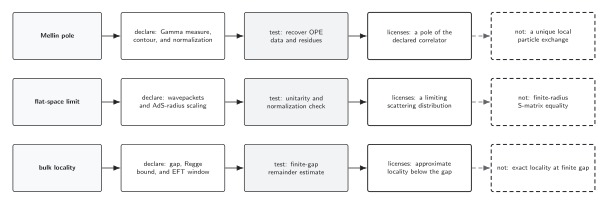
Mellin poles, bounded growth, a large gap, and a controlled flat limit support different parts of a bulk-scattering interpretation. Each row pairs a diagnostic with the strongest supported conclusion and an explicitly unsupported promotion. The diagram is an original schematic and is not to scale.
Claim-domain comparison
Section titled “Claim-domain comparison”The table below gives a screen-reader-friendly comparison of three representative claims. It keeps the required declaration, approximation status, evidence timing, counterevidence, falsifier, failure condition, and licensed conclusion in one reading order.
| Claim object | State, ensemble, and conventions | Approximation, status, and evidence timing | Uncertainty and counterevidence | Falsifier | Failure condition | Licensed conclusion |
|---|---|---|---|---|---|---|
| Mellin pole | Declare Gamma measure, contour, and normalization; use the volume conventions unless the page states a local replacement. | Model-specific calculation or conditional result. Control chain: CFT and Mellin data → exchange poles and contacts → Regge and gap controls → flat-space scaling limit → bounded locality claim. Sources are cited on the destination page; literature checked through 10 August 2026. | Track omitted corrections, alternate branches, and competing definitions. A failed “recover OPE data and residues” check is counterevidence to the promoted claim. | recover OPE data and residues | a unique local particle exchange | a pole of the declared correlator |
| flat-space limit | Declare wavepackets and AdS-radius scaling; use the volume conventions unless the page states a local replacement. | Model-specific calculation or conditional result. Control chain: CFT and Mellin data → exchange poles and contacts → Regge and gap controls → flat-space scaling limit → bounded locality claim. Sources are cited on the destination page; literature checked through 10 August 2026. | Track omitted corrections, alternate branches, and competing definitions. A failed “unitarity and normalization check” check is counterevidence to the promoted claim. | unitarity and normalization check | finite-radius S-matrix equality | a limiting scattering distribution |
| bulk locality | Declare gap, Regge bound, and EFT window; use the volume conventions unless the page states a local replacement. | Model-specific calculation or conditional result. Control chain: CFT and Mellin data → exchange poles and contacts → Regge and gap controls → flat-space scaling limit → bounded locality claim. Sources are cited on the destination page; literature checked through 10 August 2026. | Track omitted corrections, alternate branches, and competing definitions. A failed “finite-gap remainder estimate” check is counterevidence to the promoted claim. | finite-gap remainder estimate | exact locality at finite gap | approximate locality below the gap |
Download the structured table data (JSON).
References
Section titled “References”- Heemskerk, I., Penedones, J., Polchinski, J., and Sully, J. (2009), “Holography from Conformal Field Theory,” Journal of High Energy Physics 2009(10), 079. arXiv:0907.0151.
- Mack, G. (2009), “D-Independent Representation of Conformal Field Theories in D Dimensions via Transformation to Auxiliary Dual Resonance Models,” arXiv:0907.2407.
- Penedones, J. (2011), “Writing CFT Correlation Functions as AdS Scattering Amplitudes,” Journal of High Energy Physics 2011(03), 025. arXiv:1011.1485.
Original QFT.org content:CC BY 4.0, unless an item supplies different terms. Third-party material retains its own terms.