

Thermal Phases and AdS Black Holes
AdS black holes organize thermal physics through a hierarchy of statements: boundary data select an ensemble, Euclidean fillings supply candidate saddles, renormalized actions compare their free energies, fluctuation operators test local stability, and finite-N effects limit the classical phase picture. This chapter keeps that hierarchy explicit while deriving the standard transition first exhibited by Hawking and Page 1983 and the black-brane results.
Helpful background. Thermodynamic Limits, Phases, and Ensemble Equivalence supplies the statistical meaning of a phase. Black-Hole Thermodynamics at the QFT Interface supplies the horizon laws. States, Geometries, and Radial Quantization and Renormalized One-Point Functions and the Variational Problem supply the holographic state and charge maps.
Enter this chapter
Section titled “Enter this chapter”Start every thermal claim by recording:
- the boundary spatial manifold and Euclidean thermal circle;
- fixed temperature, angular velocities, chemical potentials, or conserved charges;
- the allowed bulk topologies and matter boundary conditions;
- the complete renormalized action and entropy functional;
- the large-N, derivative, loop, and spatial-volume limits;
- the distinction between equilibrium dominance, local stability, decay, and exact finite-N behavior.
Two routes then become available. The ensemble-first route fixes sources and charges before comparing actions, Hessians, and Legendre transforms. The geometry-first route follows neutral, charged, rotating, two-sided, and higher-derivative solutions before asking which phase statement each supports.
Chapter map
Section titled “Chapter map”- Euclidean Saddles, Thermal States, and Hawking–Page Transitions matches the thermal boundary circle and derives the spherical transition temperature.
- Euclidean Actions, Boundary Terms, and Free-Energy Comparisons gives the variationally complete action protocol.
- AdS Black Branes and Holographic Thermodynamics derives temperature, entropy density, energy, pressure, and the conformal equation of state.
- Rotating and Charged AdS Black Holes adds potentials, charges, angular momenta, extremality, and ensemble-dependent stability.
- Two-Sided Black Holes and Thermofield-Double States distinguishes exact purification from its leading smooth-bridge saddle.
- Imported Wald Entropy in Holographic Higher-Derivative Thermodynamics evaluates the Noether-charge correction and checks it against the first law.
- Confinement and Deconfinement Dictionaries combines free-energy scaling, center symmetry, loops, worldsheets, and topology.
- Black-Hole Instabilities and New Phases separates thermodynamic, Euclidean, Lorentzian, and global stability.
- Ensemble Inequivalence and Microcanonical Saddles explains negative heat capacity and constrained gravitational saddles.
- Finite-N Smoothing, Tunneling, and Metastability replaces the sharp saddle crossing by the appropriate crossover and decay scales.
One calculation, five different conclusions
Section titled “One calculation, five different conclusions”For a saddle in a fixed ensemble,
This compact formula supports several logically distinct results:
| Calculation | Question answered | Extra requirement | Does not establish |
|---|---|---|---|
| Compare | Which included saddle dominates? | matched boundary data and contour membership | completeness of saddles |
| Differentiate | What are , , and charges? | fixed-source convention and boundary terms | microscopic state count |
| Test the Hessian | Is the saddle locally thermodynamically stable? | correct ensemble variables | Lorentzian stability in every channel |
| Solve perturbations | Does a mode grow or bifurcate? | physical horizon and boundary conditions | nonlinear endpoint or dominance |
| Sum competing sectors | How is a large-N crossing rounded? | finite-N weights and volume limit | exact spectrum or recurrence pattern |
Keeping the columns separate prevents a classical horizon from being used as evidence for claims it was never designed to answer.
Canonical examples and checks
Section titled “Canonical examples and checks”The spherical Einstein solution gives
with a Hawking–Page crossing at . The planar solution gives and . These are different boundary topologies: the spherical problem has an intrinsic scale and competing thermal-AdS saddle, whereas the planar conformal problem has neither without an additional deformation or compactification.
Every extension should reproduce an independent identity. Charged and rotating saddles satisfy the first law with the correct potentials. Higher-derivative saddles match Wald entropy to Euclidean derivatives. A proposed new phase has a normalizable zero mode at onset and lower potential only after nonlinear continuation. A finite-N treatment retains both competing contributions instead of taking their minimum prematurely.
Scientific boundaries
Section titled “Scientific boundaries”Thermal and Nonequilibrium QFT owns general ensembles, phases, KMS structure, response, and nucleation. QFT in Curved Spacetime owns semiclassical horizon thermodynamics and entropy laws. This chapter owns their realization by asymptotically AdS saddles and the boundary phase dictionary.
The separation matters most at the frontier. Classical saddle dominance does not determine an exact discrete spectrum. Wald entropy is not a microscopic degeneracy. A Euclidean bridge is not a proof of exact interior factorization. A Page-like thermodynamic curve is not an evaporation S-matrix. Those questions require the later wormhole, microstate, and black-hole-information chapters.
Review the chapter
Section titled “Review the chapter”- Why must proper thermal-circle lengths be matched before subtracting two Euclidean actions?
- Which boundary term distinguishes fixed charge from fixed potential?
- Why is there no spherical Hawking–Page temperature for an undeformed planar CFT?
- What additional work turns a charged-scalar zero mode into a new thermodynamic phase?
- How can a negative-heat-capacity black hole appear microcanonically but not canonically?
- Why is the finite-N crossover width near a two-saddle crossing not the same as a tunneling rate?
A complete response invokes identical induced data for question 1, the Maxwell Legendre term for question 2, absence of an intrinsic planar scale and competing saddle for question 3, nonlinear backreaction and a same-ensemble free-energy comparison for question 4, constrained versus fluctuating energy for question 5, and equilibrium mixing versus a bounce barrier for question 6.
Where to go next
Section titled “Where to go next”Thermal and Real-Time Holography turns these equilibrium backgrounds into causal correlators, quasinormal modes, chaos diagnostics, and late-time questions. Holographic Matter and Transport adds density, symmetry breaking, and response. Wormholes, Gravitational Path Integrals, and Ensembles asks which saddles and contours define the gravitational sum itself.
Chapter-scale structure and validity checks
Section titled “Chapter-scale structure and validity checks”The chapter-scale structure map locates this page’s result inside the full reasoning chain. Follow the solid arrows through the declared inputs and checks; the dashed final arrow marks the point where an additional inference would be required.

A holographic phase is an ensemble-specific saddle comparison; classical dominance does not determine exact finite-N spectra or recurrences. The diagram is an original schematic, is not to scale, and uses the dashed final arrow to mark the claim boundary.
The companion validity map turns three common overclaims into explicit failure tests. Read each row from its declared object to the diagnostic, then compare the licensed conclusion with the dashed “not” endpoint.
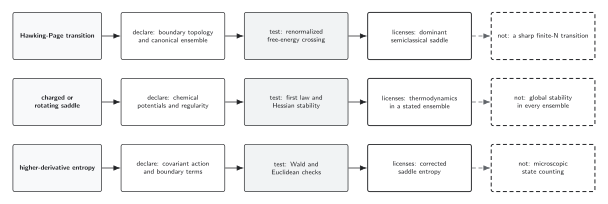
A holographic phase is an ensemble-specific saddle comparison; classical dominance does not determine exact finite-N spectra or recurrences. Each row pairs a diagnostic with the strongest supported conclusion and an explicitly unsupported promotion. The diagram is an original schematic and is not to scale.
Claim-domain comparison
Section titled “Claim-domain comparison”The table below gives a screen-reader-friendly comparison of three representative claims. It keeps the required declaration, approximation status, evidence timing, counterevidence, falsifier, failure condition, and licensed conclusion in one reading order.
| Claim object | State, ensemble, and conventions | Approximation, status, and evidence timing | Uncertainty and counterevidence | Falsifier | Failure condition | Licensed conclusion |
|---|---|---|---|---|---|---|
| Hawking-Page transition | Declare boundary topology and canonical ensemble; use the volume conventions unless the page states a local replacement. | Model-specific calculation or conditional result. Control chain: ensemble and boundary data → Euclidean gravitational saddles → action, entropy, and charges → stability and finite-N checks → thermal phase claim. Sources are cited on the destination page; literature checked through 10 August 2026. | Track omitted corrections, alternate branches, and competing definitions. A failed “renormalized free-energy crossing” check is counterevidence to the promoted claim. | renormalized free-energy crossing | a sharp finite-N transition | dominant semiclassical saddle |
| charged or rotating saddle | Declare chemical potentials and regularity; use the volume conventions unless the page states a local replacement. | Model-specific calculation or conditional result. Control chain: ensemble and boundary data → Euclidean gravitational saddles → action, entropy, and charges → stability and finite-N checks → thermal phase claim. Sources are cited on the destination page; literature checked through 10 August 2026. | Track omitted corrections, alternate branches, and competing definitions. A failed “first law and Hessian stability” check is counterevidence to the promoted claim. | first law and Hessian stability | global stability in every ensemble | thermodynamics in a stated ensemble |
| higher-derivative entropy | Declare covariant action and boundary terms; use the volume conventions unless the page states a local replacement. | Model-specific calculation or conditional result. Control chain: ensemble and boundary data → Euclidean gravitational saddles → action, entropy, and charges → stability and finite-N checks → thermal phase claim. Sources are cited on the destination page; literature checked through 10 August 2026. | Track omitted corrections, alternate branches, and competing definitions. A failed “Wald and Euclidean checks” check is counterevidence to the promoted claim. | Wald and Euclidean checks | microscopic state counting | corrected saddle entropy |
Download the structured table data (JSON).
References
Section titled “References”- Gibbons, G. W., and Stephen W. Hawking. “Action Integrals and Partition Functions in Quantum Gravity.” Physical Review D 15, 2752–2756 (1977). DOI.
- Hawking, Stephen W., and Don N. Page. “Thermodynamics of Black Holes in Anti-de Sitter Space.” Communications in Mathematical Physics 87, 577–588 (1983). DOI.
- Wald, Robert M. “Black Hole Entropy Is the Noether Charge.” Physical Review D 48, R3427–R3431 (1993). DOI; arXiv:gr-qc/9307038.
- Witten, Edward. “Anti-de Sitter Space, Thermal Phase Transition, and Confinement in Gauge Theories.” Advances in Theoretical and Mathematical Physics 2, 505–532 (1998). DOI; arXiv:hep-th/9803131.
Original QFT.org content:CC BY 4.0, unless an item supplies different terms. Third-party material retains its own terms.