

Quantum Cosmology and Singularity-Resolution Programs
Quantum cosmology has no external clock or asymptotic detector by default. The canonical constraint equation formulated by DeWitt 1967 therefore becomes predictive only after its configuration space, physical inner product, conditional observables, boundary condition, semiclassical branch, and approximation errors are specified. Likewise, a bounce in one effective variable is not automatically singularity resolution.
Helpful background. In-In Cosmological Correlators supplies observable correlators. Quantum Trapped Surfaces and Semiclassical Singularity Theorems supplies the singularity target. Wheeler–DeWitt Quantization and the Problem of Time and Quantum-Gravity Consistency Claims and Comparison Contract supply foundations and evidence standards.
Enter through the prediction contract
Section titled “Enter through the prediction contract”Ask what is conditioned on what. A relational statement has the form
only after a physical state, clock observable , conditional operator, and positive inner product are defined. A path-integral saddle weight or a Klein–Gordon-like current is not automatically a normalized probability.
Chapter route
Section titled “Chapter route”- Quantum-Cosmology Observables and the Problem of Time defines states, clocks, and probabilities.
- Minisuperspace Reductions and Approximation Control derives the homogeneous truncation and its omissions.
- Wheeler–DeWitt Cosmology: Boundary Conditions, Inner Products, and Probabilities compares solution spaces and measures.
- No-Boundary and Tunneling Wavefunction Proposals separates contour choices and WKB branches.
- Loop Quantum Cosmology and Effective Difference Dynamics derives polymer evolution and its effective limit.
- Bounce and Singularity-Resolution Claims applies a hierarchy of resolution criteria.
- BKL, Mixmaster, and Inhomogeneous Singularities restores anisotropy and gradients.
- Quantum Geometrodynamics Beyond Minisuperspace derives emergent time with perturbative modes.
- Initial-State and Trans-Planckian Interfaces maps bounded initial-state changes to correlators.
- Semiclassical Recovery, Decoherence, Obstructions, and Status states the strongest conclusions.
Synthesis and review
Section titled “Synthesis and review”Three questions must remain separate: Does the constraint equation admit continuation through a classical singular locus? Does a positive physical probability remain finite? Does a controlled inhomogeneous spacetime become geodesically and predictively extendible? A complete answer states the clock, inner product, quantization choices, fiducial-cell behavior, perturbation backreaction, curvature observables, and relation to a full theory.
For the full canonical and loop programs, return to Canonical, Loop, Spin-Foam, and Group-Field Quantum Gravity. For empirical cosmological inference, continue to the following observational chapters only after the prediction contract is complete.
Chapter-scale structure and validity checks
Section titled “Chapter-scale structure and validity checks”The chapter-scale structure map is a compact orientation device, not a universal implication graph. It shows one common control sequence: declare the state and constraint, state the clock or boundary prescription, choose a reduced or effective description when one is actually being used, test semiclassical and full-theory control, and only then state a criterion-bounded conclusion. The canonical, contour, and loop-cosmology routes branch differently; the comparison table below keeps those routes separate.

A wavefunction, effective bounce, bounded variable, geodesic extension, and full singularity resolution are different claims. This original, not-to-scale schematic shows one control sequence only; the final dashed arrow marks a claim boundary, not a theorem that every route terminates in singularity resolution.
In linear reading order, the arrows mean “supply the next declaration or control required by the chosen calculation,” not “this object physically causes the next one.” Minisuperspace and effective dynamics are optional approximations, while decoherence, perturbative control, covariance, and full-theory recovery are distinct tests.
Download the structure map (SVG) · Accessible figure data (JSON)
The companion validity map gives three representative claim gates. Read each row from the declared object to the missing data and diagnostic, then compare the model-bounded conclusion with the dashed “not” endpoint. The detailed table below supplies the route-specific state, regime, source, counterevidence, and owner that the compact diagram cannot carry.
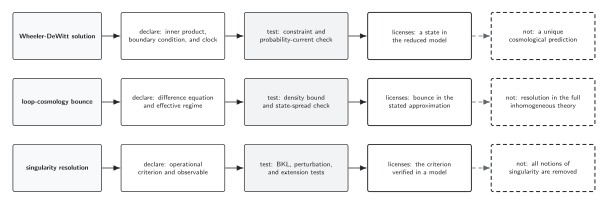
A wavefunction, effective bounce, bounded variable, geodesic extension, and full singularity resolution are different claims. Each row pairs a compact diagnostic with a model-bounded conclusion and a blocked promotion. This original schematic is not to scale and does not replace the fuller state, regime, covariance, and source checks in the table.
In linear reading order, the solid arrows mean “declare and test”; the final dashed arrow means “does not by itself license.” It is a logical warning, not a causal transition.
Download the validity map (SVG) · Accessible figure data (JSON)
Claim-domain comparison
Section titled “Claim-domain comparison”The table below separates seven claim domains that are often collapsed into “quantum-cosmology prediction” or “singularity resolution.” Each row fixes the object and observable, state and regime, logical status, dated evidence, operational failure test, strongest licensed conclusion, and the page responsible for updates. On wider screens the comparison pans horizontally and is keyboard-focusable; on phones and in print, each row reflows into a labeled record. The structured download preserves the same cells and links in reading order.
| Claim object and observable | State, regime, and conventions | Approximation and logical status | Dated evidence, uncertainty, and counterevidence | Operational failure test | Licensed conclusion | Does not license; update owner |
|---|---|---|---|---|---|---|
| Wheeler–DeWitt constraint and relational observable | Object: Ψ[h,φ]. Specify a Dirac or relational observable, configuration space, operator domain and ordering, boundary data, clock, and physical inner product. Declare an ensemble only if one is actually used. | The canonical constraint is formal until its domain and physical product are supplied. A solution is not by itself a probability theorem; any minisuperspace restriction is an additional approximation. | DeWitt 1967, § 4, Eqs. (4.6)–(4.7), and §§ 5, 7 formulates the constraints and exposes the time and product problem. Halliwell 2009, § I.B, Eqs. (1.4)–(1.13) constructs induced products and invariant operators in minisuperspace. Domains, orderings, clocks, and products need not agree; a Klein–Gordon current is not generically a positive density. | Reject the proposed observable if it fails to commute with the constraint on the stated domain, or if the physical product does not make its probabilities positive, normalized, and consistent under the declared clock evolution. | A conditional prediction for the declared observable, clock, domain, boundary data, and physical product. | Not a unique state, automatic Born rule, or solution of the problem of time. Update owner: Quantum-Cosmology Observables and the Problem of Time. |
| No-boundary or tunneling amplitude and saddle weight | Object: Ψ(q) from a specified lapse or metric contour. Fix boundary or regularity data, contributing saddles, perturbation vacuum, and the minisuperspace truncation. A branch ratio or fluctuation distribution becomes a probability only after a probability rule is declared. | A boundary-condition proposal evaluated semiclassically—not a theorem and not a contour-independent nonperturbative definition. | Hartle–Hawking 1983, § I, Eq. (1.7), and § III, Eq. (3.1) defines the compact-Euclidean proposal. Feldbrugge–Lehners–Turok 2017, § III.B.1, Eq. (48), and § V, pp. 38–39, PDF obtains a different Lorentzian thimble and fluctuation sign in closed de Sitter minisuperspace. Matsui 2024, § 3, Eqs. (27), (31), (34), and § 5 finds contour- and saddle-dependent Gaussian versus inverse-Gaussian weights, with limited flat and open exceptions. | The proposed contour fails if its contributing thimbles cannot be reached without crossing singularities, or if the quadratic fluctuation weight is non-normalizable or unstable for the stated contour and boundary data. | A model amplitude and its saddle content for the declared contour, boundary prescription, and truncation. | Not a unique probability measure, initial state of nature, or contour-independent prediction. Update owner: No-Boundary and Tunneling Wavefunction Proposals. |
| Decoherent history and history probability | Object: class operators Cα and decoherence functional D(α,α′); observable: p(α)=D(α,α). Fix the physical product, state or ensemble, coarse graining, and clock-free region definition. | The probability rule is exact only conditional on decoherence. Constructing the class operators and demonstrating decoherence are model-dependent and usually WKB-controlled steps. | Halliwell 2009, § I.C, Eqs. (1.14)–(1.20), §§ III–IV, and § VI constructs constraint-commuting class operators and obtains probabilities for decoherent alternatives. The result depends on the state, coarse graining, environment, region size, and approximation. | Compute D(α,α′). If its off-diagonal entries are not negligible at the declared tolerance, or the probabilities fail the sum rules under the stated refinement, that coarse graining has no licensed probabilities. | Probabilities for the one declared approximately decoherent partition. | Not probabilities for arbitrary questions or an interpretation-independent Born rule for every Wheeler–DeWitt solution. Update owner: Quantum-Cosmology Observables and the Problem of Time. |
| Solvable LQC bounce, minimum volume, and density bound | Observables: ⟨V⟩φ, its minimum, and the density supremum. State space: physical states of improved-dynamics, spatially flat FRW solvable LQC with a massless scalar used as relational time. | An exact result inside the solvable model. Effective equations, other matter models, inhomogeneous sectors, covariance, and the relation to full loop quantum gravity are separate claims. | Ashtekar–Corichi–Singh 2008, § IV, Eqs. (4.4)–(4.5), and § V.A, Eqs. (5.1)–(5.5) proves a nonzero minimum volume and density supremum near 0.41 Planck density in this model. Concrete contrary scope evidence is supplied by Bojowald–Díaz–Duque 2026, §§ 3.2–3.3, Eqs. (54)–(60): a covariance-compatible effective model can bounce yet encounter a finite-proper-time curvature singularity. | For the solvable-model claim, reproduce the physical-product expectation values and density bound for the stated state class. Any promotion to singularity resolution must also pass curvature-invariant and affine- or proper-time completeness tests; one finite-time divergence defeats it. | A relational bounce and universal density upper bound in the specified solvable LQC model. | Not full-loop-quantum-gravity, generic inhomogeneous, curvature-regular, or geodesically complete resolution. Update owner: Loop Quantum Cosmology and Effective Difference Dynamics. |
| BKL or inhomogeneous resolution and spacetime completeness | Object: evolution retaining anisotropy and spatial gradients. Observables: constraint closure, curvature invariants, and causal-geodesic extension for a stated open set of initial data. Declare matter, topology, gauge, and quantum state. | BKL is an asymptotic classical scenario. Quantum Bianchi or Kasner maps are partial model results; generic 3+1 quantum resolution remains unproved. | Belinskii–Khalatnikov–Lifshitz 1970, §§ 3–7 develops the oscillatory classical framework. Wilson-Ewing 2018, §§ II–IV derives an LQC Kasner transition in homogeneous Bianchi sectors and extends it only when curvature terms are negligible through the bounce. Bojowald–Díaz–Duque 2026, §§ 3.2–3.3 is direct counterevidence to “bounce implies resolution.” | Demonstrate anomaly-free constraints, bounded claimed invariants, and extendible causal geodesics while retaining the gradients or BKL sectors in scope. An open set reaching divergent curvature at finite affine or proper time falsifies the broad claim. | A transition map or bounded observable in the explicitly solved homogeneous or controlled sector. | Not generic inhomogeneous resolution, geodesic completeness, or removal of every singularity notion. Update owners: BKL, Mixmaster, and Inhomogeneous Singularities and Bounce and Singularity-Resolution Claims. |
| Born–Oppenheimer or WKB recovery and conditional QFT | Object: a selected WKB branch and light-sector conditional state. Observables: physical-product norm and QFT correlators. Fix the Born–Oppenheimer split, emergent time, gauge, measure, backreaction prescription, and retained inverse-Planck-mass order. | A controlled asymptotic result only where branch separation is adiabatic and the discarded term is bounded. Gauge choice and backreaction bookkeeping affect the apparent unitarity of subleading equations. | Kiefer–Wichmann 2018, § 3.2, Eq. (31), and § 4, Eqs. (34)–(49) shows why naive corrections are nonunitary and how a Born–Oppenheimer gauge and backreaction choice restores unitarity. Chataignier–Krämer 2021, § III.C, Eqs. (87)–(91), and § IV.D, Eqs. (159)–(160) constructs a clock-gauge-fixed positive product while retaining a limited weak-coupling regime. | Check conditional-norm conservation in the declared physical product through the retained order and bound the discarded term. Branch mixing, loss of positivity, or a correction as large as the leading term invalidates the recovery claim. | Conditional QFT on one declared semiclassical branch through a quantified Born–Oppenheimer or WKB order. | Not a unique time, complete physical Hilbert space, or robust observable quantum-gravity correction. Update owner: Quantum Geometrodynamics Beyond Minisuperspace. |
| Excited initial state or trans-Planckian signature | Object: a declared Bogoliubov coefficient βk or feature template. Observables: oscillatory power-spectrum amplitude and flattened or non-Bunch–Davies bispectrum. Specify the excited momentum band and smooth cutoff, and supply a globally admissible Hadamard completion—or the observable-specific adiabatic order—together with a backreaction bound. | A template- and dataset-dependent observational constraint within inflationary EFT—not a model-independent reconstruction of the initial state or its ultraviolet origin. | Planck Collaboration 2020, § 5.2.7 and Table 12 reports template-dependent bispectrum amplitudes, including an approximately two-standard-deviation oscillatory excursion before an unaccounted frequency-scan look-elsewhere effect. At the 30 August 2026 cutoff, Peng–Piao 2025, Tables II–III, preprint gives 95% bounds Alog<0.0286 and Alin<0.0267, while Nerval et al. 2026, § 5.1, Table 2, and § 5.3, preprint gives Alin<0.021, Alog<0.022, and Alog,rf<0.023 with moderate preference for a featureless model. | Require a common frequency and phase in independent power-spectrum and bispectrum data that survives look-elsewhere, foreground, systematic, and prior tests while satisfying the declared Hadamard completion or observable-specific adiabatic-order condition, backreaction, and EFT bounds. Failure of any condition blocks an origin claim. | A dataset- and template-specific upper limit, or a candidate feature, at the stated confidence and evidence cutoff. | Not a model-independent βk bound, detection, or evidence for a trans-Planckian origin. Update owner: Initial-State and Trans-Planckian Interfaces. |
Download the structured table data (JSON).
References
Section titled “References”- Ashtekar, A., A. Corichi, and P. Singh. “Robustness of Key Features of Loop Quantum Cosmology.” Physical Review D 77 (2008): 024046. DOI. Open PDF.
- Belinskii, V. A., I. M. Khalatnikov, and E. M. Lifshitz. “Oscillatory Approach to a Singular Point in the Relativistic Cosmology.” Advances in Physics 19 (1970): 525–573. DOI.
- Bojowald, M., M. Díaz, and E. I. Duque. “Singularities in Loop Quantum Cosmology.” Physical Review D 113 (2026): 084060. DOI. Open PDF.
- Chataignier, L., and M. Krämer. “Unitarity of Quantum-Gravitational Corrections to Primordial Fluctuations in the Born–Oppenheimer Approach.” Physical Review D 103 (2021): 066005. DOI. Open PDF.
- DeWitt, B. S. “Quantum Theory of Gravity. I. The Canonical Theory.” Physical Review 160 (1967): 1113–1148. DOI.
- Feldbrugge, J., J.-L. Lehners, and N. Turok. “Lorentzian Quantum Cosmology.” Physical Review D 95 (2017): 103508. DOI. Open PDF.
- Halliwell, J. J. “Probabilities in Quantum Cosmological Models: A Decoherent Histories Analysis Using a Complex Potential.” Physical Review D 80 (2009): 124032. DOI. Open PDF.
- Hartle, J. B., and S. W. Hawking. “Wave Function of the Universe.” Physical Review D 28 (1983): 2960–2975. DOI.
- Kiefer, C., and D. Wichmann. “Semiclassical Approximation of the Wheeler–DeWitt Equation: Arbitrary Orders and the Question of Unitarity.” General Relativity and Gravitation 50 (2018): 66. DOI. Open PDF.
- Matsui, H. “No Smooth Spacetime: Exploring Primordial Perturbations in Lorentzian Quantum Cosmology.” Physical Review D 110 (2024): 023503. DOI. Open PDF.
- Nerval, S. K., R. Hlozek, H. T. Jense, and J. R. Bond. “Constraining Primordial Oscillations and Inflationary Particle Production with Planck, ACT DR6, and DESI DR2.” arXiv:2606.28310 (2026), preprint. Preprint.
- Peng, Z.-Y., and Y.-S. Piao. “Tightening Constraints on Primordial Oscillations with Latest ACT and SPT Data.” arXiv:2507.17276v2 (2025), preprint. Preprint.
- Planck Collaboration. “Planck 2018 Results. IX. Constraints on Primordial Non-Gaussianity.” Astronomy & Astrophysics 641 (2020): A9. DOI. Open PDF.
- Wilson-Ewing, E. “The Loop Quantum Cosmology Bounce as a Kasner Transition.” Classical and Quantum Gravity 35 (2018): 065005. DOI. Open PDF.
Original QFT.org content:CC BY 4.0, unless an item supplies different terms. Third-party material retains its own terms.