

Bulk Reconstruction and Gravitational Dressing
Bulk reconstruction is not one map. An asymptotic extrapolate identifies a boundary coefficient; HKLL constructs a free bulk field on a specified patch; interactions add multi-trace corrections; gravity requires a boundary-anchored dressing or another relational definition. Every claim is relative to a boundary region and algebra, a state or code sector, a perturbative order, and an error norm. This chapter develops those data without treating entanglement-wedge quantum error correction or black-hole interiors as synonyms for perturbative reconstruction.
Helpful background. Von Neumann Factors and Type-III Local Algebras supplies the algebraic meaning of a continuum region. The GKPW Generating-Functional Dictionary supplies the boundary extrapolate and source convention. Bulk-to-Boundary and Bulk-to-Bulk Propagators supplies the Green functions used in smearing. CFT Criteria for Approximate Bulk Locality supplies the large- and spectral assumptions behind a weakly coupled bulk.
Specify the reconstruction problem
Section titled “Specify the reconstruction problem”A reproducible reconstruction statement records:
| Entry | Required choice | Why it matters |
|---|---|---|
| target | extrapolate, free field, interacting field, or relational dressed observable | these are inequivalent objects |
| region | global patch, boundary diamond, time band, causal wedge, or proposed interior | controls available boundary data |
| algebra | single-trace modes, time-band algebra, gauge-invariant algebra, or regulated subsystem | fixes what “supported in a region” means |
| state set | vacuum, perturbative Fock space, energy-bounded family, or code subspace | reconstruction may not extend beyond it |
| dressing | none for a nongravitating field, line, Coulomb, geodesic, or reference-field dressing | gravity forbids an unchanged local gauge-invariant operator |
| order | free, , , derivative, or nonperturbative | fixes which commutators and correlators are controlled |
| error | correlator, state-vector, code-subspace, energy-constrained, or operator norm | small in one sense need not be small in another |
Lorentzian formulas use signature . A scalar branch, patch, boundary condition, state, and prescription are stated where a kernel or correlator is used. The boundary algebra is never inferred solely from coordinate support.
Two entry routes
Section titled “Two entry routes”Perturbative route. Begin with the extrapolate map, construct free HKLL from a complete normal-mode basis, identify the kernel’s distributional domain, then add interactions, gravitational dressing, and an explicit error estimate.
Regional route. Begin with a boundary time band or diamond, form its causal wedge, state the accessible algebra and state family, then ask whether analytic continuation, relational anchoring, or a larger code-sector assumption is being added.
Both routes stop before entanglement-wedge recovery. Causal reconstruction, perturbative dressing, and quantum error correction can agree in overlapping examples while relying on different hypotheses.
The eleven pages
Section titled “The eleven pages”- The Bulk Reconstruction Problem separates extrapolates, smearing maps, relational observables, regions, state domains, and norms.
- Extrapolate Dictionaries versus Interior Reconstruction shows why a boundary limit is not a finite-radius inverse.
- HKLL Reconstruction for Free Bulk Fields derives the mode-sum and smearing representation at leading large .
- Mode Completeness and Smearing-Kernel Domains tests spectra, convergence, distributions, and patch dependence.
- Time-Band and Boundary-Diamond Reconstruction distinguishes causal support from analytic and state-dependent continuation.
- Interactions, Gravitational Dressing, and Microcausality adds multi-trace corrections and states the order of commutator cancellation.
- Gravitational Gauss Laws and Boundary Anchoring derives the boundary-visible tail required by a gravitational excitation.
- Relational Bulk Observables and Dressing Choices compares geodesic, Coulomb, and reference-field definitions.
- Causal Wedges and Subregion Reconstruction identifies the conservative region fixed by boundary causal access.
- Finite N, Horizons, State Dependence, and Reconstruction Limits separates perturbative control from exponentially precise and interior claims.
- Reconstruction Error Norms and Nonperturbative Precision makes the state set and metric part of the conclusion.
What the chapter establishes
Section titled “What the chapter establishes”At leading order, a complete normalizable spectrum and a specified boundary representation construct a free bulk field whose correlators and spacelike commutators agree within the chosen patch. Perturbative interactions can be incorporated order by order. In gravity, the resulting object must be dressed: the constraints give it asymptotic fields and prevent exact compact localization. At finite , a low-point or code-subspace approximation does not become an exact operator identity on the full Hilbert space.
The recurring control is a five-part statement:
Changing any entry changes the theorem or approximation being claimed. This is the central boundary emphasized by perturbative HKLL Hamilton et al. 2006, §§2–3 and by the gravitational dressing analysis Donnelly and Giddings 2016, §§2–4.
Review the chapter
Section titled “Review the chapter”Use these prompts as answer criteria.
- Object. Distinguish from and from a dressed . A complete answer states which operation supplies radial information.
- Kernel. Derive an HKLL mode sum. A complete answer names the patch, scalar branch, state, boundary condition, convergence sense, and mode completeness relation.
- Gravity. Explain why a gauge-invariant excitation has a boundary tail. A complete answer relates the Hamiltonian charge to an asymptotic surface integral and identifies a dressing.
- Region. Compare a time band, boundary diamond, and causal wedge. A complete answer separates causal support from analytic continuation or code-subspace input.
- Error. Give a reconstruction accuracy statement. A complete answer supplies a state family, norm, energy bound where needed, and the scaling with or .
Continue to Holographic Entropy and Quantum Extremal Geometry for extremal surfaces and wedges, Modular Response, Relative Entropy, and Emergent-Gravity Claims for modular reconstruction tools, or Entanglement Wedges and Holographic Quantum Error Correction for code-subspace recovery. State-dependent black-hole interiors remain in Black-Hole Information.
Chapter-scale structure and validity checks
Section titled “Chapter-scale structure and validity checks”The chapter-scale structure map locates this page’s result inside the full reasoning chain. Follow the solid arrows through the declared inputs and checks; the dashed final arrow marks the point where an additional inference would be required.

Bulk reconstruction is always relative to a region, algebra, dressing, state sector, perturbative order, and error notion. The diagram is an original schematic, is not to scale, and uses the dashed final arrow to mark the claim boundary.
The companion validity map turns three common overclaims into explicit failure tests. Read each row from its declared object to the diagnostic, then compare the licensed conclusion with the dashed “not” endpoint.
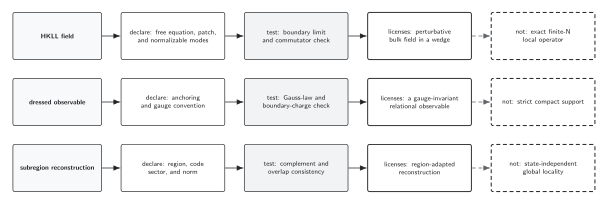
Bulk reconstruction is always relative to a region, algebra, dressing, state sector, perturbative order, and error notion. Each row pairs a diagnostic with the strongest supported conclusion and an explicitly unsupported promotion. The diagram is an original schematic and is not to scale.
Claim-domain comparison
Section titled “Claim-domain comparison”The table below gives a screen-reader-friendly comparison of three representative claims. It keeps the required declaration, approximation status, evidence timing, counterevidence, falsifier, failure condition, and licensed conclusion in one reading order.
| Claim object | State, ensemble, and conventions | Approximation, status, and evidence timing | Uncertainty and counterevidence | Falsifier | Failure condition | Licensed conclusion |
|---|---|---|---|---|---|---|
| HKLL field | Declare free equation, patch, and normalizable modes; use the volume conventions unless the page states a local replacement. | Model-specific calculation or conditional result. Control chain: boundary region and algebra → bulk equation and smearing → interaction and gravitational dressing → causal and error checks → reconstructable observable. Sources are cited on the destination page; literature checked through 10 August 2026. | Track omitted corrections, alternate branches, and competing definitions. A failed “boundary limit and commutator check” check is counterevidence to the promoted claim. | boundary limit and commutator check | exact finite-N local operator | perturbative bulk field in a wedge |
| dressed observable | Declare anchoring and gauge convention; use the volume conventions unless the page states a local replacement. | Model-specific calculation or conditional result. Control chain: boundary region and algebra → bulk equation and smearing → interaction and gravitational dressing → causal and error checks → reconstructable observable. Sources are cited on the destination page; literature checked through 10 August 2026. | Track omitted corrections, alternate branches, and competing definitions. A failed “Gauss-law and boundary-charge check” check is counterevidence to the promoted claim. | Gauss-law and boundary-charge check | strict compact support | a gauge-invariant relational observable |
| subregion reconstruction | Declare region, code sector, and norm; use the volume conventions unless the page states a local replacement. | Model-specific calculation or conditional result. Control chain: boundary region and algebra → bulk equation and smearing → interaction and gravitational dressing → causal and error checks → reconstructable observable. Sources are cited on the destination page; literature checked through 10 August 2026. | Track omitted corrections, alternate branches, and competing definitions. A failed “complement and overlap consistency” check is counterevidence to the promoted claim. | complement and overlap consistency | state-independent global locality | region-adapted reconstruction |
Download the structured table data (JSON).
References
Section titled “References”- Donnelly, William, and Steven B. Giddings. “Observables, Gravitational Dressing, and Obstructions to Locality and Subsystems.” Physical Review D 94 (2016): 104038. doi:10.1103/PhysRevD.94.104038. arXiv:1607.01025.
- Hamilton, Alex, Daniel Kabat, Gilad Lifschytz, and David A. Lowe. “Holographic Representation of Local Bulk Operators.” Physical Review D 74 (2006): 066009. doi:10.1103/PhysRevD.74.066009. arXiv:hep-th/0606141.
Original QFT.org content:CC BY 4.0, unless an item supplies different terms. Third-party material retains its own terms.