

AdS3/CFT2 and Three-Dimensional Gravity
Three-dimensional anti-de Sitter gravity is unusually revealing: pure Einstein gravity has no local graviton polarizations, yet the boundary conditions of Brown and Henneaux 1986 support an infinite-dimensional asymptotic symmetry algebra. Black-hole states and nontrivial topology then create a sharp dialogue with two-dimensional conformal field theory. This chapter develops that dialogue while keeping three questions separate: what follows from specified boundary conditions, what follows only in a semiclassical saddle expansion, and what would be needed for a complete quantum theory.
Helpful background. The Virasoro Algebra and the Stress Tensor supplies the boundary symmetry algebra; Chiral Blocks, Sewing, and Modular Invariance supplies the genus and modular language; Anti-de Sitter Geometry and the Conformal Boundary fixes the bulk geometry; and Two-Sided Black Holes and Thermofield-Double States supplies the Lorentzian black-hole interpretation.
Enter the AdS3 laboratory
Section titled “Enter the AdS3 laboratory”The chapter begins with a controlled classical statement. Brown–Henneaux boundary conditions turn diffeomorphisms that act nontrivially at infinity into physical symmetries, with two Virasoro algebras and
This equality identifies the semiclassical parameter with ; by itself it neither constructs a boundary CFT nor proves that a proposed bulk path integral exists. Boundary gravitons then organize the perturbative vacuum sector, while BTZ black holes probe high-energy states and modular thermodynamics. Virasoro blocks and Chern–Simons variables provide two complementary ways to expose the same low-dimensional structure.
The later pages ask harder completion questions. A fixed boundary Riemann surface can admit several bulk fillings. A modular sum over familiar handlebodies is a specified saddle prescription, not automatically the partition function of one unitary CFT. Likewise, agreement among a vacuum character, a BTZ entropy, and a semiclassical block is powerful cross-checking evidence, but it does not settle positivity, integrality, higher-genus factorization, spectral discreteness, or finite- completion.
A route through the chapter
Section titled “A route through the chapter”Read the pages in the following order when building the subject from first principles:
- AdS3/CFT2 and the Brown–Henneaux Central Charge derives the asymptotic charge algebra and its domain of validity.
- AdS3 Boundary Gravitons and Vacuum Characters quantizes the resulting perturbative excitations.
- BTZ Black Holes and Modular CFT Thermodynamics matches horizon entropy to controlled Cardy asymptotics.
- Virasoro Symmetry, Vacuum Blocks, and Semiclassical Gravity relates large- blocks to propagation in backreacted geometries.
- Chern–Simons Gravity and Boundary Currents rewrites the metric theory in gauge-theory variables and records the global caveats.
- Euclidean AdS3 Saddles and Handlebody Sums distinguishes a chosen family of fillings from a completed gravitational integration cycle.
- Wilson Lines, Geodesic Blocks, and Entanglement develops probe observables in the Chern–Simons and metric descriptions.
- Pure AdS3 Gravity and Candidate CFT Constraints applies modular, spectral, and factorization tests without issuing an existence verdict.
- Conical Defects, Orbifolds, and Heavy States follows the spectrum from smooth AdS through defects to the BTZ threshold.
- Finite-c Corrections and Nonperturbative Questions identifies which semiclassical statements survive exact-CFT and quantum-gravity checks.
Four distinctions that prevent overclaiming
Section titled “Four distinctions that prevent overclaiming”Asymptotic symmetry is conditional. The Virasoro algebra follows from a phase space, falloffs, boundary terms, and charge normalization. Changing any of them can change the algebra or which transformations are physical.
A character is not a full spectrum. The vacuum character counts a representation generated from the vacuum. A modular-invariant CFT partition function must also specify every other representation and its nonnegative integer multiplicity.
A saddle sum is not yet a definition. The integration contour, measure, regulator, allowed topology, and possible non-handlebody contributions remain part of the observable. Modular covariance of a regulated expression is necessary but does not establish Hilbert-space factorization or positivity.
Large is not finite . Perturbation theory around a classical geometry is ordered in , whereas new saddles and topology can be suppressed as . Null vectors, exact integrality, and spectral discreteness are finite- data that no finite perturbative expansion can infer by itself.
Review the chapter
Section titled “Review the chapter”You should be able to derive the Brown–Henneaux central term, explain why the vacuum module starts at level two, recover rotating BTZ entropy from left- and right-moving Cardy growth, and state the assumptions behind a geometric Virasoro block or Wilson-line saddle. For any proposed pure-gravity partition function, you should also be able to test modular invariance, positivity, integrality, discreteness, low-lying sparseness, and factorization without repairing a failed test silently.
The natural exits are AdS2, JT Gravity, SYK, and Random Matrices, Black-Hole Microstates and Stringy Entropy, and Wormholes, Gravitational Path Integrals, and Ensembles, where near-extremal dynamics, microscopic counting, and path-integral completion become the central questions.
Chapter-scale structure and validity checks
Section titled “Chapter-scale structure and validity checks”The chapter-scale structure map locates this page’s result inside the full reasoning chain. Follow the solid arrows through the declared inputs and checks; the dashed final arrow marks the point where an additional inference would be required.

AdS3/CFT2 combines unusually strong symmetry with global and spectral subtleties; BTZ control does not settle pure quantum gravity. The diagram is an original schematic, is not to scale, and uses the dashed final arrow to mark the claim boundary.
The companion validity map turns three common overclaims into explicit failure tests. Read each row from its declared object to the diagnostic, then compare the licensed conclusion with the dashed “not” endpoint.
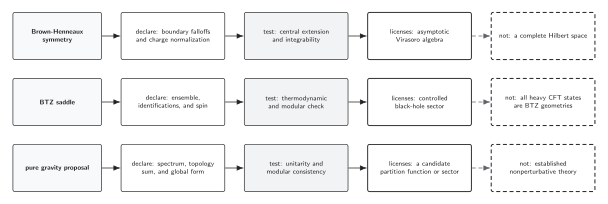
AdS3/CFT2 combines unusually strong symmetry with global and spectral subtleties; BTZ control does not settle pure quantum gravity. Each row pairs a diagnostic with the strongest supported conclusion and an explicitly unsupported promotion. The diagram is an original schematic and is not to scale.
Claim-domain comparison
Section titled “Claim-domain comparison”The table below gives a screen-reader-friendly comparison of three representative claims. It keeps the required declaration, approximation status, evidence timing, counterevidence, falsifier, failure condition, and licensed conclusion in one reading order.
| Claim object | State, ensemble, and conventions | Approximation, status, and evidence timing | Uncertainty and counterevidence | Falsifier | Failure condition | Licensed conclusion |
|---|---|---|---|---|---|---|
| Brown-Henneaux symmetry | Declare boundary falloffs and charge normalization; use the volume conventions unless the page states a local replacement. | Conditional theorem or structural result. Control chain: CFT2 and global data → AdS3 boundary conditions → Virasoro or Chern-Simons structure → BTZ and modular checks → three-dimensional gravity claim. Sources are cited on the destination page; literature checked through 10 August 2026. | Track omitted corrections, alternate branches, and competing definitions. A failed “central extension and integrability” check is counterevidence to the promoted claim. | central extension and integrability | a complete Hilbert space | asymptotic Virasoro algebra |
| BTZ saddle | Declare ensemble, identifications, and spin; use the volume conventions unless the page states a local replacement. | Model-specific calculation or conditional result. Control chain: CFT2 and global data → AdS3 boundary conditions → Virasoro or Chern-Simons structure → BTZ and modular checks → three-dimensional gravity claim. Sources are cited on the destination page; literature checked through 10 August 2026. | Track omitted corrections, alternate branches, and competing definitions. A failed “thermodynamic and modular check” check is counterevidence to the promoted claim. | thermodynamic and modular check | all heavy CFT states are BTZ geometries | controlled black-hole sector |
| pure gravity proposal | Declare spectrum, topology sum, and global form; use the volume conventions unless the page states a local replacement. | Proposal or conditional construction. Control chain: CFT2 and global data → AdS3 boundary conditions → Virasoro or Chern-Simons structure → BTZ and modular checks → three-dimensional gravity claim. Sources are cited on the destination page; literature checked through 10 August 2026. | Track omitted corrections, alternate branches, and competing definitions. A failed “unitarity and modular consistency” check is counterevidence to the promoted claim. | unitarity and modular consistency | established nonperturbative theory | a candidate partition function or sector |
Download the structured table data (JSON).
References
Section titled “References”- Brown, J. David, and Marc Henneaux. “Central Charges in the Canonical Realization of Asymptotic Symmetries: An Example from Three-Dimensional Gravity.” Communications in Mathematical Physics 104 (1986): 207–226. DOI.
- Maloney, Alexander, and Edward Witten. “Quantum Gravity Partition Functions in Three Dimensions.” Journal of High Energy Physics 2010, no. 2 (2010): 029. DOI; Open PDF.
- Witten, Edward. “Three-Dimensional Gravity Revisited.” (2007). arXiv:0706.3359.
Original QFT.org content:CC BY 4.0, unless an item supplies different terms. Third-party material retains its own terms.