

AdS2, JT Gravity, SYK, and Random Matrices
AdS₂ physics links near-extremal black holes, JT dilaton gravity, the SYK infrared, and random matrices, but the links have different logical strengths. This chapter keeps boundary conditions, effective dynamics, disorder averages, topology expansions, universal spectral correlations, and nonperturbative completion separate so that each observable carries its actual domain.
Helpful background. SYK Models and Local Quantum Criticality supplies the many-body model; Out-of-Time-Order Correlators and Contour Regularization supplies chaos diagnostics; Multi-Saddle Sums and Dilute Ensembles supplies saddle expansions; BTZ Black Holes and Modular CFT Thermodynamics provides a contrasting low-dimensional holographic system.
Evidence cutoff: 25 July 2026.
Enter this chapter
Section titled “Enter this chapter”Gravity-first readers should begin with AdS₂ boundary conditions, derive the Schwarzian, add controlled corrections and correlators, then pass from the JT topology expansion to matrix models. Many-body-first readers may begin with the SYK bilocal saddle and its conformal regime, then return to the precise near-AdS₂ matching statement. Spectral claims should always end with the universality and completion pages.
The pages appear in dependency order:
- AdS2 Boundary Conditions and Fragmentation explains why finite energy, electric flux, and multiple timelike boundaries constrain the Hilbert-space interpretation.
- JT Gravity and the Schwarzian Boundary Mode derives the Schwarzian from a renormalized nearly-AdS₂ boundary curve.
- Nearly AdS2 Effective Theory Beyond the Leading Schwarzian power-counts irrelevant deformations, matter, and higher-order throat corrections.
- JT Correlators, Bilocals, and Chaos computes soft-mode exchange and identifies the regulated OTO growth window.
- JT Topological Expansion and Weil–Petersson Volumes glues trumpets to moduli-space volumes and states the asymptotic genus ceiling.
- Near-AdS2, SYK, and the Duality Interface lists the infrared quantities that match and the ultraviolet data that do not.
- SYK Bilocal Collective Fields as Near-AdS2 Data derives the disorder-averaged collective action and saddle equations.
- SYK Conformal Regime and Schwarzian Matching extracts the soft action and matches its thermodynamic coefficient.
- Random Matrices, Spectral Statistics, and Ensemble Questions defines symmetry-resolved unfolding and universal local correlations.
- JT/SYK Spectral Form Factors and Universality Windows separates connected form factors, averaging operations, and finite-time windows.
- Non-Unique JT Matrix-Integral Completion: Fixed-Theory, Disorder-Average, and Ensemble Distinctions explains why the topology series does not select a unique exact Hamiltonian.
One calculation, four different claims
Section titled “One calculation, four different claims”A useful synthesis begins with a parent near-extremal black hole. Its throat reduction fixes the Schwarzian coefficient , and JT then predicts low-temperature thermodynamics and soft correlators Maldacena, Stanford, and Yang 2016. An SYK model can reproduce those infrared observables after matching . The JT genus coefficients can in turn be represented by a double-scaled matrix integral Saad, Shenker, and Stanford 2019, whose local correlations exhibit random-matrix universality.
Each arrow loses information:
| Step | Data retained | Data not fixed |
|---|---|---|
| parent black hole JT | near-extremal scale, boundary ensemble, | ultraviolet spectrum and exterior modes |
| SYK Schwarzian | infrared correlators and heat capacity | exact disorder realization and high-energy states |
| JT topology matrix integral | perturbative multi-boundary amplitudes | unique contour and nonperturbative completion |
| matrix universality spectral claim | symmetry class and a local window | smooth density and sample-specific levels |
Thus “JT topology data,” “a matrix-integral realization,” “universal spectral statistics,” and “a unique fixed-theory completion” are four different assertions. Evidence for an earlier item does not automatically establish a later one.
Review the chapter
Section titled “Review the chapter”- Boundary test. Why can two AdS₂ boundaries fail to define two freely excitable subsystems? A complete answer identifies the fixed flux or dilaton data, the Gauss constraint, and the backreaction caused by finite energy.
- Effective-theory test. Derive the Schwarzian coefficient from either a parent throat or SYK and name the first omitted correction. A complete answer states normalization, temperature and frequency window, and the parameter suppressing that correction.
- Chaos test. What does an term establish? A complete answer supplies the OTO contour and regulator, operator channel, connected normalization, and interval between dissipation and scrambling.
- Topology test. Why is an all-genus asymptotic series not an exact spectrum? A complete answer distinguishes fixed-genus coefficients from Stokes data or integration contours and supplies a beyond-all-orders ambiguity.
- Spectral test. Design a finite- SYK comparison with a random-matrix class. A complete answer resolves symmetries, declares unfolding and energy windows, reports sample variation, and performs sector-mixing and smoothing controls.
- Interpretation test. When may a connected two-boundary gravity amplitude be called an ensemble covariance? A complete answer writes both quantities, states the proposed map, and does not silently replace a fixed-theory product by an average.
For the higher-dimensional role of gravitational saddles, continue to Wormholes, Gravitational Path Integrals, and Ensembles. For entropy and microscopic-state questions, continue to Black-Hole Microstates and Stringy Entropy. For exact finite- Lorentzian limitations, return to Finite-N Spectra, Recurrences, and the Late-Time Plateau.
Chapter-scale structure and validity checks
Section titled “Chapter-scale structure and validity checks”The chapter-scale structure map locates this page’s result inside the full reasoning chain. Follow the solid arrows through the declared inputs and checks; the dashed final arrow marks the point where an additional inference would be required.

JT, Schwarzian dynamics, SYK, and random matrices overlap in controlled limits but do not provide one unique fixed-theory completion. The diagram is an original schematic, is not to scale, and uses the dashed final arrow to mark the claim boundary.
The companion validity map turns three common overclaims into explicit failure tests. Read each row from its declared object to the diagnostic, then compare the licensed conclusion with the dashed “not” endpoint.
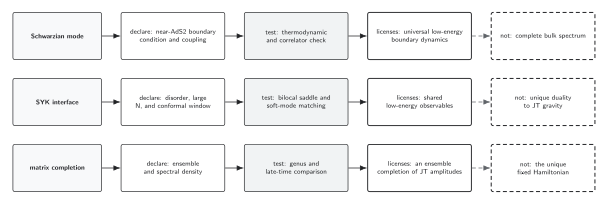
JT, Schwarzian dynamics, SYK, and random matrices overlap in controlled limits but do not provide one unique fixed-theory completion. Each row pairs a diagnostic with the strongest supported conclusion and an explicitly unsupported promotion. The diagram is an original schematic and is not to scale.
Claim-domain comparison
Section titled “Claim-domain comparison”The table below gives a screen-reader-friendly comparison of three representative claims. It keeps the required declaration, approximation status, evidence timing, counterevidence, falsifier, failure condition, and licensed conclusion in one reading order.
| Claim object | State, ensemble, and conventions | Approximation, status, and evidence timing | Uncertainty and counterevidence | Falsifier | Failure condition | Licensed conclusion |
|---|---|---|---|---|---|---|
| Schwarzian mode | Declare near-AdS2 boundary condition and coupling; use the volume conventions unless the page states a local replacement. | Model-specific calculation or conditional result. Control chain: near-AdS2 boundary data → JT and Schwarzian mode → SYK low-energy matching → topology and matrix ensemble → model-specific conclusion. Sources are cited on the destination page; literature checked through 10 August 2026. | Track omitted corrections, alternate branches, and competing definitions. A failed “thermodynamic and correlator check” check is counterevidence to the promoted claim. | thermodynamic and correlator check | complete bulk spectrum | universal low-energy boundary dynamics |
| SYK interface | Declare disorder, large N, and conformal window; use the volume conventions unless the page states a local replacement. | Dictionary entry or correspondence claim. Control chain: near-AdS2 boundary data → JT and Schwarzian mode → SYK low-energy matching → topology and matrix ensemble → model-specific conclusion. Sources are cited on the destination page; literature checked through 10 August 2026. | Track omitted corrections, alternate branches, and competing definitions. A failed “bilocal saddle and soft-mode matching” check is counterevidence to the promoted claim. | bilocal saddle and soft-mode matching | unique duality to JT gravity | shared low-energy observables |
| matrix completion | Declare ensemble and spectral density; use the volume conventions unless the page states a local replacement. | Proposal or conditional construction. Control chain: near-AdS2 boundary data → JT and Schwarzian mode → SYK low-energy matching → topology and matrix ensemble → model-specific conclusion. Sources are cited on the destination page; literature checked through 10 August 2026. | Track omitted corrections, alternate branches, and competing definitions. A failed “genus and late-time comparison” check is counterevidence to the promoted claim. | genus and late-time comparison | the unique fixed Hamiltonian | an ensemble completion of JT amplitudes |
Download the structured table data (JSON).
References
Section titled “References”- Maldacena, Juan, Douglas Stanford, and Zhenbin Yang. “Conformal Symmetry and Its Breaking in Two-Dimensional Nearly Anti-de Sitter Space.” Progress of Theoretical and Experimental Physics 2016, 12C104 (2016). DOI. Open PDF.
- Saad, Phil, Stephen H. Shenker, and Douglas Stanford. “JT Gravity as a Matrix Integral.” arXiv:1903.11115 [hep-th] (2019). arXiv.
Original QFT.org content:CC BY 4.0, unless an item supplies different terms. Third-party material retains its own terms.