

Asymptotic Safety, Causal, and Discrete Quantum-Gravity Programs
Asymptotic-safety, triangulation, causal-set, tensor, and random-geometry programs regulate gravity in fundamentally different ways. The functional-flow program begins from a proposed non-Gaussian fixed point Reuter 1998, whereas the discrete programs begin from different microscopic objects. They can be compared fairly only by asking which limit removes the regulator, which observables converge, whether unitarity and causal propagation are controlled, and whether general relativity with the required matter emerges.
Helpful background. Effective Field Theory of Gravity: Architecture and Power Counting fixes the infrared target. Complex Saddles, Lefschetz Thimbles, and Integration Cycles supplies contour logic. Tensor Large N and Melonic Dominance and Lines of Constant Physics and Continuum Extrapolation supply two technical routes. Dated Status, Counterexamples, and Falsifiers supplies the evidence standard.
Enter through the proposed continuum limit
Section titled “Enter through the proposed continuum limit”For a functional flow, identify a non-Gaussian fixed point and its finite-dimensional ultraviolet critical surface, then test regulator, gauge, truncation, and Lorentzian continuation. For a discrete sum, locate a second-order critical region, tune a line of constant physics, and show that correlation lengths diverge in lattice units while renormalized observables remain finite.
Chapter route
Section titled “Chapter route”- Asymptotic Safety and UV Fixed-Point Claims defines the completion claim.
- Functional Renormalization Group and Truncation Control derives the principal flow equation and errors.
- Perturbative and Higher-Derivative Gravity Interfaces separates renormalizability from unitarity.
- Causal Dynamical Triangulations: Phases and Continuum Evidence states the Lorentzian lattice construction.
- Causal-Set Kinematics and Dynamics separates faithful sprinkling from a successful dynamics.
- Euclidean Dynamical Triangulations and Their Relation to CDT compares configuration spaces and phases.
- Tensor Models and Random Geometry derives large- graph dominance.
- Matrix-Model Lessons Beyond Two Dimensions identifies transferable and nontransferable mechanisms.
- Spectral Dimension and Dimensional Flow defines a shared diagnostic and its limits.
- Emergence and Continuum-Limit Tests applies a common acceptance protocol.
- Unitarity, Reflection Positivity, and Causality Checks separates three consistency tests.
- Safety, Causal, and Discrete Programs: Evidence, Obstructions, and Status records the strongest current conclusions.
Synthesis: evidence does not pool automatically
Section titled “Synthesis: evidence does not pool automatically”A fixed point stable across truncations, an extended triangulated phase, a manifoldlike causal-set sprinkling, and a solvable tensor large- limit are four different achievements. None supplies the missing step in another program. The common target requires regulator-independent observables, a causal and unitary Lorentzian theory, and controlled recovery of low-energy gravity.
Review the chapter
Section titled “Review the chapter”A satisfactory program assessment should state the microscopic configurations and measure; dimensionless couplings and critical limit; renormalized observables and errors; universality test; relevant positivity and causal evidence; recovered dimension, symmetries, matter, and Einstein dynamics; and one result that would falsify the continuum interpretation. Visual resemblance to a smooth spacetime, a return probability flowing toward two, or a fixed point in one projection is not sufficient.
For canonical, loop, spin-foam, and group-field programs, continue to Canonical and Loop Programs: Evidence, Obstructions, and Current Status. For cosmological singularity claims, use Quantum Cosmology and Singularity-Resolution Programs.
Chapter-scale structure and validity checks
Section titled “Chapter-scale structure and validity checks”The chapter-scale structure map locates this page’s result inside the full reasoning chain. Follow the solid arrows through the declared inputs and checks; the dashed final arrow marks the point where an additional inference would be required.

A fixed point in a truncation or a continuum-looking phase in a discrete model is evidence that requires regulator, convergence, and unitarity control. The diagram is an original schematic, is not to scale, and uses the dashed final arrow to mark the claim boundary.
The companion validity map turns three common overclaims into explicit failure tests. Read each row from its declared object to the diagnostic, then compare the licensed conclusion with the dashed “not” endpoint.
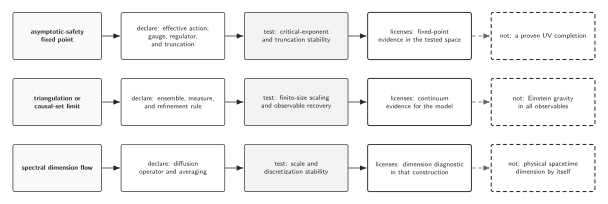
A fixed point in a truncation or a continuum-looking phase in a discrete model is evidence that requires regulator, convergence, and unitarity control. Each row pairs a diagnostic with the strongest supported conclusion and an explicitly unsupported promotion. The diagram is an original schematic and is not to scale.
Claim-domain comparison
Section titled “Claim-domain comparison”The table below gives a screen-reader-friendly comparison of three representative claims. It keeps the required declaration, approximation status, evidence timing, counterevidence, falsifier, failure condition, and licensed conclusion in one reading order.
| Claim object | State, ensemble, and conventions | Approximation, status, and evidence timing | Uncertainty and counterevidence | Falsifier | Failure condition | Licensed conclusion |
|---|---|---|---|---|---|---|
| asymptotic-safety fixed point | Declare effective action, gauge, regulator, and truncation; use the volume conventions unless the page states a local replacement. | Model-specific calculation or conditional result. Control chain: RG or discrete defining data → regulator, truncation, or refinement → continuum scaling observables → unitarity and causality tests → UV-completion claim. Sources are cited on the destination page; literature checked through 10 August 2026. | Track omitted corrections, alternate branches, and competing definitions. A failed “critical-exponent and truncation stability” check is counterevidence to the promoted claim. | critical-exponent and truncation stability | a proven UV completion | fixed-point evidence in the tested space |
| triangulation or causal-set limit | Declare ensemble, measure, and refinement rule; use the volume conventions unless the page states a local replacement. | Model-specific calculation or conditional result. Control chain: RG or discrete defining data → regulator, truncation, or refinement → continuum scaling observables → unitarity and causality tests → UV-completion claim. Sources are cited on the destination page; literature checked through 10 August 2026. | Track omitted corrections, alternate branches, and competing definitions. A failed “finite-size scaling and observable recovery” check is counterevidence to the promoted claim. | finite-size scaling and observable recovery | Einstein gravity in all observables | continuum evidence for the model |
| spectral dimension flow | Declare diffusion operator and averaging; use the volume conventions unless the page states a local replacement. | Model-specific calculation or conditional result. Control chain: RG or discrete defining data → regulator, truncation, or refinement → continuum scaling observables → unitarity and causality tests → UV-completion claim. Sources are cited on the destination page; literature checked through 10 August 2026. | Track omitted corrections, alternate branches, and competing definitions. A failed “scale and discretization stability” check is counterevidence to the promoted claim. | scale and discretization stability | physical spacetime dimension by itself | dimension diagnostic in that construction |
Download the structured table data (JSON).
References
Section titled “References”- Ambjørn, J., J. Jurkiewicz, and R. Loll. “Reconstructing the Universe.” Physical Review D 72 (2005): 064014. DOI.
- Bombelli, L., J. Lee, D. Meyer, and R. D. Sorkin. “Space-Time as a Causal Set.” Physical Review Letters 59 (1987): 521–524. DOI.
- Reuter, M. “Nonperturbative Evolution Equation for Quantum Gravity.” Physical Review D 57 (1998): 971–985. DOI.
Original QFT.org content:CC BY 4.0, unless an item supplies different terms. Third-party material retains its own terms.