

Quantum-Gravity Consistency and Swampland
Quantum-gravity consistency combines rigorous conditional deductions, semiclassical arguments, EFT estimates, and conjectures inferred from controlled constructions. This chapter preserves those distinctions while giving each claim an explicit domain, calculation, counterexample test, and dated evidence ceiling.
Helpful background. Effective Field Theory of Gravity: Architecture and Power Counting supplies the low-energy expansion; Low-Energy Constraints on UV Completion supplies infrared tests; Claim Status, Freshness, and Research Handoffs supplies dated interpretation; Top-Down, Bottom-Up, and UV-Completion Claim Contracts supplies construction status; Nonperturbative Definition Proposals: Objects, Evidence, and Falsifiers supplies definition criteria.
Evidence cutoff: 25 July 2026.
Enter this chapter
Section titled “Enter this chapter”Claim-first readers should begin with the comparison contract, then follow the page for the exact conjecture variant. Program-first readers can compare symmetry, WGC, distance, species, emergence, de Sitter, landscape, and cobordism claims before using the dated synthesis.
- Quantum-Gravity Consistency Claims and Comparison Contract fixes theory class, quantifiers, evidence, and falsifier.
- No-Global-Symmetry and Compactness Results Conditional on AdS/CFT reconstructs the holographic argument and its premises.
- Charge-Lattice and Gauge-Completeness Conjectures and Tests separates line lattices, dynamical charges, and discharge.
- Weak-Gravity Conjectures and Their Variants distinguishes electric, magnetic, convex-hull, tower, scalar, and higher-form claims.
- Distance Conjectures, Towers, and Infinite-Distance Limits computes invariant distance and tower scaling.
- Species Bounds, Cutoffs, and Scale Separation solves the self-consistent gravitational cutoff.
- Emergence Proposals for Gauge and Gravitational Couplings separates threshold calculations from origin principles.
- de Sitter Constraints and Vacuum-Structure Claims distinguishes no-go theorems, metastability, and conjectural inequalities.
- Landscape and Swampland Evidence Grammar controls sampling, measures, dual descriptions, and current landscape claims.
- Cobordism Conjecture and Topological-Sector Completeness relates bordism classes to dynamical defects without conflating gauge completeness.
- Dated Status, Counterexamples, and Falsifiers synthesizes the strongest claim licensed at the cutoff.
How the claims connect
Section titled “How the claims connect”No-global-symmetry arguments motivate charge completeness, and completeness can support black-hole discharge, but neither proves a WGC mass bound. An infinite-distance tower lowers the species scale; that connection is quantitative once the tower is known, while the universal tower premise remains conjectural. Loop dominance can support emergence in a chosen UV frame, but an allowed bare term blocks a universal origin claim.
The same separation governs vacuum claims:
| Result | What it can establish | What it cannot establish alone |
|---|---|---|
| controlled construction | existence in its approximation and regime | genericity or exact stability |
| no-go theorem | nonexistence inside its hypotheses | absence after excluded corrections |
| statistical scan | distribution under its sample and measure | universal frequency |
| swampland conjecture | a testable proposed quantum-gravity boundary | its own proof |
For broad comparisons among conjecture variants, compactification evidence, and their known limitations, see Palti 2019 and van Beest et al. 2022.
Review the chapter
Section titled “Review the chapter”- Logical status. Classify a claim as theorem, conditional derivation, EFT estimate, or conjecture. A complete answer states its quantified theory class and one genuine falsifier.
- Charge test. Given data, distinguish the allowed lattice, populated spectrum, and convex-hull condition. A complete answer uses the kinetic metric and global form.
- Distance/species test. Follow a radius to infinity. A complete answer computes canonical distance, tower masses, , and the self-consistent cutoff.
- Emergence test. Sum a tower threshold. A complete answer separates running from power-sensitive matching and names the UV condition on the bare term.
- Vacuum test. Assess a positive critical point against a no-go theorem and refined de Sitter criteria. A complete answer checks different hypotheses and the first omitted correction.
- Evidence test. Reweight and deduplicate a landscape survey. A complete answer reports whether the conclusion is measure-sensitive.
- Cobordism test. Compute a bordism group and interpret it physically. A complete answer specifies all structures and exhibits the proposed trivializing defect.
For explicit string constructions, return to String, Brane, and Top-Down Constructions. For alternative quantum-gravity definitions, continue to Canonical, Loop, Spin-Foam, and Group-Field Quantum Gravity. For observational consequences and cross-program comparison, continue to Quantum-Gravity Phenomenology and Comparative Status.
Chapter-scale structure and validity checks
Section titled “Chapter-scale structure and validity checks”The chapter-scale structure map locates this page’s result inside the full reasoning chain. Follow the solid arrows through the declared inputs and checks; the dashed final arrow marks the point where an additional inference would be required.

No-global-symmetry results and swampland conjectures have different hypotheses and evidence; examples do not erase counterexamples or dates. The diagram is an original schematic, is not to scale, and uses the dashed final arrow to mark the claim boundary.
The companion validity map turns three common overclaims into explicit failure tests. Read each row from its declared object to the diagnostic, then compare the licensed conclusion with the dashed “not” endpoint.
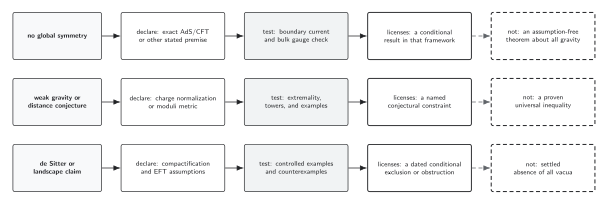
No-global-symmetry results and swampland conjectures have different hypotheses and evidence; examples do not erase counterexamples or dates. Each row pairs a diagnostic with the strongest supported conclusion and an explicitly unsupported promotion. The diagram is an original schematic and is not to scale.
Claim-domain comparison
Section titled “Claim-domain comparison”The table below gives a screen-reader-friendly comparison of three representative claims. It keeps the required declaration, approximation status, evidence timing, counterevidence, falsifier, failure condition, and licensed conclusion in one reading order.
| Claim object | State, ensemble, and conventions | Approximation, status, and evidence timing | Uncertainty and counterevidence | Falsifier | Failure condition | Licensed conclusion |
|---|---|---|---|---|---|---|
| no global symmetry | Declare exact AdS/CFT or other stated premise; use the volume conventions unless the page states a local replacement. | Conditional theorem or structural result. Control chain: quantum-gravity premise and black holes → charge, tower, and moduli constraints → examples and conditional derivations → counterexamples and dated tests → typed consistency claim. Sources are cited on the destination page; literature checked through 10 August 2026. | Track omitted corrections, alternate branches, and competing definitions. A failed “boundary current and bulk gauge check” check is counterevidence to the promoted claim. | boundary current and bulk gauge check | an assumption-free theorem about all gravity | a conditional result in that framework |
| weak gravity or distance conjecture | Declare charge normalization or moduli metric; use the volume conventions unless the page states a local replacement. | Named conjecture under stated hypotheses. Control chain: quantum-gravity premise and black holes → charge, tower, and moduli constraints → examples and conditional derivations → counterexamples and dated tests → typed consistency claim. Sources are cited on the destination page; literature checked through 10 August 2026. | Track omitted corrections, alternate branches, and competing definitions. A failed “extremality, towers, and examples” check is counterevidence to the promoted claim. | extremality, towers, and examples | a proven universal inequality | a named conjectural constraint |
| de Sitter or landscape claim | Declare compactification and EFT assumptions; use the volume conventions unless the page states a local replacement. | Model-specific calculation or conditional result. Control chain: quantum-gravity premise and black holes → charge, tower, and moduli constraints → examples and conditional derivations → counterexamples and dated tests → typed consistency claim. Sources are cited on the destination page; literature checked through 10 August 2026. | Track omitted corrections, alternate branches, and competing definitions. A failed “controlled examples and counterexamples” check is counterevidence to the promoted claim. | controlled examples and counterexamples | settled absence of all vacua | a dated conditional exclusion or obstruction |
Download the structured table data (JSON).
References
Section titled “References”- Palti, Eran. “The Swampland: Introduction and Review.” Fortschritte der Physik 67, 1900037 (2019). DOI. Open PDF.
- van Beest, Marieke, José Calderón-Infante, Delaram Mirfendereski, and Irene Valenzuela. “Lectures on the Swampland Program in String Compactifications.” Physics Reports 989, 1–50 (2022). DOI. Open PDF.
Original QFT.org content:CC BY 4.0, unless an item supplies different terms. Third-party material retains its own terms.