The Toric Code and Intrinsic Topological Order
Four states can have the same energy and give identical answers to every measurement confined to a small region, yet remain distinguishable by transporting a particle around the whole sample. The toric code makes this statement exact. Its ground-state degeneracy comes from the topology of space, and its excitations detect one another through a phase acquired on encircling, even though their energy does not grow with separation.
We will construct the four states on an actual finite torus, calculate the string algebra that distinguishes them, and then ask which conclusions survive a weak perturbation. This supplies a concrete meaning of intrinsic topological order, beyond the absence of a magnetic order parameter.
Preparation: Pauli matrices, tensor-product Hilbert spaces, and elementary degenerate perturbation theory. The qubits below sit on edges; they are not assumed to carry a microscopic spin-rotation symmetry. We use .
Commuting local constraints
Take a square lattice with periodic boundary conditions in both directions. Let , with distinct edges retained even on the smallest torus. There are vertices and plaquettes, and edge qubits. On edge , write the Pauli operators as . Define
where . Stars commute with stars, and plaquettes with plaquettes. A star and a plaquette overlap on either zero or two edges. Each shared edge contributes an anticommutation sign, so the two signs cancel:
Every energy eigenstate can therefore have definite signs . A ground state satisfies all signs equal to , giving
A violated star is called an electric excitation ; a violated plaquette is a magnetic excitation , or vison. The energy costs are and per defect. These names describe emergent excitations, not electromagnetic charge. This is the stabilizer Hamiltonian introduced in Kitaev, §1, Eqs. (1)–(4).
There are two global identities:
Every edge occurs twice in each product. Thus a closed torus contains an even number of each defect type. Its lowest electric excitation costs , not ; the latter is the contribution of one member of a pair. The many-body gap is .
Constructing the ground space
The two identities are the only independent relations on a connected square torus. To see this for the stars, choose any subset of vertices. Its star product acts on precisely the edges with one endpoint in the subset. It equals the identity only if no edge leaves the subset, which requires the subset to be empty or the whole connected lattice. Applying the same argument to the dual lattice proves the plaquette statement. No mixed relation can remove a nontrivial or support.
Consequently the number of independent stabilizers is
This count can be made into wavefunctions. In the basis, label a configuration by bits , with . The zero-flux constraint is
Let be the group generated by the stars. It has elements, because multiplying all stars gives the identity. Start from a zero-flux configuration whose two noncontractible loops have eigenvalues . Then
All terms in a given sum are distinct computational-basis states. The normalization follows immediately. Acting with any star permutes the terms, while every term already satisfies every plaquette constraint. Different loop eigenvalues make the four sums orthogonal. This is an explicit construction, rather than a count of formal solutions; compare Kitaev, §1, Eq. (3).
The companion calculation in examples/condensed-matter/spin-liquids/exact-models/ constructs these vectors and applies the actual edge operators. The table gives the independent star and plaquette constraints, the terms in each ground vector, and the resulting number of ground states:
| Torus | Qubits | Stars | Plaquettes | Terms per vector | Ground states |
|---|---|---|---|---|---|
| 8 | 3 | 3 | 8 | 4 | |
| 12 | 5 | 5 | 32 | 4 |
It checks the ranks over the binary field separately from the wavefunctions. The four vectors are orthonormal, satisfy every stabilizer, and have the same energy. No numerical search for nearly degenerate eigenvalues is needed.
Strings, endpoints, and an actual linking operation
For a direct-lattice path and a dual-lattice path , define
An open string anticommutes with the stars at its two endpoints. At an interior vertex it meets the star twice and commutes. It creates two excitations and costs , independent of the length of the string. The dual string similarly creates two excitations. Extending either string moves an endpoint without leaving an energy-costing trail: the particles are deconfined in this exactly solvable Hamiltonian.
At each crossing, . Thus
where counts intersections modulo two. For one crossing, the sequence of operations has group commutator
The phase becomes a braiding statement when one string closes around an endpoint of the other. A closed dual loop enclosing a region of vertices obeys
Internal edges cancel. On a ground state its value is ; on a state with one inside and its partner outside it is . Operationally, create an pair, transport one around the enclosed , and annihilate the pair. Comparing this path with a path enclosing no yields a relative phase . The single-vertex case is especially transparent: the closed transport operator is just . The numerical ground vectors give before a crossing string and afterward, and the open-string group commutator is on all four ground states. Kitaev, §2, Eq. (5) and Fig. 4 develops this relation between string operations and braiding.
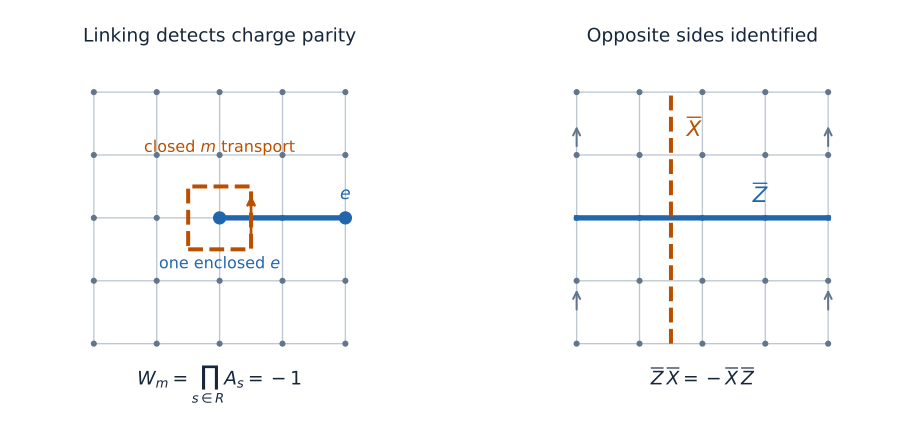
Left: a closed dual string measures the star defects inside it; one enclosed gives a minus sign. Right: opposite sides of the square are identified. The noncontractible and dual loops intersect once, so they act as anticommuting logical operators. Lines denote products of edge operators, not energy-carrying strings.
The fusion rules follow from applying the same string twice:
Exchanging two particles or two particles gives . Exchanging the composite includes one electric–magnetic winding and gives . These are bosonic and fermionic , with nontrivial mutual statistics. Calling a spinon would require an additional statement about how a microscopic symmetry acts on it; the Hamiltonian above does not make that assignment.
Logical loops and local indistinguishability
Choose a direct loop around each torus cycle, denoted . Choose dual loops so that crosses once and the other direct loop zero times. They commute with the Hamiltonian and satisfy
On the constructed basis their action is
and similarly for the second label. The four-dimensional ground space therefore carries two logical qubits. A contractible closed loop is a product of plaquettes, and a contractible dual loop is a product of stars; both act trivially in this space.
Let project onto the ground space. A Pauli string supported inside a contractible region either creates a defect, in which case , or has closed supports deformable into stabilizers, in which case it acts as a scalar. Expanding a general local operator into Pauli strings gives
The support condition matters: it excludes an operator wrapping a torus cycle. The companion verifies the vanishing projected matrices of every single-edge Pauli operator and the nontrivial matrices of the four logical loops. Local indistinguishability is consequently compatible with global distinguishability.
The same noncontractible string now has a different operational use. Given a measured syndrome, compare two errors with identical endpoints and different homology to see when recovery changes the encoded state. Here the winding loops distinguished ground sectors without referring to a recovery protocol.
From an exact point to a phase
A local perturbation usually spoils exact commutativity and exact finite-size degeneracy. Consider, for example, a weak field . A single insertion creates an electric pair. To return to the ground space with a nontrivial logical action, a sequence must complete a noncontractible loop. For a shortest cycle of length , such a process first appears at order in this field, with intermediate pair energies of order :
up to path multiplicities and other intermediate configurations. This estimate explains the exponentially small splitting at weak coupling; it is not a formula valid near a phase transition. Local virtual processes already change the energy density at lower order but cannot distinguish the logical states.
The phase interpretation combines a bulk gap, deconfined excitations with robust braiding, and topology-dependent degeneracy that becomes exact in the thermodynamic limit. A finite fourfold degeneracy alone would not establish it: an ordinary symmetry-breaking Hamiltonian can also have several ground states, distinguished by local observables. Nor does this two-dimensional model supply a passive memory with an energy barrier growing with system size; an error string can be extended while paying only for its endpoints.
The Kitaev honeycomb model gives a bond-dependent two-spin Hamiltonian whose strongly anisotropic limit produces this order. Z2 Spin Liquids and Deconfinement explains the relation to dynamical gauge theories.
Summary
The two global stabilizer identities leave four ground states on a torus. Explicit star-orbit sums construct them, and noncontractible strings distinguish them. Open strings create endpoint defects at a separation-independent cost; an electric–magnetic crossing supplies the minus sign measured by a linking operation. Local indistinguishability and this braiding algebra, together with a stable bulk gap, explain the topological phase rather than merely its solvable spectrum.
Exercises
1. Change the topology
Put the same edge-qubit construction on a connected cellulation of a closed orientable surface of genus . Assume the star and plaquette sets each have only their one global product relation. Use the Euler characteristic to find the ground-space dimension. Explain why a sphere has no logical torus loops.
Solution
The number of independent stabilizers is , so the number of encoded qubits is
Here . The ground-space dimension is therefore . On a sphere every closed loop can contract, so closed strings reduce to products of local stabilizers; the ground state is unique. The sphere still permits separated anyon pairs and their mutual braiding. Ground-state degeneracy depends on the spatial topology, whereas local excitation types need not disappear on a sphere.
2. A loop measures parity, not distance
An electric string creates two endpoints . A closed dual loop encloses a region . Compute its eigenvalue when contains zero, one, or two endpoints. Then apply both and on a single edge of the vacuum and find the excitation energy. Does this determine the energy of two widely separated composites?
Solution
The loop equals , so its eigenvalue is : respectively . It detects the parity of enclosed electric charge, independent of the particles' positions within the region.
The single-edge product, proportional to , flips two adjacent stars and two adjacent plaquettes. Its excitation energy is
At this commuting-projector point the energy depends only on the defect signs, so moving the defects to form two separated – composites keeps the same total energy. There is no additional binding energy in this Hamiltonian. Weak perturbations can change dispersions and interactions without changing the topological fusion label while the phase remains intact.
References
- A. Yu. Kitaev, “Fault-tolerant quantum computation by anyons,” Annals of Physics 303, 2–30 (2003), doi:10.1016/S0003-4916(02)00018-0; 1997 preprint, version 1 (PDF). Sections 1–2, Eqs. (1)–(5) and Fig. 4, construct the ground space, strings, and mutual phase. Its electric and magnetic labels match those used here; our positive couplings restore the two energy scales.
- A. Kitaev, “Anyons in an exactly solved model and beyond,” Annals of Physics 321, 2–111 (2006), doi:10.1016/j.aop.2005.10.005; version 3 (PDF). Sections 5.1–5.2, Eqs. (37)–(42), connect the anisotropic honeycomb model to the toric code and its anyons.
Scrollable formula. Use Left and Right arrow keys to reveal hidden content.
Scrollable table. Use Left and Right arrow keys to reveal hidden columns.
Scrollable figure. Use Left and Right arrow keys to reveal hidden content.