Cluster Extensions and Spatial Correlations
An electron can leave one site, interact with its neighbor, and return. A purely local self-energy cannot retain all the spatial information in that process. Cluster methods keep several interacting sites together, but what surrounds those sites matters as much as their number.
We calculate a nearest-neighbor one-particle correlator of the infinite Hubbard chain using one-site and two-site cluster perturbation theory (CPT). We then identify the additional bath self-consistency required by cellular DMFT and the dynamical cluster approximation. The small CPT calculation exposes a concrete change in a spatial correlator; it is not a converged solution of the chain or a two-site DMFT calculation.
Preparation: The Hubbard atom and dimer supply the reference systems. Dynamical mean-field theory explains what a self-consistent impurity bath does. We use the fermionic anticommutator Green function, with frequencies relative to the chemical potential.
Which problem is being approximated?
Consider the infinite one-dimensional chain with lattice spacing one:
We work at half filling, with , in a spin-symmetric thermal state. This chain is a different lattice from the infinite-coordination Bethe model used in the preceding article. Here the single-site comparator will be one-site CPT, or Hubbard-I, rather than an exact DMFT solver on either lattice.
Tile the chain into identical open clusters. Treat every hopping and interaction inside a cluster exactly, and collect the hopping between clusters in a matrix . The reference Hamiltonian is a collection of disconnected interacting clusters. It has no adjustable bath.
For a cluster with sites , its exact thermal Green matrix is
The energies are eigenvalues of the cluster grand Hamiltonian. In our calculation all sectors and thermal states are retained. The site matrix includes off-diagonal propagation and the influence of intra-cluster spin and charge correlations on the one-particle spectrum.
The cluster perturbation approximation
Expanding in intercluster hopping gives chains of exact cluster one-particle propagators, but also terms containing connected higher cluster cumulants. CPT retains the former and omits the latter. Summing the retained chain gives
This is a geometric resummation of hopping, not truncation after one hop. It retains the cluster self-energy when embedding the cluster in the lattice, while neglecting changes to that self-energy induced by intercluster correlations. The derivation from cluster cumulants appears in Sénéchal, Perez, and Plouffe, arXiv:cond-mat/0205044v1, §II.A, Eqs. (6)–(13) (PDF).
Two exact endpoints help identify the approximation. At , all higher connected fermionic cumulants vanish, so the hopping resummation reconstructs the exact free lattice. With intercluster hopping zero, it returns the isolated cluster exactly. These facts do not imply that an arbitrary small cluster is accurate between the endpoints.
For a dimer, sites lie at positions , where is even. Fourier transform the cluster coordinate with . The hopping from site 1 of one dimer to site 0 of the next gives
The cluster matrix is periodic in the reduced Brillouin zone. To form a translationally averaged lattice propagator at a physical momentum in the full Brillouin zone, use
Equivalently, project with the normalized plane wave . This is the Green-function periodization of Sénéchal et al., §II.B, Eqs. (14)–(20) (PDF). We have included in the grand Hamiltonian, so no further chemical-potential shift is added to .
For a single-site reference system, the atomic propagator immediately gives
This Hubbard-I self-energy is local and contains the atomic pole. The dimer includes a nonlocal self-energy and internal singlet correlations. Neither reference cluster is updated after the hopping resummation.
A spatial correlator, not just a spectrum
A specific test is the retarded propagator across one lattice spacing,
Inversion symmetry makes the sine part vanish. Its equal-time counterpart, per spin, is
This quantity directly determines the kinetic energy per physical site, including both spin species:
The factor four contains two spins and the Hermitian-conjugate hopping. Losing that factor would leave a plausible-looking spectrum but a wrong energy.
For the numerical example choose
The table evaluates the complex-frequency propagator at . Its units are ; the bond occupation is dimensionless.
| Reference | per spin | |||
|---|---|---|---|---|
| One site | −0.03181894 | −0.03319280 | 0.11483343 | −0.45933372 |
| Open dimer | 0.24129554 | 0.02281658 | 0.22724163 | −0.90896652 |
A positive imaginary part of this off-diagonal propagator is allowed. Positivity constrains the spectral matrix as a quadratic form, and therefore its diagonal or any normalized physical projection. It does not require each off-diagonal matrix element to have a nonnegative spectrum.
The dimer changes both the bond occupation and the momentum-resolved spectrum. The figure shows the latter at fixed momentum and the associated occupation function; its first cosine moment is the bond in the table.
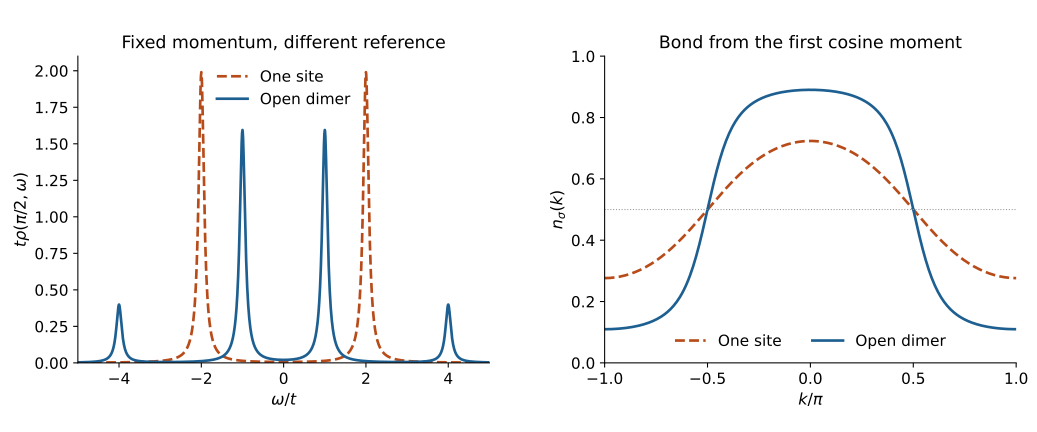
CPT for the infinite half-filled chain at and .
Left: at , displayed with . Right: per-spin occupations computed from the Hermitian pole representation without broadening. Both approximations have . The one-site versus dimer change measures sensitivity to the reference cluster; it is not an error bar for the exact chain.
The reference dimer itself has at this temperature. That number describes the disconnected reference system whose correlations enter . It is not a calculation of the embedded infinite chain's spin correlator. A one-particle hopping resummation does not supply the missing two-particle vertex.
Computing the bond in two representations
One route obtains the occupation through the Matsubara sum. Since has no term, there is no equal-time half-discontinuity to add:
At large frequency, a single nearest-neighbor hop gives
Consequently the omitted leading tail after positive frequencies is known analytically:
where is the trigamma function. The remaining error scales as . For the dimer, using 64, 128, 256, and 512 frequencies gives
At the final frequency cutoff, increasing the momentum grid from 128 to 512 points changes the result by less than . This tests integration of the stated approximation, not cluster-size convergence.
A second route avoids the frequency sum. Factor the positive Lehmann residues to write
Here contains transition energies, rather than many-body energy levels themselves; the columns of include thermal weights. The hopping series then gives the identity
The matrix in this resolvent is Hermitian before adding . Its eigenvalues and projected weights yield by multiplying each pole weight by the Fermi function. This proves causality and normalization for this embedding and supplies an independent numerical evaluation of the same CPT correlator. It gives the bond values in the table; the 512-frequency result differs by less than .
The companion groups numerically degenerate cluster poles before factorization. Tightening the pole rounding and residue threshold changes the dimer bond by less than . It also checks the free-chain and atomic limits directly, the identity spectral-weight matrix, and the local second moment
These are useful checks on phase factors, chemical-potential shifts, and spin normalization. Agreement does not restore the intercluster vertex processes that CPT omitted.
What a self-consistent cluster bath adds
CPT solves an isolated reference cluster. Cellular DMFT (CDMFT) instead couples a real-space cluster to a matrix-valued dynamical bath. Given a cluster self-energy, its self-consistency equations are
The brackets denote a normalized average over the reduced Brillouin zone, and includes both intra- and intercluster hopping. Solving the interacting cluster with this new Weiss field updates . Open cluster boundaries distinguish boundary and interior sites and retain only superlattice translation symmetry at finite cluster size. Reconstructing a fully translationally invariant lattice quantity then requires a specified prescription.
The dynamical cluster approximation (DCA) partitions momentum space into patches labeled by cluster momentum . It approximates the self-energy by a constant within each patch:
Its cluster is periodic, with patch-averaged hopping and a self-consistent environment; cluster momentum remains a good label. Thus CDMFT and DCA allocate spatial and momentum resolution differently. Both reduce to single-site DMFT for a one-site cluster. The bath equations and boundary distinctions are developed in Maier et al., arXiv:cond-mat/0404055v1, §§II.B.2–4 and II.C.4, Eqs. (57), (63), and (64) (PDF).
Adding a bath is not equivalent to enlarging the isolated dimer, and an accurately solved finite bath is still not an exact continuous environment. A convincing cluster study varies cluster size or shape, bath resolution or solver accuracy, and temperature separately. The two CPT calculations here answer the narrower question: what changes when internal nearest-neighbor correlations enter the reference one-particle Green function?
Summary
A cluster retains spatial information inside its interacting reference system. CPT embeds that information through a hopping resummation without a self-consistent bath. The calculated nearest-neighbor propagator and bond occupation change substantially between one-site and dimer references. CDMFT and DCA additionally update a dynamical environment, with different real-space and momentum-space symmetry constraints. None of these distinctions can be replaced by the statement that a calculation used “two sites.”
Exercises
1. Recover the free chain from the open dimer
Set . Starting from the open-dimer Green matrix and the intercluster hopping above, show that the plane-wave projection gives the exact free-chain propagator. Explain why using would fail this test even though the dimer was solved exactly.
Solution
At half filling the free chemical potential is zero. The reference hopping matrix has off-diagonal entries , so . After adding intercluster hopping,
Acting on gives
Therefore its inverse, projected onto the same normalized vector, is
Keeping only the isolated dimer instead gives two nondispersing eigenenergies , with momentum-dependent projection weights. Exact solution of the reference system does not remove the need to reconstruct intercluster propagation.
2. What does the single-site bond predict at strong coupling?
At zero temperature, derive the one-site CPT momentum occupation and its leading large- bond occupation. Does the resulting kinetic energy determine the chain's low-temperature spin state?
Solution
Write . The two poles of are
For positive , only the lower pole is occupied at zero temperature. Its residue gives
The first cosine moment is consequently
We used the Brillouin-zone averages of and , respectively one half and three eighths. The atomic reference is spin symmetric but contains no intersite spin correlation. This computation therefore does not select the spin state created by superexchange. At temperatures small compared with that exchange scale, the missing spin correlations can change even the coefficient of the leading kinetic energy. Exactness at the atomic endpoint alone does not establish that coefficient in the low-temperature chain.
References
- T. Maier, M. Jarrell, T. Pruschke, and M. H. Hettler, Quantum Cluster Theories, arXiv:cond-mat/0404055v1. The inspected PDF gives CDMFT and DCA bath equations in §§II.B.2–4, Eqs. (57), (63), and (64), and compares boundary conditions in §II.C.4. Our normalized averages replace their explicit momentum-sum factors.
- D. Sénéchal, D. Perez, and D. Plouffe, Cluster Perturbation Theory for Hubbard models, arXiv:cond-mat/0205044v1. The inspected PDF derives the hopping resummation in §II.A, Eqs. (6)–(13), and periodization in §II.B, Eqs. (14)–(20); §III.A discusses the exact endpoints. Its Eq. (19) uses normalization and adds the chemical potential to the spectral argument; ours is already included in . Our plotted density is .
Scrollable formula. Use Left and Right arrow keys to reveal hidden content.
Scrollable table. Use Left and Right arrow keys to reveal hidden columns.
Scrollable figure. Use Left and Right arrow keys to reveal hidden content.