Valence Bonds, Triplons, and Dimer Transitions
A pair of antiferromagnetically coupled spin- moments has a singlet ground state and a triplet excitation. If many such pairs are weakly coupled, the triplet can move. Its dispersion and interactions give a useful description of a quantum paramagnet and, when the gap closes, a route toward magnetic order.
We derive these triplons from the four states of a dimer, calculate their band in a square bilayer, and test the approximation against exact small spin clusters. The comparison matters: a zero of a harmonic band is a warning that the expansion is failing, not by itself an accurate critical coupling.
Preparation: Use Spin Waves in Ferromagnets and Antiferromagnets for bosonic quadratic Hamiltonians. Frustration and Order by Disorder illustrates an expansion about classical moments; here the starting point is a product of quantum singlets.
We set . All exchange constants have units of energy, and every physical spin in this article is spin . A dimer contains two such spins; its triplet has total spin one.
Four physical states, four auxiliary bosons
Let be the exchange within one dimer. Its Hamiltonian and eigenvalues follow from adding angular momenta:
A convenient Cartesian basis is
Introduce canonical bosons that create these states from an auxiliary vacuum. The vacuum itself is not a physical spin state. Exactly one bond boson must occupy each dimer:
Matrix elements between these four states give the exact operators on the constrained subspace:
Repeated Cartesian indices are summed.
For example, and . Within the triplet subspace the bilinear term supplies the spin-one rotation matrices. Both pieces are needed for the spin commutators. These definitions and the one-boson constraint are given in Sachdev, §2.2, Eqs. (4)–(7) (PDF).
Eliminating the singlet occupation gives
The local triplet cost is . It is not the classical energy required to rotate a pair of fixed vectors.
Multiplying all four auxiliary bosons on a dimer by the same phase changes no physical spin operator. Thus choosing the singlet amplitude real is a choice within the auxiliary representation. A nonzero singlet amplitude does not break physical spin symmetry. Nor may the constraint be discarded when computing exact matrix elements: unrestricted bosons would introduce states with several triplets on one dimer that do not exist in the four-state spin Hilbert space.
From two dimers to a square bilayer
Take two identical square layers, with spacing within a layer:
There is one dimer per bilayer unit cell. At , the ground state is exactly the singlet product. For small , replace the singlet amplitude by one at leading order. The linear part of each spin operator then gives
The factor includes both layers. It can be checked without auxiliary bosons:
The first matrix element moves a triplet; the second creates a virtual pair. Keeping only the hopping is enough for the first-order one-triplon energy. Pair creation changes the vacuum and contributes at higher orders in a strong-dimer expansion.
Use dimensionless lattice momenta and the transform
Each of the three polarizations has quadratic coefficients
Here the pairing term is . Its sign follows from the chosen triplet phases. The resulting band is
Expanding at weak coupling recovers the independently obtained hopping band:
The minimum is at . In harmonic theory its gap is
The subscript matters: this is the gap of the stated quadratic approximation.
Vacuum fluctuations and a magnetic probe
The Bogoliubov vacuum contains virtual triplet pairs. Its energy and triplet density per dimer are
The factor three counts polarizations. A small is a useful self-consistency check on the singlet starting point, but it does not by itself bound every interaction correction near a soft gap.
These are harmonic integrals, evaluated with successively refined meshes. The first two rows lie much deeper in the strong-dimer regime than the last two.
A probe antisymmetric between the layers couples to the difference
For one Cartesian component, use . The harmonic retarded function in the site's convention is
Thus has a positive-frequency pole of weight . For a perturbation , the physical susceptibility is , giving the positive static response . By contrast, the sum of the two layer spins is bilinear in triplets and annihilates the isolated singlet. The choice of probe therefore determines whether the leading response sees a one-triplon pole.
An exact four-spin test of the approximation
Consider just two dimers connected by one bond in each layer. This is a finite four-spin Hamiltonian, not a thermodynamic bilayer. In its total-spin-zero subspace, use the singlet product and the total-spin-zero combination of two triplets. Up to the phase of the second basis vector, the matrix is
Its lowest eigenvalue and the lowest triplet energy are
Their difference is exactly
For this two-dimer geometry, the quadratic bond-operator theory instead gives
The linear term agrees and the quadratic term does not. Pairing terms in a quadratic Hamiltonian resum some higher-order processes, but do not include all processes imposed by the physical constraint and triplet interactions. Calling the resummation “second order” would be incorrect.
The companion constructs the original spin matrices and diagonalizes them in fixed magnetization sectors.
The two-dimer gap error is below . It also diagonalizes an eight-spin cluster: four dimers on an open square, with four inter-dimer edges. For that graph, the lowest first-order gap is .
At , exact diagonalization gives , compared with at first order. Halving the coupling makes the first-order error approximately four times smaller, as an order- remainder should.
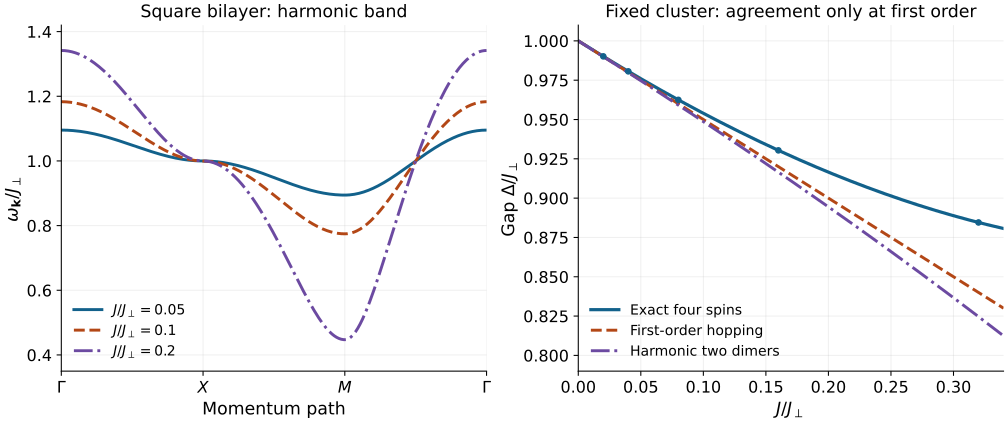
Left: the harmonic square-bilayer band for three values of .
The dimensionless path runs through , , and . Right: the exact four-spin gap, its first-order hopping approximation, and the quadratic two-dimer prediction. The right panel tests an approximation on a fixed cluster; it does not estimate a thermodynamic transition.
What band softening says about a transition
Near the bilayer minimum, write the physical momentum as . The harmonic band obeys
A real field theory follows directly from the quadratic bosons. Define the coordinate and its conjugate momentum for each polarization by
The Hamiltonian stiffnesses are for and for . Integrating out of the canonical real-time action gives a kinetic term . After extracting the staggered factor and defining the continuum field , the long-wavelength quadratic action is
The emergent velocity is retained; it is not set to the speed of light. The kinetic and gradient signs agree with the site's mostly-minus convention. The constraint and interactions generate additional terms, including a quartic invariant in , and renormalize the mass. When the ordinary continuous transition is realized, this three-component field describes the dimer-paramagnet to Néel transition. The bond-operator route to this field theory is explained in Sachdev, §2.2, Eqs. (9)–(12) (PDF).
The harmonic mass vanishes at . This is outside a parametrically small-coupling expansion. For the full square bilayer, quantum Monte Carlo and finite-size scaling instead put the transition near , or . That comparison uses the actual bilayer Hamiltonian and a thermodynamic analysis, not our finite cluster. See Wang, Beach, and Sandvik, §I, Eq. (1), and §III (PDF).
Geometry is equally consequential. Repeating the quadratic construction for an infinite two-leg ladder gives , with a spurious harmonic zero at . This does not establish a ladder transition. Independent strong-coupling and numerical studies support a spin gap for every positive antiferromagnetic rung coupling; see Barnes et al., §§II.A and III.A (PDF). The bilayer's zero-temperature ordering problem cannot be transferred to a ladder by keeping only a coordination-number change.
There is also a symmetry distinction between a dimer paramagnet and a valence-bond solid. The bilayer has two spins per unit cell and explicitly distinguishes rung bonds. Its strong-rung singlet phase preserves the Hamiltonian's lattice symmetries. A valence-bond solid instead chooses a bond pattern spontaneously and breaks a lattice symmetry. A spin gap alone does not demonstrate that pattern or its thermodynamic degeneracy; bond correlations and symmetry information are required. Filling Constraints and the Lieb–Schultz–Mattis Theorem develops the role of the spin representation per unit cell.
Summary
The constrained singlet–triplet basis is exact for a dimer. Weak inter-dimer exchange then gives a calculated hopping amplitude, pair creation, and a dispersing spin-one excitation. Harmonic theory predicts a band and its magnetic spectral weight, while exact small clusters identify its controlled first-order content and its incomplete higher-order resummation. A genuine dimer transition requires the interactions, geometry, and thermodynamic limit to be treated consistently.
The spin-matrix checks, cluster spectra, Brillouin-zone refinement, and figure generator are in examples/condensed-matter/quantum-magnetism/frustration-dimers/.
Exercises
1. Recover the leading vacuum-energy shift
Use ordinary second-order perturbation theory about the singlet product to find the ground-state energy shift from one inter-dimer edge with coupling in both layers. Then obtain the energy per dimer for the square bilayer and compare it with the small- expansion of the harmonic integral.
Solution
Acting on the singlet product, an edge creates one of three equal-polarization triplet pairs. Each matrix element is , and each intermediate state costs . Therefore
A square lattice has two edges per dimer after counting each edge once, so
In the harmonic expression, expanding the square root gives
The Brillouin-zone average of is one. Multiplication by the three-polarization factor reproduces the same second-order ground-state energy. Agreement for this observable does not repair the incorrect second-order cluster gap: the intermediate states and subtraction of the ground-state shift differ between the two calculations.
2. Normalize the isolated-dimer response
At , couple a weak time-dependent field to .
The perturbation is . Derive the retarded function from the exact eigenstates. Check the static susceptibility, the equal-time variance, and the first spectral moment.
Solution
The only nonzero matrix element out of the singlet is , with excitation energy . The Lehmann expression is
The physical static response is . Direct stationary perturbation theory gives the same result: the ground-state energy shifts by , and differentiating twice with respect to the source yields .
The spectral function is
Its positive-frequency integral with measure is . The first moment over both signs is
The factor two in this moment comes from the positive- and negative-frequency poles. It is not a sum over three triplet polarizations: the chosen Cartesian probe excites only one of them.
References
- Barnes, T., E. Dagotto, J. Riera, and E. S. Swanson. “Excitation Spectrum of Heisenberg Spin Ladders.” Physical Review B 47, 3196–3203 (1993). Author-hosted PDF, §§II.A and III.A: strong-rung expansion and finite-size gap analysis for the two-leg ladder.
- Sachdev, S. “Quantum Phases and Phase Transitions of Mott Insulators.” arXiv:cond-mat/0401041v1 (PDF), §2.2, Eqs. (4)–(12): physical constraint, spin matrix elements, and the continuum action. His illustrative single-layer dimer geometry differs from the bilayer used here.
- Wang, L., K. S. D. Beach, and A. W. Sandvik. “High-Precision Finite-Size Scaling Analysis of the Quantum-Critical Point of Spin- Heisenberg Antiferromagnetic Bilayers.” Physical Review B 73, 014431 (2006). arXiv:cond-mat/0509747v1 (PDF), §I, Eq. (1), and §III. The article uses only the rounded critical ratio near ; the precise estimates differ between the inspected preprint and publication.
Scrollable formula. Use Left and Right arrow keys to reveal hidden content.
Scrollable table. Use Left and Right arrow keys to reveal hidden columns.
Scrollable figure. Use Left and Right arrow keys to reveal hidden content.