Time-Reversal Topological Insulators
Can an insulator have conducting edges when its charge Hall conductivity vanishes? Yes: two time-reversed Chern bands can have counterpropagating boundary states. The important question is whether those states can be removed by mixing them while preserving time reversal. An odd number of Kramers pairs has an obstruction that an even number does not.
We calculate the invariant of a four-band lattice model and solve its boundary states. Spin conservation makes the starting point transparent, but we explicitly break that conservation without opening an edge gap.
Preparation: Berry geometry and Chern bands, including occupied-band projectors and open-boundary hopping matrices. Set ; energies below are in units of the nearest-neighbor hopping.
Two Chern bands related by time reversal
Let act on two orbitals and on physical spin. At half filling, two of the four bands of
are occupied. Tensor-product identity matrices are implicit. The antiunitary time-reversal operator and inversion are
Complex conjugation acts on the orbital matrices too. For example, it changes the sign of . Direct substitution gives
The four displayed matrices anticommute. The two doubly degenerate energies are therefore
A bulk gap closes only at . At , spin up is the QWZ Chern model and spin down is its time reverse. With the chapter's connection , the lower spin-up band has at , while . Their charge Hall conductivities cancel. The term mixes spin, so separately quantized spin-band Chern numbers are no longer the appropriate invariant. The protecting symmetry is , not conservation of .
Count one parity per occupied Kramers pair
At a time-reversal-invariant momentum , Kramers partners are orthogonal and have the same energy. Because commutes with , they also have the same inversion eigenvalue. The inversion formula is
Here is one parity from each occupied pair. Multiplying both partners would square every sign and incorrectly give a trivial result. The formula follows by evaluating the time-reversal sewing matrix in an inversion-compatible gauge: its antisymmetric Pfaffian at a fixed momentum reduces to that product. Continuation between the four fixed points removes the individual gauge choices. See Fu and Kane, arXiv:cond-mat/0611341v2, §§ I and III. Their connection has the opposite sign to ours; this does not change the parity product or .
In this model every sine vanishes at a fixed point, leaving . The occupied pair thus has
Thus both intervals between the outer and central gap closings are nontrivial. At , this is equivalently . The gap closing at changes the spin Chern number by two and leaves its parity unchanged. The invariant detects a distinction between phases; it does not require every possible bulk gap closing to change that distinction.
Inversion is a convenient way to calculate . It is not needed to preserve it. A time-reversal-invariant inversion-breaking perturbation smaller in operator norm than half the direct bulk gap cannot close that gap, and cannot change . One must then use a sewing-matrix or Wilson-loop construction, or continuity from the inversion-symmetric Hamiltonian, rather than assign inversion eigenvalues to states that no longer have them.
Solve the boundary before interpreting its crossing
Open the direction and retain momentum . With sites , write
This convention reconstructs the bulk Hamiltonian as . Define orbital states . A left-edge doublet has the form
Substitution into the missing-bond equation at and the bulk recurrence cancels the terms. In this two-state subspace, denote Pauli matrices by . The remaining Hamiltonian is
The expression for the two branches retains their signed labels; their ordered energies use an absolute value. At the states exist for and meet at . They are a Kramers pair there. At the edge of their localization interval they join bulk bands: a protected edge is not an isolated one-dimensional band over the entire Brillouin zone.
Why can spin mixing rotate the edge velocity but not supply a constant mass? In a Kramers basis, , so every traceless Hermitian matrix is odd under . A constant coefficient of , or breaks time reversal. An odd-in-momentum coefficient is allowed. Consequently a single isolated Kramers crossing survives a small symmetry-preserving perturbation, although its velocity and energy can change.
To remove it explicitly, add , which is odd under . The left-edge Hamiltonian becomes
Its minimum positive energy is , provided the minimizing momentum lies in the localization interval. The minimum moves away from zero momentum when is nonzero; simply measuring the splitting at zero would give the wrong minimum gap.
The companion diagonalizes the actual strip matrix. For and , widths give crossing gaps
These are finite-width coupling between two edges, not a symmetry-preserving mass of one semi-infinite edge. Independently substituting the truncated half-space vectors gives residuals that decrease with their exponentially small far-edge tail. At , a 32-site strip with gives a minimum gap on the momentum grid, compared with the half-space result .
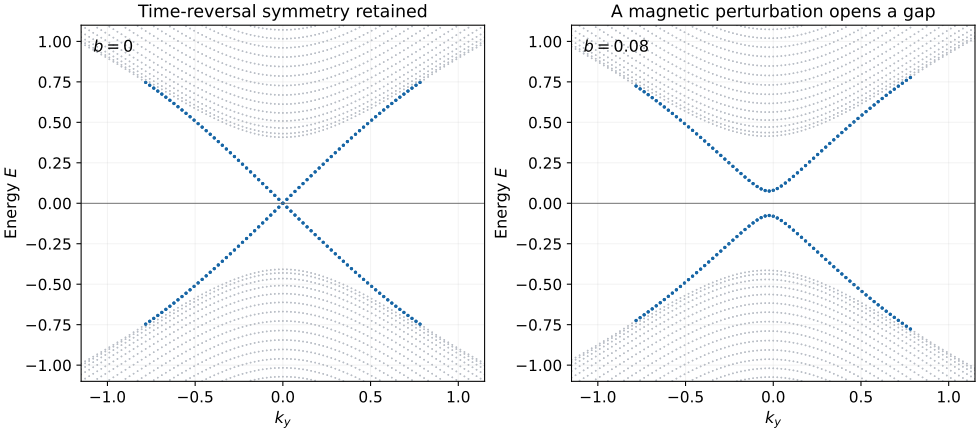
Eigenvalues of a 32-site strip at and . Blue points have more than 60% of their norm in the outer four layers on the two sides; gray points are more extended. The right panel adds . The left panel retains a tiny finite-width splitting that is invisible at this scale; the quoted width sequence resolves it.
The three-dimensional extension
A related four-band Hamiltonian supplies a strong three-dimensional example:
It has the same and . At , the mass at is positive and the masses at the other seven fixed points are negative. One occupied Kramers-pair parity is negative and seven are positive. Their product gives the strong index . The four-point product on each plane is positive, giving weak indices .
The strong index constrains an odd number of surface Dirac cones in a noninteracting, charge-conserving, time-reversal-preserving boundary description. Weak indices instead involve crystal translations and can be understood through stacked two-dimensional layers. Neither an arbitrary surface dispersion nor a quantized spin Hall coefficient follows from this classification. The boundary Dirac calculation obtains a surface cone and its response directly.
These band arguments assume a bulk insulating gap. They do not prove that arbitrarily strong interactions leave a free-electron surface intact. Symmetry breaking, coupling opposite surfaces, and intrinsically topologically ordered interacting surfaces are distinct possibilities; see symmetry protection beyond bands.
Summary
One parity per occupied Kramers pair gives the inversion formula for . The doubled QWZ model has vanishing charge Chern number but an odd helical boundary pair. Its exact edge recurrence distinguishes harmless spin mixing, a magnetic gap, and exponentially small coupling between opposite edges. The same parity construction identifies a strong three-dimensional insulator.
Exercises
1. Break inversion without closing the gap
At and add with . Which symmetry is lost, and why does the phase survive?
Solution
The perturbation is real and spin independent, so leaves it invariant. Inversion changes its sign because . The unperturbed spectrum obeys
The perturbation norm is . The occupied and empty energies therefore remain separated from zero by at least along the interpolation that turns on . No bulk gap closes, so stays one. The original parity entries cannot be reused as eigenvalues of the perturbed occupied states: inversion has ceased to be a symmetry. Continuity, not a fictitious parity measurement, gives the answer.
2. Gap two helical pairs without breaking time reversal
For two identical edge pairs, let act on the copy index. Starting from , find an allowed mass and its spectrum.
Solution
Use acting on both copies. The matrix is time-reversal odd, while complex conjugation changes the sign of the imaginary matrix . Their product is time-reversal even. Thus
is gapped and time-reversal invariant. Each energy remains doubly degenerate. The mass anticommutes with the kinetic matrix, and no spin conservation was assumed. This demonstrates why the protected quantity is the parity of the number of helical pairs rather than their integer count.
References
- Liang Fu and C. L. Kane, “Topological Insulators with Inversion Symmetry,” Physical Review B 76 (2007) 045302, arXiv:cond-mat/0611341v2, §§ I–III for the invariant and boundary parity, § IV for four-band models. Its Berry-connection sign is opposite to the one used here; the formula is unchanged.
- Xiao-Liang Qi and Shou-Cheng Zhang, “Topological insulators and superconductors,” arXiv:1008.2026v1 (PDF), §§ II.B–C and III.B for explicit edge and surface constructions. Our lattice recurrence and matrix basis are given above rather than imported from their continuum parametrization.
The reproducible strip, symmetry, and parity calculations are in examples/condensed-matter/topological-bands/boundaries-nodes/.
Scrollable formula. Use Left and Right arrow keys to reveal hidden content.
Scrollable table. Use Left and Right arrow keys to reveal hidden columns.
Scrollable figure. Use Left and Right arrow keys to reveal hidden content.